
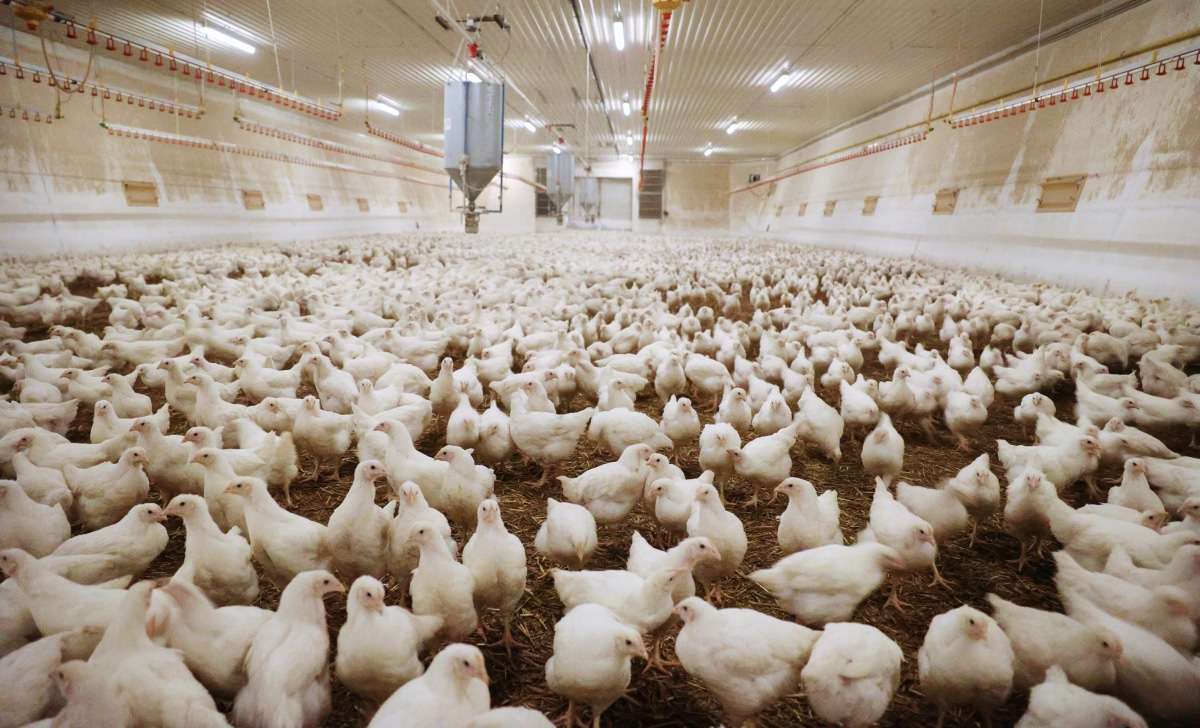
En las aves de corral, la salmonela suele ser más un problema de seguridad alimentaria y responsabilidad legal que una emergencia sanitaria para el lote. La mayoría de los serotipos colonizan el intestino de aves sanas sin causarles enfermedad, pero pueden contaminar la carne y los huevos antes del sacrificio o la puesta (Neelawala et al., 2024). Un pequeño grupo de cepas adaptadas al hospedador rompe ese patrón y enferma directamente a las aves.
¿Cómo contraen salmonela las gallinas? Vías de transmisión en granjas comerciales
La salmonela llega a un lote por dos vías. La transmisión vertical ocurre cuando una reproductora infectada lleva la bacteria hasta el ovario o el oviducto, de modo que el huevo se contamina antes de que se forme la cáscara. Una vez que el patógeno entra en la nave, se propaga por transmisión horizontal a través de las heces, el pienso y el agua contaminados, los roedores, las aves silvestres, los insectos y los equipos trasladados entre lotes (Neelawala et al., 2024).
¿Todas las gallinas tienen salmonela? Serotipos, síntomas y cepas adaptadas al hospedador
No en un sentido relevante. De los más de 2.500 serotipos de Salmonella reconocidos, solo alrededor del 10 % se detectan en aves de corral comerciales. La mayoría coloniza el intestino sin causar síntomas ni afectar al apetito o al crecimiento (Foley et al., 2011). En un lote expuesto, algunas aves pueden portar pequeñas cantidades de estos serotipos sin mostrar síntomas: una microbiota intestinal diversa mantiene la bacteria bajo control, aunque no la elimina por completo (Pedroso et al., 2021).
Dos serotipos adaptados al hospedador se comportan de otra manera. Salmonella Gallinarum, causante de la tifosis aviar, y Salmonella Pullorum, causante de la pullorosis, provocan una enfermedad sistémica en lugar de una colonización silenciosa. Las aves afectadas dejan de comer, presentan dificultad para respirar y pueden tener la cloaca cubierta de heces adheridas. Estos son los síntomas de salmonela en gallinas que los productores tienen más probabilidades de observar, ya que la colonización habitual no produce ninguno. La mortalidad de los pollitos alcanza su punto máximo entre la segunda y la tercera semana; no se recomienda el tratamiento porque los supervivientes se convierten en portadores de por vida (WOAH, 2018).
Cómo se refleja la salmonela en los datos de peso del lote
Como la mayoría de las aves adultas portadoras no presentan síntomas, el seguimiento del peso rara vez permite detectar la infección por sí solo. Hay dos excepciones. Si los pollitos se infectan durante su primera semana de vida, la inmadurez de su sistema inmunitario hace posible que aparezcan diarrea y deshidratación; los supervivientes pueden quedar retrasados en el crecimiento y presentar tamaños desiguales. Incluso cuando reciben dosis idénticas de Salmonella, los pollos de engorde responden de forma distinta en su crecimiento. En un estudio controlado, un desafío asociado a Salmonella redujo la uniformidad del lote en 2,7 puntos porcentuales hasta el día 28, principalmente porque algunas aves quedaron muy rezagadas, mientras que el peso de todo el lote no descendió de manera uniforme (Choi et al., 2026). En datos de peso continuos de toda la nave, esto se manifiesta como una separación gradual entre las aves, no como una caída brusca.
La segunda excepción es un brote causado por una cepa adaptada al hospedador. Su aspecto es distinto: la pérdida intensa de apetito y la elevada mortalidad se reflejan en una marcada caída de la curva de peso acumulado (WOAH, 2018). La tifosis aviar puede evolucionar de forma aguda; en ese caso, la caída solo aparece cuando la mortalidad ya ha comenzado. Si la evolución es más gradual, una distinción que también recoge el manual de la WOAH, la tendencia del peso puede hacerse visible antes de que las pérdidas alcancen su máximo. Una sesión de pesaje manual que incluya la revisión del estado de las aves puede ayudar a confirmar lo que indican los datos.
Control de la salmonela en lotes de aves de corral: bioseguridad, vacunación y pruebas
La bioseguridad aporta más al control de la salmonela que cualquier medida aislada aplicada en etapas posteriores. El vallado perimetral, el control de acceso y el sistema «todo dentro, todo fuera» pueden reducir la contaminación hasta en un 80 % (Neelawala et al., 2024). La vacunación contra la salmonela añade una segunda barrera: en ponedoras vacunadas, puede reducir la prevalencia hasta en un 70 % (Neelawala et al., 2024). Una microbiota intestinal estable constituye una tercera barrera. La exclusión competitiva ejercida por bacterias comensales limita el espacio disponible para que Salmonella colonice el intestino; los probióticos, la limpieza y la calidad de la cama ayudan a mantener ese equilibrio (Adeyemi & Nahashon, 2026; Pedroso et al., 2021).
Las pruebas y el seguimiento de Salmonella en los lotes permiten comprobar los resultados de estas medidas. Programas como el NPIP de Estados Unidos y el sistema de control de la UE exigen muestreos periódicos de los lotes de reproductoras y del entorno de las naves. Un resultado positivo puede dar lugar a nuevas pruebas o a que los huevos no se destinen a la venta (Neelawala et al., 2024). La aplicación de las medidas difiere considerablemente: la normativa de la UE obliga a sacrificar los lotes de reproductoras en los que se confirmen determinados serovares, mientras que la participación en el NPIP es voluntaria y no existe una exigencia equivalente en Estados Unidos (EFSA BIOHAZ Panel, 2019). Combinar el calendario de pruebas con la báscula automática BAT2 Connect incorpora una fuente continua de datos junto a los resultados de las muestras.
Durante el manejo habitual, la báscula manual para aves BAT1 ofrece al personal otra señal que las muestras y los valores medios no proporcionan.
Al incorporar esas mediciones a la plataforma de datos BAT Cloud, el peso y los resultados de las pruebas quedan en una misma línea temporal. Esto resulta útil para comparar un resultado positivo con el historial de crecimiento.
En la mayoría de los lotes comerciales, Salmonella permanece como un huésped silencioso cuyo control depende de la bioseguridad, la vacunación y las pruebas. Los datos de peso solo cumplen una función complementaria en situaciones concretas.
Referencias
- Adeyemi, O. D., & Nahashon, S. N. (2026). Mitigating Salmonella in poultry using probiotics: Mechanisms, challenges, and opportunities. Microorganisms, 14(2), 365. https://doi.org/10.3390/microorganisms14020365
- Choi, J., Goo, D., Ko, H., Lee, J., & Kim, W. K. (2026). Factors affecting flock uniformity in broiler production: Individual, environmental, and management characteristics. Animals, 16(2), 185. https://doi.org/10.3390/ani16020185
- EFSA Panel on Biological Hazards (EFSA BIOHAZ Panel). (2019). Salmonella control in poultry flocks and its public health impact. EFSA Journal, 17(2), 5596. https://doi.org/10.2903/j.efsa.2019.5596
- Foley, S. L., Nayak, R., Hanning, I. B., Johnson, T. J., Han, J., & Ricke, S. C. (2011). Population dynamics of Salmonella enterica serotypes in commercial egg and poultry production. Applied and Environmental Microbiology, 77(13), 4273–4279. https://pmc.ncbi.nlm.nih.gov/articles/PMC3127710/
- Neelawala, R. N., Edison, L. K., & Kariyawasam, S. (2024). Pre-harvest non-typhoidal Salmonella control strategies in commercial layer chickens. Animals, 14(24), 3578. https://www.mdpi.com/2076-2615/14/24/3578
- Pedroso, A. A., Lee, M. D., & Maurer, J. J. (2021). Strength lies in diversity: How community diversity limits Salmonella abundance in the chicken intestine. Frontiers in Microbiology, 12, 694215. https://doi.org/10.3389/fmicb.2021.694215
- WOAH (World Organisation for Animal Health). (2018). Chapter 3.3.11: Fowl typhoid and Pullorum disease. Manual of Diagnostic Tests and Vaccines for Terrestrial Animals. https://www.woah.org/fileadmin/Home/eng/Health_standards/tahm/3.03.11_FOWL_TYPHOID.pdf