
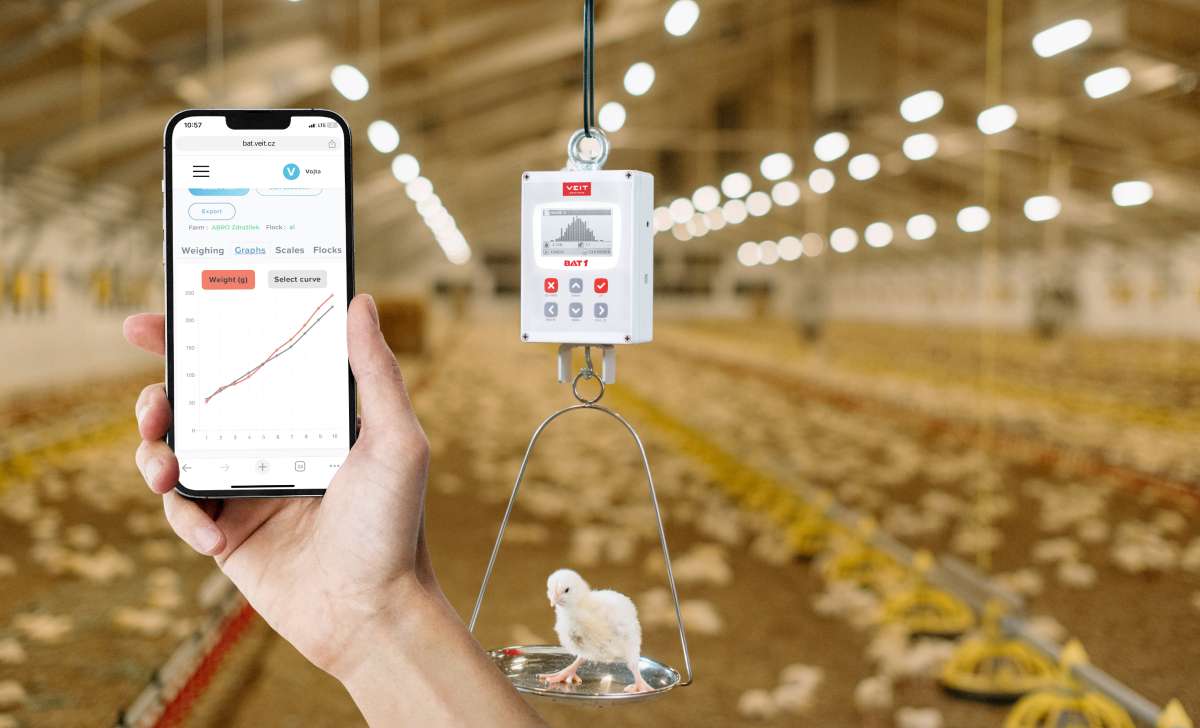
A day-old chick reaching 2.66kg in 40 days leaves little room for error. Discover how frequent, accurate weighing protects flock performance and feed conversion ratios.
Modern broiler production has become as much about data as it is about feed and genetics. The extraordinary growth trajectory of the Ross 308 broiler, documented in recent European Poultry Science research, illustrates why precision monitoring has moved from optional to essential in commercial flocks (Hinz et al., 2019).
The scale of modern broiler growth
A day-old chick weighing 45 grams reaches 2.66 kg in just 40 days. That is a 59-fold weight increase, a rate that pushes biological limits and demands close attention at every stage of the production cycle.
This growth is not accidental. Modern broiler genetics are engineered for rapid, efficient weight gain. But realising that genetic potential is a different matter. Growth rates can vary dramatically between individual birds, and problems rooted in disease, environmental stress, or feed quality can erode performance before they become visible to the naked eye.
Feed conversion ratios and the cost of deviation
When Ross 308 broilers achieve feed conversion ratios of 1.63 kg of feed per kg of weight gain, the margin for error is narrow. Even small deviations from optimal growth curves carry a real economic cost. A few grams difference per bird, multiplied across thousands of birds, compounds quickly into feed waste and reduced profitability. In an industry where margins are measured in pennies per pound, untapped genetic potential is not a minor inefficiency. It is a direct loss.
Why daily gain rates make weekly weighing inadequate
During peak growth phases, broilers gain more than 60 grams per day. At that rate, a full week between measurements means potentially missing the intervention windows that matter most. By the time a weekly weigh-in flags a problem, the flock may have already fallen behind a planned growth curve in ways that are difficult to recover.
Traditional weekly weighing simply cannot provide the granular data needed for this level of precision management.
What the research says about monitoring and performance
The research by Hinz et al. (2019) demonstrates that even minor improvements in management, whether through feed additives, environmental optimisation, or enhanced monitoring, can yield measurable improvements in growth performance while also supporting overall bird welfare.
Continuous weight monitoring addresses the data gap directly. Real-time statistics and insights allow producers to detect deviations from planned growth curves before they affect overall flock performance, and to make immediate adjustments to feeding programmes, environmental controls, or health interventions. The frequency and accuracy of weight data determine how quickly those adjustments can be made. In a production system defined by daily gains, that speed is the difference between hitting target weights and missing performance benchmarks.
Sources
- Hinz, K., et al. (2019). Foot pad health and growth performance in broiler chickens as affected by supplemental charcoal and fermented herb extract (FKE): an on-farm study. European Poultry Science, 83.