
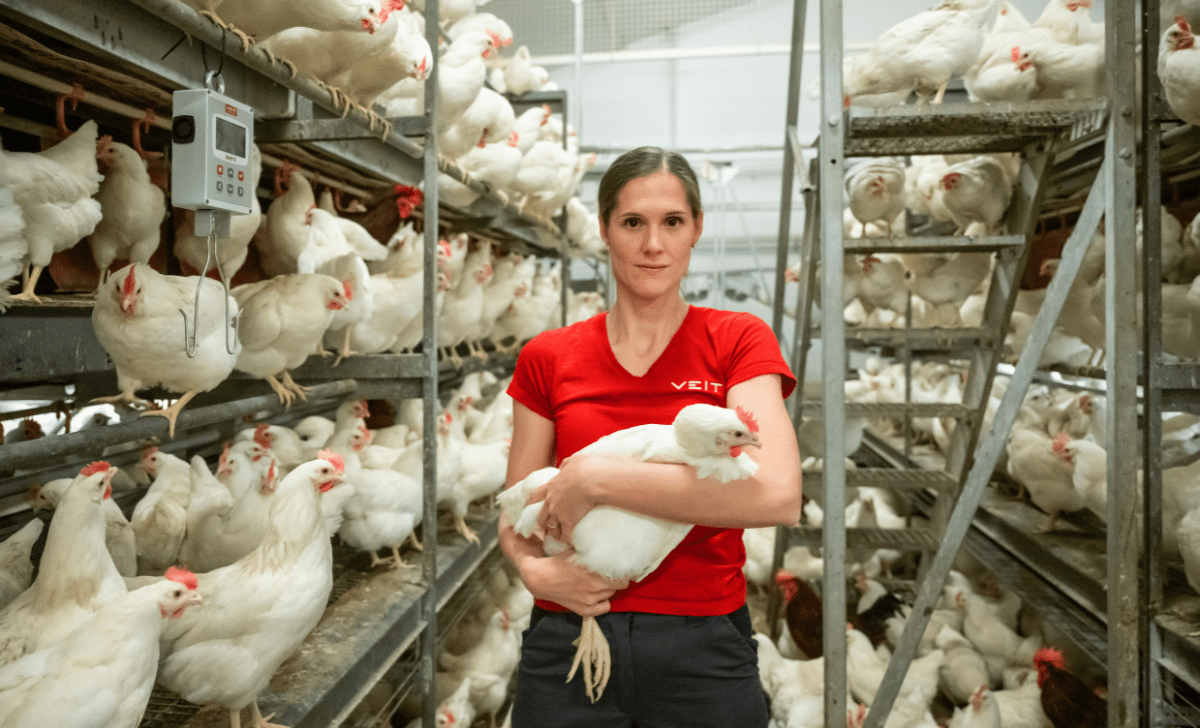
Every egg on your breakfast plate began with a single hen. Between laying house and table, it passes through multiple checks, machines, and hands. The full egg production process is more carefully managed than most consumers realize and it starts well before the first shell is formed.
It Starts With the Hen
Commercial egg production begins with rearing pullets to the correct body weight before the onset of lay. Body weight at photo-stimulation directly determines egg size and laying consistency across the full production cycle (Sibanda et al., 2020). Breeding companies recommend flock uniformity of 80% or higher at 16 weeks of age, as flocks that reach target weight together peak earlier and more reliably (Mels et al., 2023).
Producers monitor live body weight throughout the rearing period to detect nutritional or health problems early. An automatic in-house weighing system like the BAT2 Connect tracks flock weight continuously without disturbing the birds. Operations of all sizes benefit from a precision manual scale for targeted bird sampling such as the BAT1, which has been used in peer-reviewed research on commercial laying flocks (Sibanda et al., 2020). All weight records feed into the BAT Cloud data platform, where producers can monitor trends, document flock condition, and generate records to support audits and buyer compliance.
Egg Collection and the First Quality Filter
Once hens begin laying, egg collection and processing starts on the farm itself. In modern laying systems, conveyor belts carry eggs from nest boxes to a collection point multiple times per day. The Cobb Breeder Management Guide recommends a minimum of six daily collections from manual nests to reduce shell cracking and contamination risk (Cobb Vantress, n.d.). Cracked, soiled, or misshapen eggs are removed at this stage. This on-farm filter is the first step in the wider sequence of commercial egg processing steps that follow.
Grading and Packaging
Eggs then move to a registered packing center, where the formal egg collection and packaging process takes place under regulatory oversight. In the EU, Regulation (EC) No 589/2008 governs grading, marking, and packaging standards for eggs sold at retail (European Commission, 2008). Automated candling machines inspect each egg using transmitted light to detect blood spots, hairline cracks, and other internal defects. Eggs are then weighed and assigned to size grades: EU standards range from S (under 53 g) to XL (73 g and above). The USDA applies a comparable classification based on minimum net weight per dozen (USDA AMS, 2000). After sorting, eggs are washed, dried, and packed into labeled cartons that display the producer code, best-before date, and production system.
Traceability Across the Egg Supply Chain
Traceability in egg production is now both a regulatory requirement and a commercial expectation. The producer code stamped on each egg links it back to the farm of origin, flock, and date of lay. When flock weight data is recorded and timestamped in a platform like the BAT Cloud, producers can document the conditions of the egg production and distribution process at any point in time. This strengthens audit readiness and supports the wider egg supply chain in responding quickly to any quality or safety concern.
Distribution and the Final Steps
After packing, eggs are transported to distribution centers and then to retail under temperature-controlled conditions. The Cobb Breeder Management Guide recommends a truck temperature range of 5 to 14°C during transport to preserve shell integrity and internal quality (Cobb Vantress, n.d.). Egg quality declines with age and temperature fluctuations, making cold chain management essential at every link in the chain.
Why the Farm Stage Sets the Standard
Understanding how eggs get from farm to table makes clear that every downstream step depends on what happens in the laying house first. Shell integrity, yolk quality, albumen index, and microbial load are all shaped during production and not at the packing center. Producers who track live body weight consistently throughout the laying cycle build a stronger foundation for everything that follows. The automatic weighing data collected at farm level, and the individual measurements that validate it, directly influence what a consumer finds on the shelf.
REFERENCES
Cobb Vantress. (n.d.). Cobb Breeder Management Guide. Cobb-Vantress, Inc. Retrieved from https://www.cobb-vantress.com/resources/
European Commission. (2008). Commission Regulation (EC) No 589/2008 of 23 June 2008 laying down detailed rules for implementing Council Regulation (EC) No 1234/2007 as regards marketing standards for eggs. Official Journal of the European Union. https://eur-lex.europa.eu/legal-content/EN/TXT/?uri=CELEX:32008R0589
Mels, C., Niebuhr, K., Rault, J.-L., Waiblinger, S., & Hartung, J. (2023). Animal-based parameters as early indicators for health and welfare problems in pullets: A pilot study. Preventive Veterinary Medicine, 213, 105929. https://doi.org/10.1016/j.prevetmed.2023.105929
Sibanda, T. Z., Kolakshyapati, M., Walkden-Brown, S. W., de Souza Vilela, J., Courtice, J. M., & Ruhnke, I. (2020). Body weight sub-populations are associated with significantly different welfare, health and egg production status in Australian commercial free-range laying hens in an aviary system. European Poultry Science, 84. https://doi.org/10.1399/eps.2020.295
United States Department of Agriculture, Agricultural Marketing Service. (2000). Egg Grading Manual (Agricultural Handbook No. 75). USDA AMS. https://www.ams.usda.gov/publications/content/egg-grading-manual