
Chickens are the world’s most numerous domestic animals, with around 34 billion alive at any given time. That presence traces back to wild birds in Southeast Asian forests, gradually shaped by human selection into the hybrid strains that fill farms today.
Understanding chicken domestication history helps explain why modern commercial hybrid strains grow as they do, and why their management centres on one signal above all: live weight.
From Wild Chicken to Farm: How Domestication Began
The ancestor of all domestic chickens is the red junglefowl, Gallus gallus. Analysis of 863 wild and domestic genomes identified G. gallus spadiceus, native to southwestern China, northern Thailand and Myanmar, as the primary progenitor of domestic lineages (Wang et al., 2020).
A 2022 study by Peters and colleagues, drawing on evidence from more than 600 sites in 89 countries, placed the first confirmed domestic chicken remains at Ban Non Wat, central Thailand, dated to around 1650 to 1250 BCE. The early evolution of domestic chickens appears closely tied to grain cultivation: stored rice and millet drew junglefowl into farming settlements, initiating domestication (Peters et al., 2022).
Ancient Chicken Farming History
Early kept chickens served ritual purposes before food, used for cockfighting and sacrifice long before systematic meat or egg production developed.
The poultry domestication timeline moved westward through trade and agricultural networks. Chickens reached Central China, South Asia, and Mesopotamia in the late second millennium BCE, and arrived in Ethiopia and Mediterranean Europe by around 800 BCE (Peters et al., 2022).
Timeline of Chicken Breeding Development
Selective breeding accelerated sharply in the twentieth century. The pivotal shift in chicken breeding history came in the 1950s and 1960s, when the industry replaced dual-purpose breeds with dedicated meat and egg lines. Selection programs advanced from Mendelian phenotypic methods to genomic tools built on whole-genome sequencing (Tixier-Boichard et al., 2012).
The results are striking. Modern broilers produce more than three times the eight-week body weight of 1957 birds fed equivalent diets (Havenstein et al., 2003). Between 1985 and 2010, 35-day live weight climbed from 1.4 to 2.4 kg while feed conversion improved from 2.3 to 1.5 (Siegel, 2014). This reflects a poultry genetic history built on generations of focused selection for growth and efficiency.
Weight Data as a Management Foundation
Modern commercial strains operate within precise breed-standard growth curves. Missing a weekly weight target affects feed conversion, uniformity, and slaughter outcomes across the flock.
Continuous live weight monitoring gives managers an early signal when growth deviates from the target curve.
The BAT2 Connect automatic poultry scale delivers that coverage, recording bird weights throughout the day without manual intervention and feeding data directly into flock records.
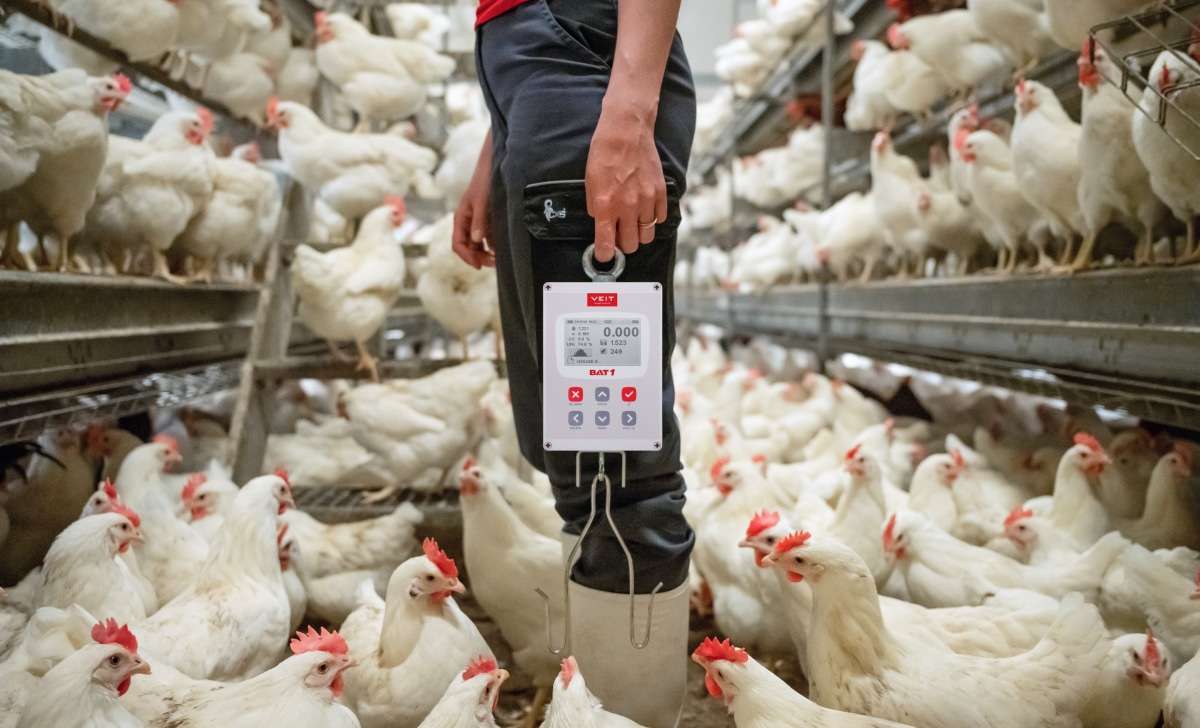
For farms running periodic catch-and-weigh sessions, the BAT1 manual poultry scale combines live weight recording with hands-on assessment of fleshing score and condition. Additionally, reliable sample weight data adds a layer of flock intelligence that automated systems cannot replicate.
Both tools connect to the BAT Cloud data platform, where records can be tracked and compared across cycles.
The journey from junglefowl to modern broiler spans millennia of gradual domestication and a few decades of intensive genetics. Meeting the demands of the bird that emerged starts with knowing whether it is on weight.
References
1.) Havenstein, G.B., Ferket, P.R. and Qureshi, M.A. (2003). Growth, livability, and feed conversion of 1957 versus 2001 broilers when fed representative 1957 and 2001 broiler diets. Poultry Science, 82(10), 1500–1508. https://doi.org/10.1093/ps/82.10.1500
2.) Peters, J., Lebrasseur, O., Irving-Pease, E.K., Paxinos, P.D., Best, J., Smallman, R., Callou, C., Gardeisen, A., Trixl, S., Frantz, L., Sykes, N., Fuller, D.Q. and Larson, G. (2022). The biocultural origins and dispersal of domestic chickens. Proceedings of the National Academy of Sciences, 119(24), e2121978119. https://doi.org/10.1073/pnas.2121978119
3.) Siegel, P.B. (2014). Evolution of the modern broiler and feed efficiency. Annual Review of Animal Biosciences, 2, 375–385. https://doi.org/10.1146/annurev-animal-022513-114132
4.) Tixier-Boichard, M., Leenstra, F., Flock, D.K., Hocking, P.M. and Weigend, S. (2012). A century of poultry genetics. World’s Poultry Science Journal, 68(2), 307–321. https://doi.org/10.1017/S0043933912000360
5.) Wang, M.S., Thakur, M., Peng, M.S., Jiang, Y., Frantz, L.A.F., Li, M., Zhang, J.J., Wang, S., Peters, J. et al. (2020). 863 genomes reveal the origin and domestication of chicken. Cell Research, 30(8), 693–701. https://doi.org/10.1038/s41422-020-0349-y