
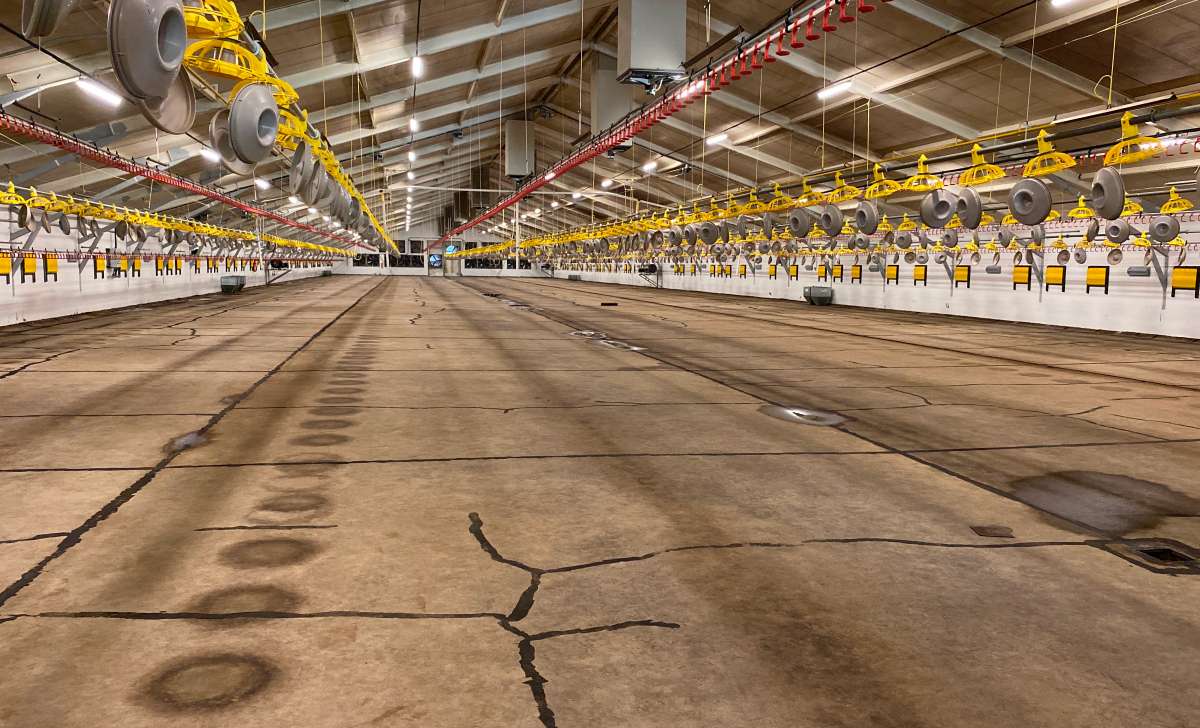
With heat stress already draining $2.36 billion annually from the US poultry industry, smart producers are looking at every angle to protect their bottom line.
One of the most cost-effective interventions? Something as simple as roof surface treatment.
Heat stress hits hard. Research shows it decreases feed intake by 98g per bird and reduces body weight gain by 151g (during the study period). The feed conversion ratio worsens by 0.17 points, while mortality increases by 3.74% (Liu et al., 2020).
These numbers add up fast. For a standard 20,000-bird house, the losses compound quickly. In many cases, these halls are repurposed buildings that were not built with poultry farming in mind. As a result, the materials used may create environments that greatly impact flock performance. Roofing materials are a prime example of this.
Clean, shiny metallic surfaces like zinc paint or aluminum can dramatically reduce solar heat absorption in poultry houses (Çaylı et al., 2021). Dark surfaces absorb heat while light reflective surfaces reject it. Basic physics that delivers immediate results.
The math is compelling. When you consider that temperature is the most significant environmental factor affecting growth performance, preventing just a portion of heat stress impacts could save thousands in feed costs and lost production.
The roof modification pays for itself through improved feed conversion and reduced mortality. While producers invest in complex cooling systems, they might be overlooking this simple physics principle that delivers results for a fraction of the cost.
Smart producers are turning to precise monitoring systems to track the impact of these environmental changes. Accurate weight data becomes essential when measuring the effectiveness of heat stress interventions. Without reliable bird weight measurements, it’s impossible to confirm that roof treatments and other modifications are delivering the expected performance improvements.
Sometimes the biggest return on investment comes from the simplest solutions.
Cited Sources
Liu, L., Ren, M., Ren, K., Jin, Y., & Yan, M. (2020). Heat stress impacts on broiler performance: a systematic review and meta-analysis. Poultry Science, 99(11), 6205-6211.
Çaylı, A., Akyüz, A., Üstün, S., & Yeter, B. (2021). Efficiency of two different types of evaporative cooling systems in broiler houses in Eastern Mediterranean climate conditions. Thermal Science and Engineering Progress, 22, 100844.