
Hybrid chickens are the commercial foundation of modern
poultry production, generating virtually all broiler meat and table eggs produced at scale.
What are sometimes called hybrid chicken breeds are more precisely commercial strains: the controlled end-product of crossing specialized pure lines in a breeding pyramid, from great-grandparent nucleus flocks through grandparent and parent stock to the commercial bird. Unlike true breeds, they do not reproduce true. Replacement chicks must always be sourced from the multiplication pyramid, not bred on-farm.
List of Hybrid Chickens Used in Commercial Production
Layer strains prioritize egg output and feed efficiency. The Lohmann Brown Classic produces approximately 324 eggs per hen housed over a standard 72-week laying cycle (Lohmann Breeders, 2021), alongside the ISA Brown and Hy-Line Brown. White-egg strains include the Lohmann LSL Classic and Hy-Line W-36. As Preisinger (2021) notes, egg production in developed countries is predominantly achieved through hybrid strains derived from a small number of nucleus lines.
Broiler strains focus on rapid growth and feed conversion. The Cobb 500 and Ross 308 target around 2.44 kg at 35 days with a feed conversion ratio of 1.39 (Cobb-Vantress, 2018; Aviagen, 2019).
Dual-purpose strains such as the Lohmann Dual are increasingly relevant in markets restricting the culling of male layer chicks (Preisinger, 2021).
Hybrid Meat Chickens: Growth Targets and Profit Margins
Modern hybrid meat chickens have been selected to a performance ceiling so precise that deviations from the growth curve carry direct financial consequences. Lukić et al. (2020) showed that under suboptimal conditions, Cobb 500 and Ross 308 broilers finished 300 to 400 g below manufacturer targets at day 42, representing measurable lost revenue per bird.
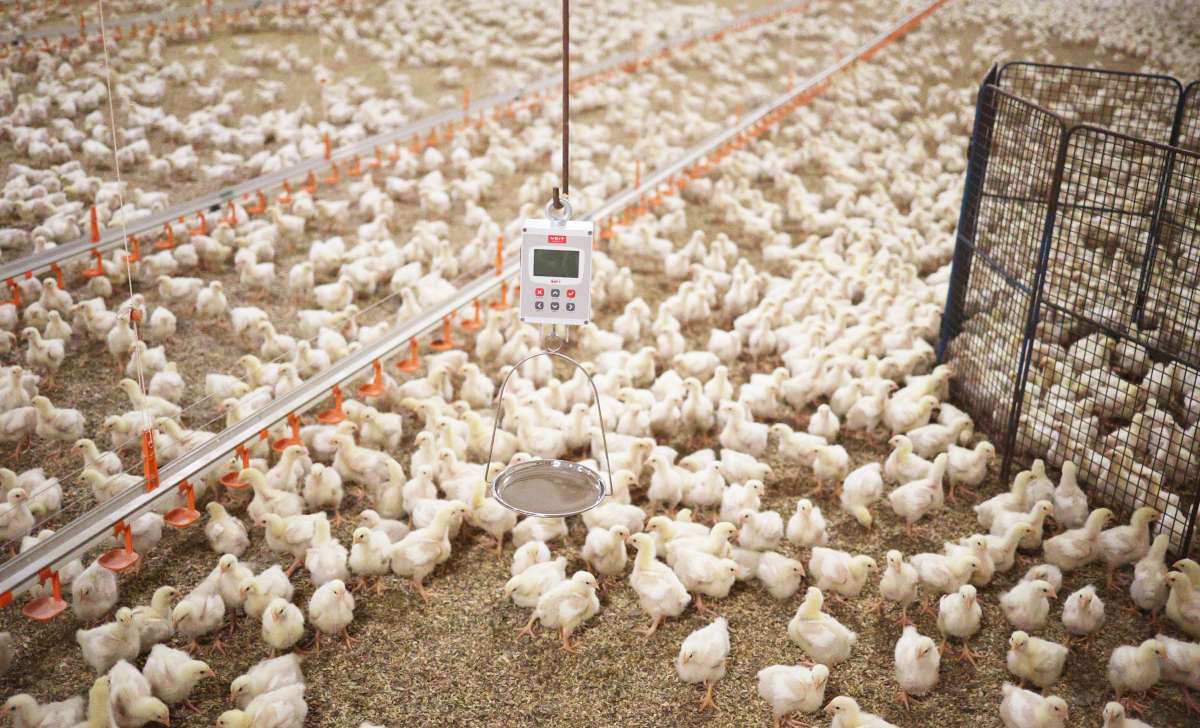
Automated daily weighing is the most efficient way to track weight gain against the curve throughout the cycle. The BAT1 manual poultry scale provides individually confirmed sample entries that cross-check continuous data and enable hands-on flock assessment.
Best Hybrid Chickens for Commercial Egg Production
Lohmann Brown, ISA Brown and Bovans Brown strains perform reliably across cage, barn, and free-range systems. Flock uniformity at point-of-lay is a primary driver of output. Sibanda et al. (2020) found that heavier Lohmann Brown-classic hens at 74 weeks showed significantly higher rates of active egg follicle production but at the cost of a higher occurrence of fatty liver, which can cause significant metabolic issues and impact performance. This finding confirms that breed-standard body weight during rearing directly supports viable egg yield.
Hy-Line guidelines target 80 to 85 percent flock uniformity at point-of-lay (Hy-Line, 2019). The BAT2 Connect automatic poultry scale provides continuous rearing weight data to detect uniformity problems early. Individual weight sampling adds a quality-assurance checkpoint at key management transitions.
How Long Do Hybrid Chickens Live?
In commercial production, lifespan is defined by cycle length. Broiler hybrids are processed at 32 to 38 days. Layer flocks are typically depopulated at 90 weeks of age, once efficiency falls below economic thresholds.
Hobby keepers often retain end-of-lay hens and report continued production for several more years, but hybrid strains are not suited to self-sustaining flocks. Their F1 genetics do not breed true, and replacement stock must always come from the breeding pyramid.
REFERENCES
1.) Aviagen (2019). Ross 308 / Ross 308 FF Broiler Performance Objectives. Aviagen Group. https://en.aviagen.com/brands/ross/products/ross-308
2.) Cobb-Vantress (2018). Cobb 500 Broiler Performance and Nutrition Supplement. Cobb-Vantress. https://www.cobb-vantress.com/products/cobb500
3.) Hy-Line International (2019). Hy-Line Brown Commercial Management Guide. Hy-Line International. https://www.hyline.com/filesimages/Hy-Line-Products/Hy-Line-Product-PDFs/Brown/BRN%20PS%20ENG.pdf
4.) Lohmann Breeders (2021). Lohmann Brown-Classic Performance Data. Lohmann Breeders GmbH (document code 08.21_V01-21). https://lohmann-breeders.com/files/downloads/MG/e-Guides/Cage/English/LB_eMG_Cage_EN_PerfData_LB-Classic_p8.pdf
5.) Lukić, M., Petričević, V., Škrbić, Z., Delić, N., Tolimir, N., Dosković, V., and Rakonjac, S. (2020). Genotype and breeder flock age impact on broiler performance in suboptimal conditions. Biotechnology in Animal Husbandry, 36(4), 447–462. https://doi.org/10.2298/BAH2004447L
6.) Preisinger, R. (2021). Commercial layer breeding: Review and forecast. Züchtungskunde, 93(4), 210–228.
7.) Sibanda, T.Z., Kolakshyapati, M., Walkden-Brown, S.W., de Souza Vilela, J., Courtice, J.M., and Ruhnke, I. (2020). Body weight sub-populations are associated with significantly different welfare, health and egg production status in Australian commercial free-range laying hens in an aviary system. European Poultry Science, 84. https://doi.org/10.1399/eps.2020.295