
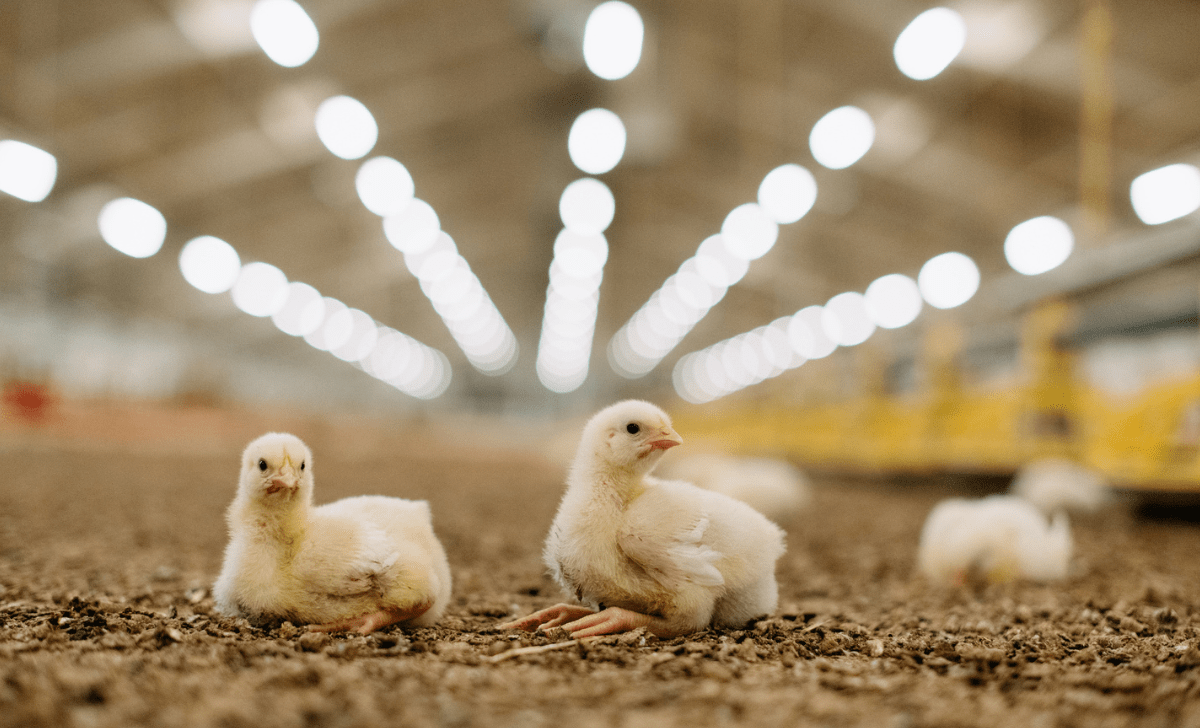
La forma en que se comportan las gallinas está determinada en gran medida por el entorno en el que viven. Comprender el comportamiento avícola en distintos sistemas de alojamiento es esencial para los productores que quieren optimizar tanto el bienestar como la productividad, independientemente del sistema que operen.
Sistemas avícolas intensivos y comportamiento de los pollos de engorde
En instalaciones interiores convencionales, los pollos de engorde pasan hasta el 80% de su tiempo inactivos cuando no están comiendo o bebiendo (Weeks et al., 2000). Los sistemas de producción avícola intensiva suelen alojar lotes de 20.000 o más aves sobre suelos planos con cama, con comederos automáticos y control climático (Spieß et al., 2022). Aunque son eficientes, estos entornos poco enriquecidos ofrecen poca orientación estructural, lo que limita actividades propias de la especie como el baño de polvo y, en poblaciones que no son de engorde, el uso de perchas (Karcher and Mench, 2018).
Esta inactividad contribuye a problemas como la cojera y la dermatitis plantar, especialmente en las últimas semanas de un ciclo de producción (Spieß et al., 2022). Se ha demostrado que el enriquecimiento ambiental, incluidas plataformas elevadas y pacas de paja, aumenta la locomoción y reduce estos problemas de bienestar (Pedersen et al., 2020).
Libertad vs sin jaulas: dónde diverge el comportamiento
Al comparar la cría en libertad con la producción avícola intensiva, la diferencia más visible es el repertorio de conductas disponible para las aves. Los sistemas sin jaulas permiten que las gallinas realicen actividades naturales como anidar, posarse, buscar alimento y darse baños de polvo (Lay et al., 2011). La investigación confirma que el comportamiento de las gallinas en distintos entornos cambia de forma marcada cuando las aves tienen acceso a áreas exteriores o a espacios interiores enriquecidos (Donaldson and O’Connell, 2012).
Sin embargo, una comparación de sistemas de alojamiento avícola revela compensaciones. El alojamiento sin jaulas puede implicar mayores tasas de picaje de plumas, fracturas de quilla y mortalidad (Petrik et al., 2015). Un estudio histórico publicado en Nature concluyó que el bienestar avícola en distintos entornos está más influido por la calidad de las condiciones de alojamiento que por la densidad de alojamiento por sí sola (Dawkins et al., 2004).
Sin jaulas vs sistemas convencionales: calidad del aire y salud
El cambio hacia sistemas sin jaulas frente a sistemas convencionales se ha acelerado a nivel global, con estimaciones de que los lotes sin jaulas en EE. UU. crecieron de 57 millones a 105 millones de gallinas entre 2019 y 2022 (USDA, 2022). Aunque el alojamiento sin jaulas favorece conductas naturales, a menudo trae consigo peor calidad del aire interior, incluidos niveles más altos de amoníaco y de material particulado (Chai et al., 2019).
Estos hallazgos subrayan que ningún modelo de alojamiento garantiza por sí solo un bienestar superior. La calidad del manejo, la monitorización ambiental y la detección temprana de problemas siguen siendo los factores decisivos.
Datos de peso: el hilo común en cualquier entorno
Independientemente del sistema, el peso corporal es uno de los indicadores más fiables de la salud y el rendimiento del lote. Un estudio de monitorización veterinaria en 100 lotes comerciales de pollitas utilizó plataformas de pesaje automático para seguir el peso y la uniformidad a intervalos regulares. Los investigadores observaron que contar con datos de peso consistentes permitió la detección temprana de problemas de bienestar y el benchmarking entre granjas (Mels et al., 2023).
El comportamiento avícola varía ampliamente entre entornos, pero las tendencias de crecimiento siguen siendo universalmente informativas. Una báscula automática instalada entre comederos y bebederos ofrece información continua y en tiempo real sin depender únicamente de la observación visual. En la práctica, esto se consigue con una plataforma como BAT2 Connect, que registra el peso de forma continua en condiciones de granja.
Para operaciones que dependen de controles periódicos manuales, una báscula avícola portátil ofrece la precisión y las estadísticas integradas necesarias para verificaciones puntuales en cualquier tipo de alojamiento. Ya sea para medir la uniformidad en un aviario sin jaulas o para verificar pesos objetivo en una granja de cría en libertad, una báscula manual dedicada para aves vivas convierte cada sesión en datos accionables. Para este uso, la BAT1 permite muestreos dirigidos con registros consistentes.
Centralizar todos los registros de peso mediante una plataforma de datos del lote basada en la nube hace posible comparar el rendimiento entre naves, sistemas y ciclos de producción desde cualquier dispositivo. Esto puede gestionarse con una solución como BAT Cloud.
El debate sobre cría en libertad vs sistemas sin jaulas o modelos intensivos continuará. Pero la visión más clara de cómo están rindiendo realmente las aves proviene de los datos de sus básculas.
References
Chai, L., Xin, H., Wang, Y., Oliveira, J., Wang, K. and Zhao, Y. (2019). Mitigating particulate matter generations of a commercial cage-free henhouse. Transactions of the ASABE, 62, 877–886. https://doi.org/10.13031/trans.13234
Dawkins, M.S., Donnelly, C.A. and Jones, T.A. (2004). Chicken welfare is influenced more by housing conditions than by stocking density. Nature, 427, 342–344. https://doi.org/10.1038/nature02226
Donaldson, C.J. and O’Connell, N.E. (2012). The influence of access to aerial perches on fearfulness, social behaviour and production parameters in free-range laying hens. Applied Animal Behaviour Science, 142, 51–60. https://doi.org/10.1016/j.applanim.2012.08.006
Karcher, D.M. and Mench, J.A. (2018). Overview of commercial poultry production systems and their main welfare challenges. In Advances in Poultry Welfare (pp. 3–25). Elsevier. https://doi.org/10.1016/B978-0-08-100915-4.00001-4
Lay, D.C., Fulton, R.M., Hester, P.Y., Karcher, D.M., Kjaer, J.B., Mench, J.A. and Porter, R.E. (2011). Hen welfare in different housing systems. Poultry Science, 90, 278–294. https://doi.org/10.3382/ps.2010-00962
Mels, C., Niebuhr, K., Futschik, A., Rault, J.L. and Waiblinger, S. (2023). Development and evaluation of an animal health and welfare monitoring system for veterinary supervision of pullet farms. Preventive Veterinary Medicine, 217, 105929. https://doi.org/10.1016/j.prevetmed.2023.105929
Pedersen, I.J., Tahamtani, F.M., Forkman, B., Young, J.F., Poulsen, H.D. and Riber, A.B. (2020). Effects of environmental enrichment on health and bone characteristics of fast growing broiler chickens. Poultry Science, 99, 1946–1955. https://doi.org/10.1016/j.psj.2019.11.061
Petrik, M.T., Guerin, M.T., Widowski, T.M. (2015). On-farm comparison of keel fracture prevalence and other welfare indicators in conventional cage and floor-housed laying hens in Ontario, Canada. Poultry Science, 94, 579–585. https://doi.org/10.3382/ps/pev039
Spieß, F., Reckels, B., Abd-El Wahab, A., Ahmed, M.F.E., Sürie, C., Auerbach, M., Rautenschlein, S., Distl, O., Hartung, J. and Visscher, C. (2022). The influence of different types of environmental enrichment on the performance and welfare of broiler chickens and the possibilities of real-time monitoring via a farmer-assistant system. Sustainability, 14, 5727. https://doi.org/10.3390/su14095727
USDA (2022). Cage-free shell egg report. United States Department of Agriculture, Agricultural Marketing Service. https://usda.library.cornell.edu/concern/publications/1j92g7448
Weeks, C.A., Danbury, T.D., Davies, H.C., Hunt, P. and Kestin, S.C. (2000). The behaviour of broiler chickens and its modification by lameness. Applied Animal Behaviour Science, 67, 111–125. https://doi.org/10.1016/S0168-1591(99)00102-1