
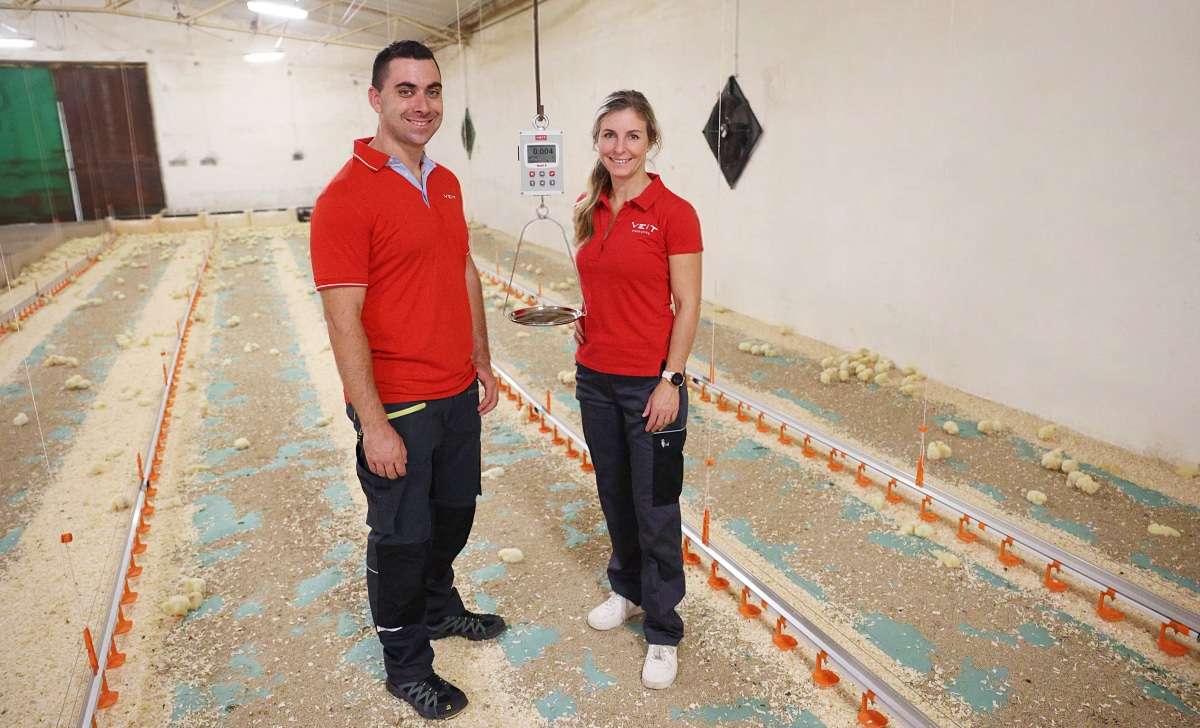
Every management decision on a poultry farm begins with weight data. Feed allocations, growth tracking, uniformity grading, and early disease detection all depend on readings from your poultry scale. Yet even the best equipment will drift over time if it is not properly maintained. Knowing the right calibration schedule for farm weighing equipment is essential for protecting both flock welfare and profitability.
Why Calibration Matters in Poultry Production
Accurate feed amounts can only be determined if bodyweight is measured accurately every week (Cobb-Vantress, 2024). A scale reading just 20 grams high across thousands of birds can distort uniformity calculations, mask early health problems, and lead to costly overfeeding. In breeder operations, even small inaccuracies in egg weight can cause viable hatching eggs to be rejected (Cobb-Vantress, 2024). Scale accuracy maintenance is not optional. It is foundational to sound flock management.
Recommended Calibration Frequencies
There is no universal answer to how often weighing equipment calibration should occur. The right interval depends on usage, environment, and applicable regulations.
The Cobb Breeder Management Guide recommends monthly calibration of poultry scales as good practice and instructs producers to calibrate all scales before flock placement or within two weeks of receiving new birds (Cobb-Vantress, 2024). The Aviagen Ross Broiler Pocket Guide is more concise, stating that producers should calibrate automatic equipment at least once per flock (Aviagen, 2025). Both sources also emphasize regular verification using known test weights.
In the United States, regulations under the Packers and Stockyards Act require that scales used for live poultry transactions be tested for accuracy at least twice per calendar year, with a minimum of 120 days between tests (USDA AMS, 2024). Operations where scales fail to hold accuracy between tests may face more frequent agricultural scale servicing requirements.
Poultry House Conditions Accelerate Drift
Farm scale maintenance cannot be separated from the environment in which the equipment operates. Dust, ammonia, moisture, and temperature swings inside a poultry house all affect load cell performance. Ammonia concentrations above 25 ppm not only impair bird health and production efficiency (Bist et al., 2023) but can also corrode sensitive electronics over time. Routine cleaning and platform inspection should accompany every calibration check.
How the Right Equipment Simplifies the Process
A purpose-built poultry scale reduces calibration burden significantly. The BAT2 Connect automatic poultry scale features a 3-touch calibration process and Hang&Go mounting for consistent positioning, which eliminates a common source of measurement error. Because automated daily weighing runs continuously, deviations become visible faster, allowing producers to verify accuracy before problems compound.
For manual weighing sessions, the BAT1 manual poultry scale delivers results accurate to within 1 gram for all types of live birds. Pairing consistent, single-operator weighing with a regular test weight check keeps your livestock scale maintenance frequency manageable and your data trustworthy.
Build Calibration into Your Flock Calendar
Treat agricultural scale calibration as a standing item on your pre-placement checklist. Verify with a test weight weekly, perform a full recalibration between every flock, and recalibrate any time a scale is moved, repaired, or exposed to unusual conditions. Document each check. Consistent records support quality audits and reinforce confidence in the data driving your daily decisions.
Regardless of housing system or production type, weight data remains the most effective way to judge performance and welfare of poultry flocks. Keeping your poultry scales properly calibrated ensures that every reading you rely on is a reading you can trust.
References
Aviagen. (2025). Ross Broiler Pocket Guide 2025. Aviagen Inc. https://aviagen.com/assets/Tech_Center/Ross_Broiler/Aviagen-ROSS-Broiler-PocketGuide-EN.pdf
Bist, R. B., Subedi, S., Chai, L., & Yang, X. (2023). Ammonia emissions, impacts, and mitigation strategies for poultry production: A critical review. Journal of Environmental Management, 328, 116919. https://doi.org/10.1016/j.jenvman.2022.116919
Cobb-Vantress. (2024). Cobb Breeder Management Guide. Cobb-Vantress Inc. https://www.cobb-vantress.com/resources/management-guides
USDA AMS. (2024). Responsibility for accurate scales and live poultry weights. United States Department of Agriculture, Agricultural Marketing Service. https://www.ams.usda.gov/rules-regulations/packers-and-stockyards-act/regulated-entities/accurate-scales-and-weights