
Understanding poultry circadian rhythms is essential for optimizing flock management in modern commercial production. While natural chicken behavior patterns evolved under natural sunlight, today’s producers strategically employ artificial lighting to enhance performance, creating carefully controlled day-night cycles that directly influence broiler daily activity cycles and laying hen feeding and resting cycles.
Commercial poultry operations intentionally use artificial light management rather than natural photoperiods, allowing precise control over chicken feeding patterns and rest periods. Research demonstrates that chickens reared under moderate day lengths consume most feed during light periods, with minimal activity during darkness (Geng et al., 2022). This controlled approach to poultry circadian rhythm management significantly impacts both welfare and productivity.
Broiler chicken daily activity patterns respond dramatically to lighting programs. Studies show exposing 7+ day-old broilers to continuous 24-hour light impedes the development of stable feeding rhythms, while those provided with 6-8 hours of darkness develop consistent poultry rest and feeding schedule patterns (Ashabranner et al., 2025). Birds exposed to dark periods from day one exhibit higher melatonin production, potentially improving immune function and stress resistance without compromising end-of-flock performance.
Layer hen behavior patterns follow distinct circadian cycles that affect both productivity and welfare. Research indicates laying hens exhibit highest feeding activity in early morning and late afternoon, with peak egg-laying typically occurring during mid-morning hours (in commercial context, the beginning, end, and second quarter of the lighting period, respectively) (Geng et al., 2022). Groups exposed to continuous lighting show different reproductive development compared to intermittent lighting patterns, clearly demonstrating the effect of lighting on ovarian weight and oviduct development. A widely adopted lighting regimen for laying hens is 8 hours of darkness and 16 hours of light.
Optimal feeding times for poultry align with natural diurnal patterns. Birds typically consume larger meals at first light and before darkness, eating approximately every 15 minutes during active periods (Buyse et al., 1993). Modern broilers concentrate feeding activity 20 minutes before but primarily 20 minutes after each dark period when provided intermittent lighting (Jiang et al., 2023), demonstrating their ability to adjust behavior according to photoperiod.
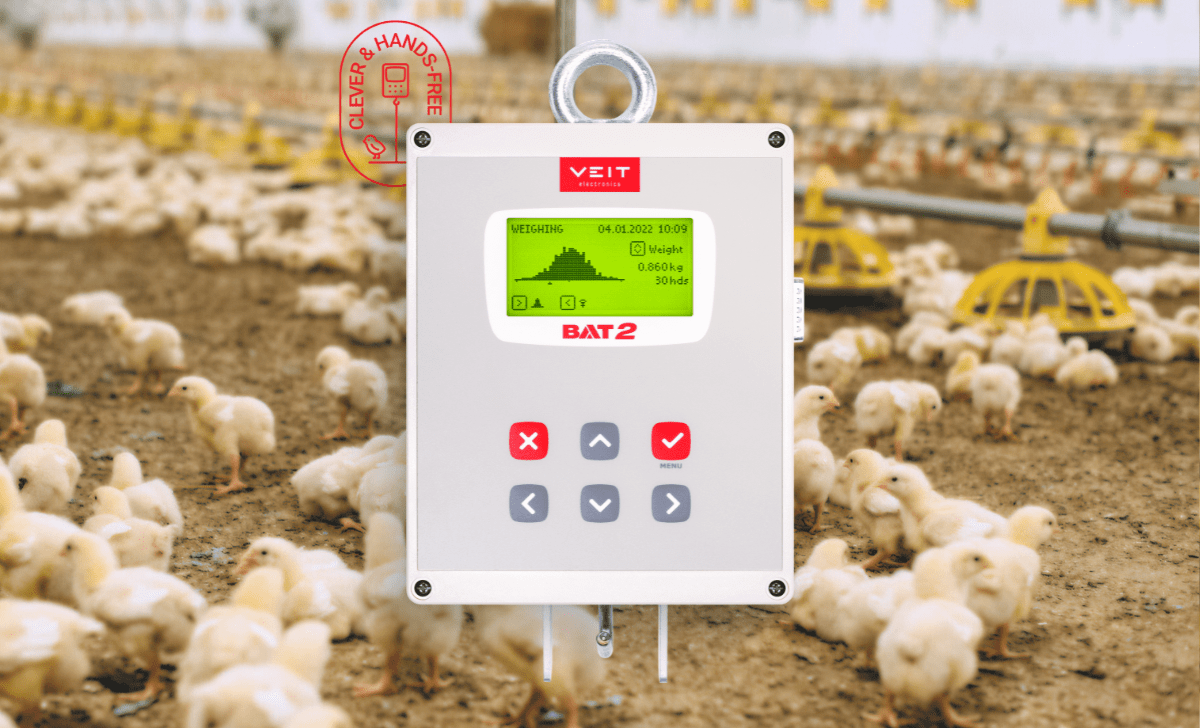
Monitoring broiler chicken daily activity patterns and laying hen feeding and resting cycles provides valuable welfare and performance insights. When dealing with parent stock, the BAT2 Connect automatic poultry scale enables producers to track growth patterns throughout different photoperiods, identifying how lighting programs affect daily weight gain. For operations requiring manual monitoring, the BAT1 manual poultry scale delivers 1-gram accuracy with WiFi connectivity, allowing precise tracking of how circadian management impacts individual bird development.
Properly managed poultry circadian rhythm management through strategic lighting improves skeletal health, reduces leg abnormalities, and enhances overall welfare (Schwean-Lardner et al., 2014). Dark periods stimulate natural rest behaviors while allowing birds to maintain growth performance through compensatory feeding when lights return. Data collected and organized on the BAT Cloud platform helps producers analyze how specific lighting schedules correlate with flock uniformity and performance metrics over time.
Modern commercial poultry production’s intentional use of artificial lighting represents an evidence-based approach to balancing animal welfare with production efficiency. Understanding and applying knowledge of chicken natural behavior patterns within controlled environments allows producers to optimize chicken feeding patterns while respecting biological rhythms essential for health and productivity.
References:
Ashabranner, G.G., Czarick, M., & Fairchild, B.D. (2025). Evaluating the effect of daylength (24, 20, and 18 hours) during brooding on broiler performance and physiological responses to light environment. Journal of Applied Poultry Research, 34, 100558. https://doi.org/10.1016/j.japr.2025.100558
Buyse, J., Simons, P.C.M., Boshouwers, F.M.G., & Decuypere, E. (1993). Diurnal-nocturnal changes in food intake, gut storage of ingesta, food transit time and metabolism in growing broiler chickens: A model for temporal control of energy balance. British Poultry Science, 34(4), 699-709.
Geng, A.L., Zhang, Y., Zhang, J., Wang, H.H., Chu, Q., Yan, Z.X., & Liu, H.G. (2022). Effects of light regime on circadian rhythmic behavior and reproductive parameters in native laying hens. Poultry Science, 101(5), 101808. https://doi.org/10.1016/j.psj.2022.101808
Jiang, S., Fu, Y., & Cheng, H.W. (2023). Daylight exposure and circadian clocks in broilers: part I—photoperiod effect on broiler behavior, skeletal health, and fear response. Poultry Science, 102(12), 103162. https://doi.org/10.1016/j.psj.2023.103162
Schwean-Lardner, K., Fancher, B.I., Laarveld, B., & Classen, H.L. (2014). Effect of day length on flock behavioural patterns and melatonin rhythms in broilers. British Poultry Science, 55(1), 21-30. https://doi.org/10.1080/00071668.2013.860211