
Drops in egg output or body weight on commercial flocks often trace back to external parasites. Chicken lice and mites are the most common culprits, yet they are frequently confused. The distinction matters: each parasite occupies a different environment and requires a different treatment approach.
What Are Chicken Lice?
Poultry lice (suborder Mallophaga) complete their entire life cycle on the host. The most commercially significant species is Menacanthus stramineus, the chicken body louse: pale yellow, 3 to 3.5 mm long, and feeding on feathers, skin debris, and occasionally blood from pin feathers (Mlondo et al., 2025; Murillo et al., 2024). White egg clusters glued to feather shafts at the vent and breast are the clearest field indicator. Lice survive only about one week off a host.
What Are Chicken Mites?
Poultry mites are arachnids, not insects. The two most commercially important species are Dermanyssus gallinae (the red poultry mite) and Ornithonyssus sylviarum (the northern fowl mite). D. gallinae hides in building cracks and nest boxes by day and feeds at night; it has been confirmed on over 83% of European laying hen farms and vectors Salmonella and Mycoplasma gallisepticum (Sparagano et al., 2014; Schiavone et al., 2022). O. sylviarum lives permanently on the host and is the most damaging ectoparasite in US commercial poultry, soiling the vent feathers with droppings and dried blood (Murillo & Mullens, 2020).
Chicken Lice or Mites: How to Tell Them Apart
Timing and location are the most reliable diagnostics. Lice are visible in daylight at the vent, breast, and thigh: pale, fast-moving insects with white nit clusters on feather shafts (Cobb-Vantress, n.d.). Red mites are active at night, but can be identified at any time through environmental inspection; ash-like residue in cracks and nest boxes, or blood spots on egg shells are strong indicators. Northern fowl mites remain on the bird all day, concentrated at the vent, unlike D. gallinae, which retreats off the host by day (Di Palma et al., 2012; Murillo & Mullens, 2020).
Why Identification Matters for Flock Performance
Mite infestations cause anemia and reduced egg output in laying flocks (Sparagano et al., 2014). Parasitised hens also show increased preening behaviour and develop skin lesions as infestation progresses (Murillo et al., 2020). Louse infestations elevate preening behaviour even at low infestation levels, with skin lesions appearing at moderate infestation levels (Murillo et al., 2024). In layers and parent stock, infestations build over weeks before production impacts become measurable, making early physical detection during handling the most reliable first alert.
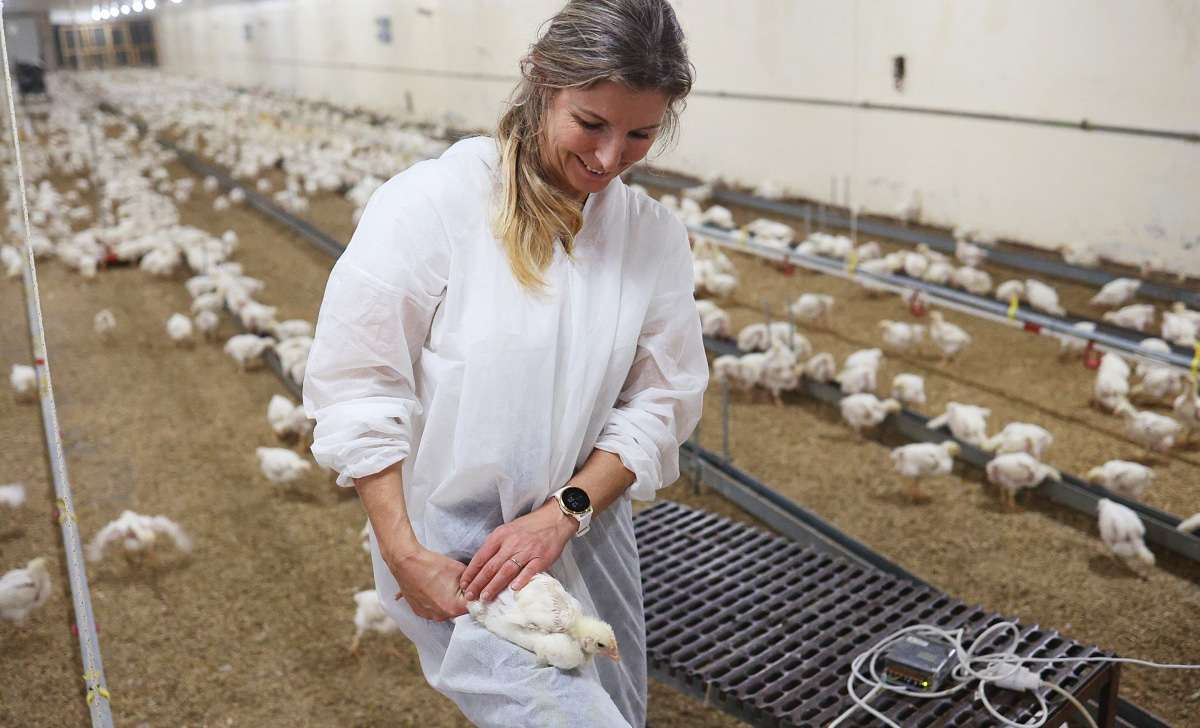
Individual bird weight assessment involves direct physical contact with each bird. In layer flocks where D. gallinae is active, mites crawl immediately onto the handler’s hands during handling, often giving the first indication of infestation well before any weight trend reflects a change.
Continuous live weight monitoring tracks production trends across the flock cycle, providing the performance baseline needed to assess whether treatment has been effective and whether weights have returned to expected levels.
Weight records in BAT Cloud support baseline comparisons, helping link production anomalies to infestation events.
How to Treat Chicken Lice and Mites
Chicken lice and mites treatment must be matched to the parasite’s location. Lice live entirely on the bird, so approved compounds such as permethrin, carbaryl, or spinosad are applied directly, with a follow-up after 10 to 14 days to break the egg cycle (Cobb-Vantress, n.d.; Mlondo et al., 2025). Red mite demands environmental treatment too, since D. gallinae lives in building cracks and nest boxes between feeds and cannot be controlled by bird treatment alone.
For D. gallinae, diatomaceous earth (DE) is among the most effective non-chemical preventive measures available. Applied during downtime between flocks to equipment, perches, nest boxes, and crevices where the mite congregates, DE kills by physically abrading and desiccating the cuticle, a mechanical mode of action that precludes resistance development. Laboratory testing shows 100% adult mite mortality within 48 hours of exposure, and field application combined with mechanical cleaning has achieved mite population reductions exceeding 94% (Kilpinen & Steenberg, 2009; Alves et al., 2020). Efficacy diminishes at relative humidity above approximately 85%, so downtime application is the most reliable window (Decru et al., 2020). Because lice live entirely on the bird and do not inhabit building infrastructure, DE applied to housing equipment does not affect louse populations.
Handling birds at treatment time using the BAT1 manual poultry scale provides both weight data and direct physical contact with each bird. If D. gallinae remains active, mites will still crawl onto the handler’s hands, giving immediate tactile confirmation that the infestation has not yet been resolved.
The BAT2 Connect automatic scale complements that hands-on assessment by tracking whether flock weight is recovering toward expected levels, providing the production continuity that periodic manual sessions cannot supply on their own.
References
1.) Alves, L.F.A., de Oliveira, D.G.P., Pares, R.B., Sparagano, O.A. and Godinho, R.P. (2020). Association of mechanical cleaning and a liquid preparation of diatomaceous earth in the management of poultry red mite, Dermanyssus gallinae (Mesostigmata: Dermanyssidae). Experimental and Applied Acarology, 81, 215-222. https://doi.org/10.1007/s10493-020-00497-z
2.) Cobb-Vantress (n.d.). Cobb Breeder Management Guide. Siloam Springs, AR: Cobb-Vantress. https://www.cobb-vantress.com/docs/default-source/guides/breeder-management-guide.pdf
3.) Decru, E., Mul, M., Nisbet, A.J., Vargas Navarro, A.H., Chiron, G., Walton, J., Norton, T., Roy, L. and Sleeckx, N. (2020). Possibilities for IPM strategies in European laying hen farms for improved control of the poultry red mite (Dermanyssus gallinae): details and state of affairs. Frontiers in Veterinary Science, 7, 565866. https://doi.org/10.3389/fvets.2020.565866
4.) Di Palma, A., Giangaspero, A., Cafiero, M.A. and Germinara, G.S. (2012). A gallery of the key characters to ease identification of Dermanyssus gallinae (Acari: Gamasida: Dermanyssidae) and allow differentiation from Ornithonyssus sylviarum (Acari: Gamasida: Macronyssidae). Parasites & Vectors, 5, 104. https://doi.org/10.1186/1756-3305-5-104
5.) Kilpinen, O. and Steenberg, T. (2009). Inert dusts and their effects on the poultry red mite (Dermanyssus gallinae). Experimental and Applied Acarology, 48, 51-62. https://doi.org/10.1007/s10493-008-9232-0
6.) Mlondo, S., Tembe, D., Malatji, M.P. and Mukaratirwa, S. (2025). Epidemiology of chewing lice (Phthiraptera: Mallophaga) fauna of poultry in sub-Saharan Africa. Pathogens, 14(12), 1192. https://doi.org/10.3390/pathogens14121192
7.) Murillo, A.C., Abdoli, A., Blatchford, R.A., Keogh, E.J. and Gerry, A.C. (2020). Parasitic mites alter chicken behaviour and negatively impact animal welfare. Scientific Reports, 10, 8236. https://doi.org/10.1038/s41598-020-65021-0
8.) Murillo, A.C., Abdoli, A., Blatchford, R.A., Keogh, E.J. and Gerry, A.C. (2024). Low levels of chicken body louse (Menacanthus stramineus) infestations affect chicken welfare in a cage-free housing system. Parasites & Vectors, 17, 221. https://doi.org/10.1186/s13071-024-06313-6
9.) Murillo, A.C. and Mullens, B.A. (2020). Collecting and monitoring for northern fowl mite (Acari: Macronyssidae) and poultry red mite (Acari: Dermanyssidae) in poultry systems. Journal of Insect Science, 20(6), 12. https://doi.org/10.1093/jisesa/ieaa032
10.) Schiavone, A., Pugliese, N., Otranto, D., Samarelli, R., Circella, E., De Virgilio, C. and Camarda, A. (2022). Dermanyssus gallinae: the long journey of the poultry red mite to become a vector. Parasites & Vectors, 15, 29. https://doi.org/10.1186/s13071-021-05142-1
11.) Sparagano, O.A.E., George, D.R., Harrington, D.W.J. and Giangaspero, A. (2014). Significance and control of the poultry red mite, Dermanyssus gallinae. Annual Review of Entomology, 59, 447-466. https://doi.org/10.1146/annurev-ento-011613-162101