
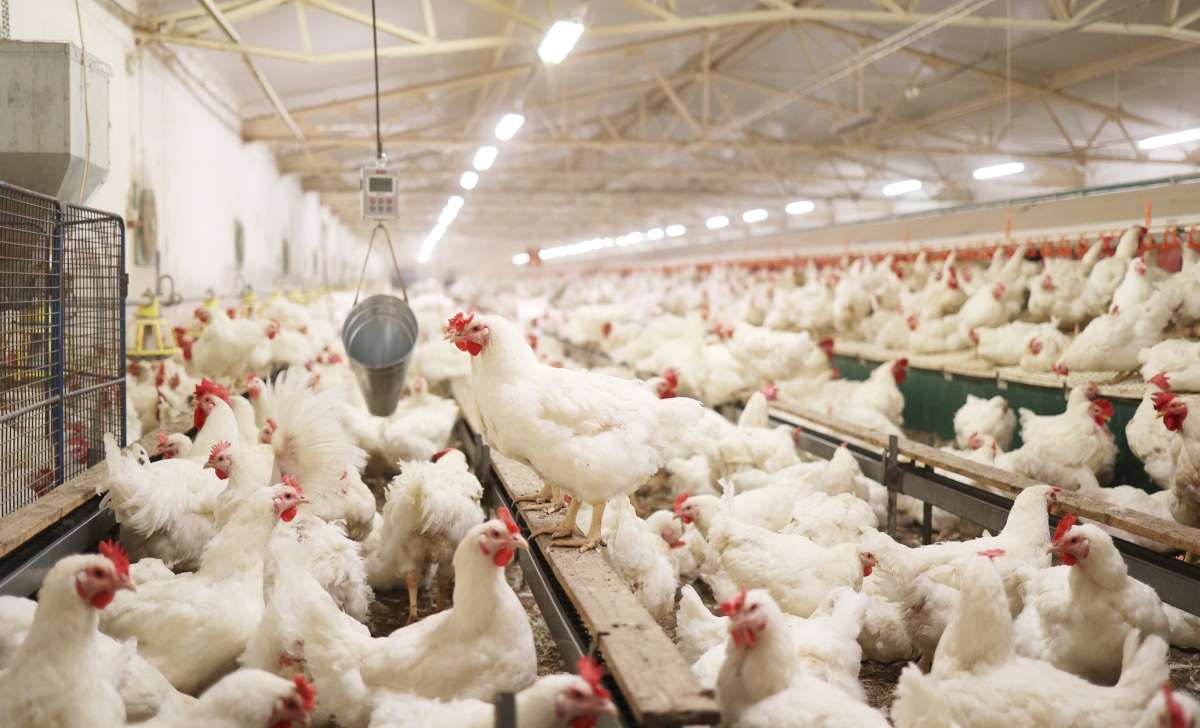
In commercial broiler breeder operations, reproductive efficiency determines chicks per hen housed, and that figure determines profitability.
The Mechanics: How Chickens and Roosters Mate
Chickens and roosters lack external genitalia. Mating in chickens occurs through a brief event called the cloacal kiss. The rooster mounts the hen and presses his cloaca against hers for a matter of seconds, transferring sperm into the hen’s oviduct (Duncan et al., 1990). Sperm is retained in storage tubules near the utero-vaginal junction, where hens can maintain viable sperm for up to 3 weeks (Bakst, 1987). One successful mating can fertilize a run of consecutive eggs.
How Often Do Roosters and Chickens Mate in Commercial Flocks?
A healthy male in good condition mates multiple times daily. Cobb recommends housing males at 8 to 9% of the hen population in slatted houses and 9 to 10% in litter-only houses at transfer (Cobb, 2022). Not all attempts end in successful cloacal contact: dominant birds complete a disproportionate share of contacts, and heavier males tend toward more incomplete attempts (Pizzari et al., 2005). Male numbers alone do not guarantee even sperm coverage across the hen population.
Why Body Weight Determines Reproductive Outcomes
Broiler breeder fertility is inseparable from body weight management. This comes from a negative genetic correlation between growth and reproductive performance. The Cobb Breeder Management Guide identifies the male growth profile as the single most important factor correlating with flock fertility, and males should be weighed at least weekly from one to 30 weeks of age (Cobb, 2022).
Oversized males accumulate breast muscle that impairs balance during mounting. Males with a fleshing score above 4 show reduced mating efficiency, and males losing more than 100 g in production risk a decline in sperm quality (Cobb, 2022).
For females, body weight at photostimulation determines whether ovarian follicle development follows the correct hormonal pathway. Renema et al. (1999b) showed that weight during sexual maturation influences plasma estradiol profiles, which regulate ovulation onset and quality. Robinson and Wilson (1996) documented reproductive failure in both overweight male and female broiler breeders.
Flock uniformity compounds these risks. Petitte et al. (1982) found that poor uniformity reduced reproductive performance in broiler breeder hens. A CV above 10% typically reflects inadequate feed management or unreliable data collection.
When Weight Data Fails, Fertility Follows
Inaccurate weight records produce distorted feed adjustments. Males drift from their growth curve. Females approach photostimulation in the wrong body condition, eroding hatchability.
Automated daily weighing catches these deviations early, making growth trends visible within days rather than weeks.
The BAT2 Connect automatic poultry scale records weights throughout the day without handler intervention, giving managers a reliable continuous baseline.
Manual weighing adds what automation cannot replicate. Because every bird is caught individually, a hands-on weighing session enables direct fleshing evaluation alongside body weight. The Cobb guide recommends assessing male breast condition every two weeks in production.
The BAT1 manual poultry scale is designed for exactly this kind of physical flock inspection.
Both data streams can be consolidated in BAT Cloud, where managers track weight trends, monitor uniformity, and align feeding decisions with reproductive requirements.
Chickens and roosters mate in seconds. Protecting that moment requires weeks of precise weight management.
Cited Sources
1.) Bakst, M.R. (1987). Sperm storage in the avian oviduct. American Zoologist 27(3):519–527. [FLAG: verify exact title and journal details for this citation]
2.) Cobb (2022). Cobb Breeder Management Guide. Cobb-Vantress, Inc. https://www.cobb-vantress.com/resources/management-guides/
3.) Duncan, I.J.H., P.M. Hocking, and E. Seawright (1990). Sexual behaviour and fertility in broiler breeder domestic fowl. Applied Animal Behaviour Science 26(3):201–213. https://doi.org/10.1016/0168-1591(90)90137-3
4.) Petitte, J.N., R.O. Hawes, and R.W. Gerry (1982). The influence of flock uniformity on the reproductive performance of broiler breeder hens housed in cages and floor pens. Poultry Science 61(11):2166–2171. https://doi.org/10.3382/ps.0612166
5.) Pizzari, T., et al. (2005). Reproductive success of broiler breeders in natural mating systems: the effect of male-male competition, sperm quality, and morphological characteristics. Poultry Science.
6.) Renema, R.A., F.E. Robinson, J.A. Proudman, M. Newcombe, and R.I. McKay (1999b). Effects of body weight and feed allocation during sexual maturation in broiler breeder hens. 2. Ovarian morphology and plasma hormone profiles. Poultry Science 78(4):629–639.
7.) Robinson, F.E., and J.L. Wilson (1996). Reproductive failure in overweight male and female broiler breeders. Animal Feed Science and Technology 58(1–2):143–150.