
Poultry breeders, situated at the start of the supply chain, are tasked with the crucial responsibility of meeting increasing market and societal demands for more, healthy, and responsibly produced food, a commitment that builds upon the long history of chicken domestication, which began with the Red Jungle Fowl (Gallus gallus). While the modern broiler originated from 19th-century breeds like Cornish and Leghorn, the last 60 years have seen the implementation of balanced breeding driven by scientific advances in genetics and computing power. This development has occurred alongside an industry consolidation, moving toward fewer companies that now bear the ethical role of addressing global food security and sustainability. To guide this responsibility, the industry adheres to ensure health, biodiversity, balanced breeding, stockmanship, and transparency (Neeteson et al., 2023).
Historical overview of poultry breeding
Today’s classic division of breeding therefore includes great grant parent flocks, where pure lines are created, which are then combined in grandparent farms, and the two breeds are combined at the parent farm level, where broiler chickens are produced for commercial farms. Today’s breeding program has been shaped by decades of experience and mistakes during the early years of breeding. Breeding is therefore undergoing constant development, which is driven by the demands of society.
- Initial Breeding Method: Poultry breeding initially relied on mass selection, where individual birds with favorable phenotypes for traits with sufficient heritability were selected to parent the next generation (Hocking, 2010).
- Shift to Line Breeding: Due to a negative correlation between production and reproduction traits, individual male and female lines were developed, first in layers and then in meat birds.
- Adoption of Crossbreeding: Starting in the 1950s, breeders began testing crosses for growth rate and meatiness. Crossing distinct male and female lines introduced the heterosis effect, which provides extra ‚vitality‘ and is highest in the first crossbred generation (Hocking, 2010).
- Breeding Program Structure (Breeding Pyramid): Modern poultry breeding is structured as a breeding pyramid and requires significant investment and maintenance of multiple contributing flocks. Genetic improvement occurs in the pure lines at the top.
- The Best Linear Unbiased Prediction (BLUP): BLUP is a sophisticated statistical approach that combines an animal’s phenotypic performance with its pedigree relationship to maximize genetic gain. It is well-suited for the multivariate, sequential selection settings typical in poultry breeding, enabling the selection of superior genotypes and families (Jeyaruban et al., 1995).
- Development of genomic selection: Prompted by successful validation with real data, the broiler breeding industry incorporated genomic approaches and rapidly developed related analytical tools (Avendaño et al., 2012).
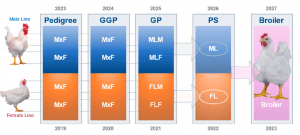
Dissemination and Timeline: The genetic improvement from the pure lines is disseminated through a series of multiplying generations. Crossbreeding typically begins at the grandparent stock level. The entire process, from pedigree selection to the final commercial generation grown by farmers, takes approximately 4 years (Fig. 1)
Continuous Improvement: The breeding program is positioned at the start of the supply chain and uses continuous feedback to set and fine-tune its breeding goals.
 Male line male; MLF—Male line female; FLM—Female line male; FLF—Female line female; ML—Male line; FL—Female line; GGP—Great Grandparent; GP—Grandparent; PS—Parent Stock“ width=“300″ height=“135″ />
Fig. 1: From pure lines to commercial crossbreds (Neeteson et al., 2023). M—Male; F—Female; MLM—Male line male; MLF—Male line female; FLM—Female line male; FLF—Female line female; ML—Male line; FL—Female line; GGP—Great Grandparent; GP—Grandparent; PS—Parent Stock
Breeding goals
The breeding goal defines the set of traits aimed for improvement, determining what the „most appropriate“ selection candidates are. The Estimated Breeding Value for each trait is calculated using an individual’s data, plus information from relatives and ancestors, to determine selection accuracy and predict genetic progress (Burnside and Neeteson, 2025).
– Modern breeding goals have expanded vastly in the last four decades from focusing only on production to simultaneously balancing production, reproduction, health, welfare, and environmental impact.
– Modern poultry breeding involves broad gene pools consisting of tens of genetic lines with specific goals. Commercial crossbred populations are derived from combining three to four pure lines, with the balance of selection traits in each line differing based on its role (e.g., growth vs. reproduction).
– Modern commercial breeding goals are highly complex, typically including 30 to 40 traits across a wide range of attributes: production, reproduction, robustness, health, product quality, and environmental adaptability (Burnside and Neeteson, 2025).
– Breeding goals are determined by a long-term view and influence from external factors like market requirements (e.g., live weight, yield), geography, and societal requirements (e.g., welfare).
– Integrating Welfare and Health: Health and livability traits and animal welfare traits are now considered as important as productivity traits, and their improvement is noted to not represent a constraint to increasing productivity (Fig. 2).
– Environmental and Efficiency Focus: Due to increased demand for animal products and limited resources, future goals emphasize biological efficiency (feed conversion ratio) to increase productivity and reduce environmental impact (e.g., lower greenhouse gas emissions and nitrogen excretion).
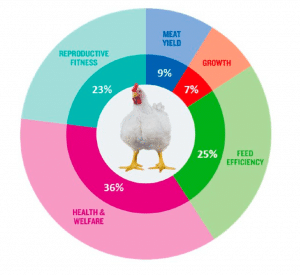
Fig. 2 Breeding goals of Ross 308 hybrid (Neeteson et al., 2023)
Consequences of breeding
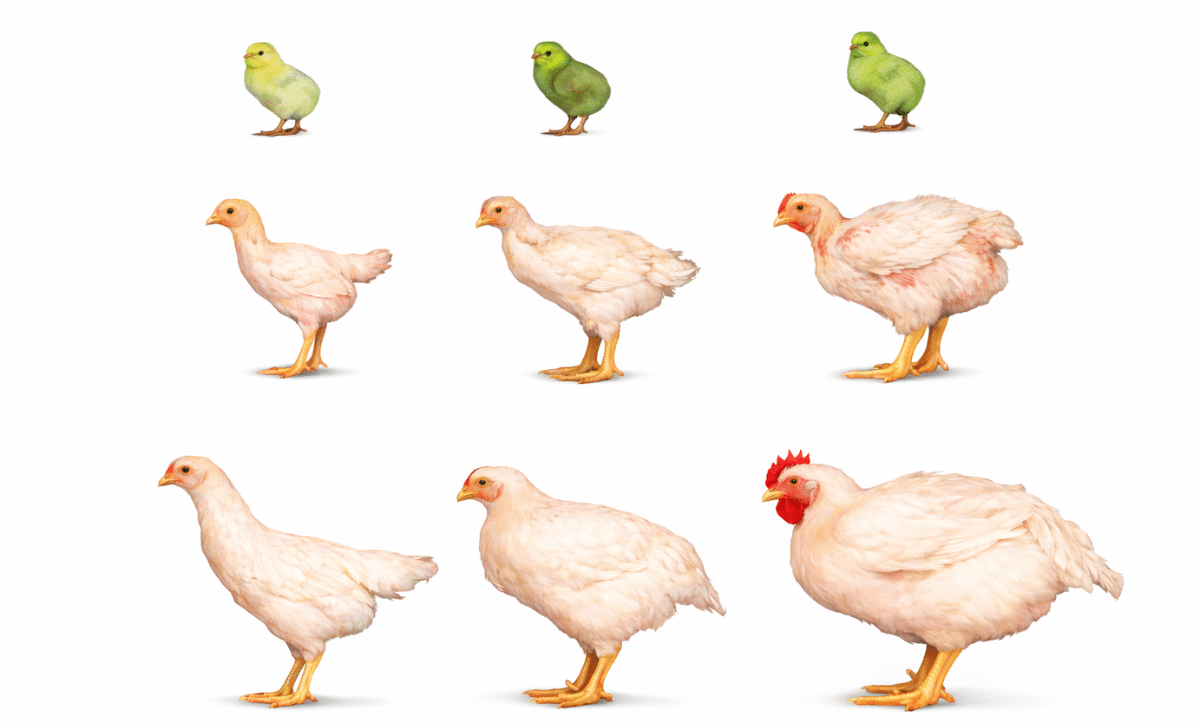
The narrow selection focus for growth has caused widespread welfare problems directly linked to the fast growth rate. Genetic selection over the past 60 years has led to dramatic increases in broiler growth rates (over 400% between 1957 and 2005) and meat yield (Fig. 3), significantly reducing slaughter age and improving feed efficiency. The feed conversion ratio (FCR) was reduced by 50% concurrently. 42-day FCR decreased by 2.55% each year. Pectoralis major yield at 42 days increased by 79% in males and 85% in females. Pectoralis minor yield at 42 days increased by 30% in males and 37% in females. 85–90% of this increase is attributed to genetic selection (Zuidhof et al., 2014).
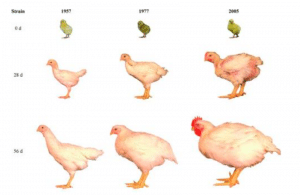
Fig. 3 Size comparison among genotypes of chickens from 1957, 1977 and 2005 (Zuidhof et al., 2014)
Major Welfare Consequences of Fast Growth
The rapid growth rate is directly linked to three main categories of severe welfare issues (Hartcher and Lum, 2020).
In broilers:
- Cardiovascular Diseases: The high metabolic demand for oxygen, coupled with disproportionately small hearts and lungs, leads to insufficient oxygen supply. This causes significant mortality from conditions like Sudden death syndrome and Ascites (fluid accumulation in abdominal cavity from heart failure) (Olkowski, 2007).
- Musculoskeletal Disorders: The high body weight and unbalanced body conformation (e.g., increased breast muscle) cause leg disorders and bone deformities, resulting in lameness, low locomotor activity, and an inability to perform natural behaviors (Kwon et al., 2024).
- Contact Dermatitis: Reduced walking ability causes fast-growing birds to spend more time sitting/lying on moist litter, leading to painful skin lesions like Foot Pad Dermatitis and Hock Burn (Forseth et al., 2025).
In broiler breeders:
– Breeder Welfare Issues: The broiler breeder birds (the parents of the fast-growing broilers) also suffer from welfare. Since they retain the high-growth genetics but are kept to an older age for reproduction, they rapidly become obese with compromised reproductive function.
– Severe Feed Restriction: To manage obesity, high mortality, and walking problems, breeders are subjected to chronic, severe feed restriction (limiting intake to 1/3 of ad libitum), which causes the serious welfare problem of chronic hunger, stress, frustration, and aggression (Burnside and Neeteson, 2025, de Jong and Guememe, 2011).
Current situation in incidence of broiler welfare problems associated with breeding
Modern balanced breeding has led to improvements in a range of welfare traits over several decades, including reduced incidence of long bone deformities, gait issues (Fig. 4) contact dermatitis (footpad dermatitis, hock burn), and improved cardiovascular function (less ascites, sudden death syndrome) (Fig. 5) and livability. The main selection goals for meat chickens are now balanced across biological efficiency, environmental adaptability, health, and welfare. For instance, the Ross 308 breed dedicates over one third of its emphasis to welfare traits (leg health, gait, and cardiovascular health) (Burnside and Neeteson et al., 2025).
Addressing Genetics (G) x Environment (E) Interaction:
– Welfare traits like footpad health showed that families ranked differently in clean bio-secure pedigree environments compared to dirtier commercial environments (G×E interaction).
– The effective strategy to overcome this is to select only those families that perform above average in both environments, which improves robustness across varying conditions (e.g., pathogen exposure, temperature).
– This dual-environment testing is used to improve robustness against disease and climate situations, as well as for general welfare traits (de Kinderen et al., 2023).
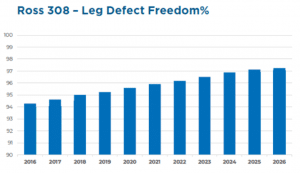
Fig. 4 percentage of Ross 308 chickens free of leg defects in the last years (Duggan et al., 2023)
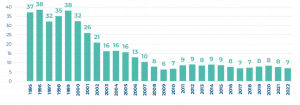
Fig. 5 Condemnation rates due to ascites in broiler chickens (related condemnation rates per 10 000 chickens) (Duggan et al., 2023)
Combating Breast Myopathies: Recent issues like white stripping, wooden breast, and spaghetti breast (linked to selection for growth rate and breast yield) are being addressed by integrating myopathy data into the balanced breeding program alongside growth and yield to reduce the genetic predisposition for these conditions (Kuttappan et al., 2015).
Conclusion
With the global population projected to grow 11% by 2032 and meat production expected to expand 15%—with poultry meat as the dominant sector, accounting for nearly half of the increase—the focus on sustainability and efficiency is paramount. Poultry is a more sustainable choice, and breeding efforts have already contributed to a 50% lower carbon footprint compared to the 1970 broiler. Furthermore, since most of this growth will occur in developing economies, future poultry crossbreds must be selected for high robustness and environmental adaptability to thrive in diverse production systems (Neeteson et al., 2023). This necessity for robust health is reinforced by the ongoing push to reduce antibiotic use, while market dynamics simultaneously demand that breeders respond to increasing consumer influence and welfare concerns by offering a broader portfolio, including specialized and slower-growing breeds.
Cited sources
Avendaño, S., Watson, K. A., & Kranis, A. (2012, August). Genomics in poultry breeding—Into consolidation phases. In Proceedings of the 24th World’s Poultry Congress, Salvador, Bahia, Brazil (pp. 5-9).
Burnside, T., & Neeteson, A. M. (2024). Developments in welfare of parent stock and commercial broilers. Poultry Science, 104732.
De Jong, I. C., & Guemene, D. (2011). Major welfare issues in broiler breeders. World’s Poultry Science Journal, 67(1), 73-82.
de Kinderen, M. A., Sölkner, J., Mészáros, G., Alemu, S. W., Esatu, W., Bastiaansen, J. W., … & Dessie, T. (2023). Genotype by environment interactions (G* E) of chickens tested in Ethiopia using body weight as a performance trait. Animals, 13(19), 3121.
Duggan, B., Ralph, J., Avenda˜no, S., Neeteson, A.M., Burnside, T.A., Koerhuis, A., 2023. Decades of Welfare and Sustainability Selection at Aviagen. Aviagen Group, Newbridge, UK. Accessed Oct. 2023. https://aviagen.com/assets/Welfare/AviagenDecades-of-WelfareReport_2023.pdf
Forseth, M., Toftaker, I., Moe, R. O., Kittelsen, K., & Eriksen, E. Ø. (2025). Foot pad dermatitis in broiler chickens-effects of hybrid and weather conditions. Preventive Veterinary Medicine, 106631.
Hartcher, K. M., & Lum, H. K. (2020). Genetic selection of broilers and welfare consequences: a review. World’s poultry science journal, 76(1), 154-167.
Hocking, P. M. (2010). Developments in poultry genetic research 1960–2009. British poultry science, 51(sup1), 44-51.
Jeyaruban, M. G., Gibson, J. P., & Gowe, R. S. (1995). Comparison of index selection and best linear unbiased prediction for simulated layer poultry data. Poultry science, 74(10), 1566–1576. https://doi.org/10.3382/ps.0741566
Kuttappan, V. A., Hargis, B. M., & Owens, C. M. (2016). White striping and woody breast myopathies in the modern poultry industry: a review. Poultry Science, 95(11), 2724-2733.
Neeteson, A. M., Avendaño, S., Koerhuis, A., Duggan, B., Souza, E., Mason, J., … & Bailey, R. (2023). Evolutions in commercial meat poultry breeding. Animals, 13(19), 3150.
Olkowski, A. A. (2007). Pathophysiology of heart failure in broiler chickens: structural, biochemical, and molecular characteristics. Poultry Science, 86(5), 999-1005.
Zuidhof, M. J., Schneider, B. L., Carney, V. L., Korver, D. R., & Robinson, F. E. (2014). Growth, efficiency, and yield of commercial broilers from 1957, 1978, and 2005. Poultry science, 93(12), 2970-2982.