The design of a modern house for fast-growing broilers is a set of linked numbers: floor area, stocking density, roof insulation, ventilation capacity and control. Cobb sets the maximum stocking density at 30 kg/m² (6.1 lb/ft²) in open-sided houses with natural ventilation and stir fans, and at 42 kg/m² (8.6 lb/ft²) in solid-wall tunnel houses with evaporative cooling (Cobb-Vantress, 2021). Ventilation capacity therefore decides how much live weight the same floor can carry. A sealed, well-insulated shell and enough fan capacity for hot weather keep that density safe for litter and birds. Automatic monitoring then confirms, flock after flock, that the building performs as planned.
Floor area and stocking density set the size
Size the floor from the output that ventilation can support. Divide the permitted live weight per square metre by the expected final bird weight, and the result is the number of birds the house can hold. Cobb gives 35 to 42 kg/m² (7.2 to 8.6 lb/ft²) for solid-wall houses with cross ventilation, foggers and directional perimeter inlets, and 39 kg/m² (8.0 lb/ft²) for tunnel ventilation with foggers (Cobb-Vantress, 2021).
A worked example shows how much the choice matters. The Cobb sample house measures 150 m by 14 m (492 ft by 46 ft), which gives 2,100 m² (22,600 ft²) of floor (Cobb-Vantress, 2021). At 30 kg/m² it holds 63,000 kg (139,000 lb) of live weight at the end of the cycle. At 42 kg/m² it holds 88,200 kg (194,000 lb), or 40% more from the same floor. Both totals are calculations taken from the Cobb figures.
Higher density has a price in the birds. In a trial with Ross 708 broilers reared to 34 days, footpad dermatitis affected 36.7% of birds at 41.5 kg/m² (8.5 lb/ft²) and 11.7% at 31 kg/m² (6.3 lb/ft²) when scored at 27 days, and infectious mortality between 21 and 34 days fell linearly as density fell (Shynkaruk et al., 2023). The authors add that density effects depend on how well the environment is managed.
Plan the floor in zones as well, because chicks do not need the whole house at first. Cobb advises that initial stocking in the brooding area should not exceed 50 to 60 birds/m² (0.18 to 0.22 ft² per bird) in winter and 40 to 50 birds/m² (0.22 to 0.27 ft² per bird) in summer, with access to the full house after 14 to 16 days (Cobb-Vantress, 2021).
Constructing a house for poultry: site, roof and airtightness
Siting and shell decide how much energy the building needs over its whole life. Cobb advises a well-drained site with plenty of air movement and an east-west axis, which reduces heat from direct sunlight in the hottest part of the day (Cobb-Vantress, 2021).
The roof comes first. Cobb calls roof design and insulation probably the most important part of the building and sets a minimum R-value of 20 to 25 in US units, depending on climate (about 3.5 to 4.4 m²K/W in SI units). A well-insulated roof cuts solar heat gain on warm days and heat loss in cold weather, above all during brooding (Cobb-Vantress, 2021). Cobb also lists a reflective roof surface, with a 1.5 m (4.9 ft) overhang, among the requirements for naturally ventilated houses (Cobb-Vantress, 2021). Where reflective materials are not practical, a white roof is an alternative.
Airtightness follows, because negative-pressure ventilation needs a sealed shell. Curtains must overlap a solid surface by at least 15 cm (5.9 in), be sealed at the base, and be repaired wherever holes or tears appear (Cobb-Vantress, 2021).
The heating system also belongs in the construction plan, because it changes house moisture. Unvented propane brooders release water vapour as they burn. In two experiments with 1,472 Ross 308 chicks each, birds in a room heated by an external heat exchanger had lower foot pad scores at 35 days than birds under radiant propane brooders (1.31 against 1.70 on a 0 to 3 scale; P = 0.0112), while overall performance did not differ (Ayres et al., 2025). The result comes from one site, so it supports a design preference, not a rule.
Controlling the climate through three ventilation stages
A house has to work in cold, mild and hot weather, so ventilation runs in stages. Minimum ventilation manages litter moisture and air quality on a timer cycle. Early in the cycle, house humidity can be low, and Cobb and Aviagen correct for it by raising the air temperature setting; as birds grow and release more moisture, minimum ventilation runs longer to remove it (Cobb-Vantress, 2021; Donald, 2009). Transition ventilation adds air exchange without strong air speed at bird level. Tunnel ventilation cools the flock by wind chill. The table gives the Cobb capacity guidelines for each stage (Cobb-Vantress, 2021).
| Stage | Main job | Capacity guideline |
|---|---|---|
| Minimum | Litter moisture and air quality in cold weather and brooding | 0.3 to 0.6 m³/min per m² of floor (1 to 2 cfm/ft²) |
| Transition | More air exchange and temperature control without high air speed | About 50% of tunnel capacity, or 1.7 to 1.85 m³/min per m² (5.6 to 6.1 cfm/ft²); air exchange every 2 to 3 minutes |
| Tunnel | Cooling in hot weather | 2.75 to 3.35 m³/min per m² (9.0 to 11.0 cfm/ft²); about 3 m/s air speed (600 ft/min) |
The Cobb sample house shows the tunnel arithmetic. Its cross-section is 14 m by 2.88 m (9.45 ft), or 40.32 m² (434 ft²). An air speed of 3 m/s needs 7,257 m³/min, which is 11 fans of 680 m³/min, and renews the 6,048 m³ of house air in 49 seconds, inside the 40 to 50 second target (Cobb-Vantress, 2021).
Chicks need a gentler programme. They cannot regulate body temperature during the first five days, and Cobb limits air speed at bird level to 0 to 0.3 m/s (0 to 59 ft/min) over that period (Cobb-Vantress, 2021).
Air quality limits give the targets: carbon dioxide below 3,000 ppm, ammonia below 10 ppm, relative humidity below 65% and oxygen above 19.6% (Cobb-Vantress, 2021). Evaporative cooling depends on outside conditions. In Cobb’s example for pads with 75% efficiency, air at 32 °C (89.6 °F) cools by about 9 °C (16 °F) when outside humidity is 30%, but by only 5 °C (9 °F) at 60%. Each 1 °C of cooling adds about 4.5% relative humidity, so house humidity reaches about 71% in the first case and 83% in the second. Pads should not run below 28 to 29 °C (82.4 to 84.2 °F), or when house humidity would exceed 85% (Cobb-Vantress, 2021).
Growth shows whether the climate plan works. Continuous flock-level weight data from an automatic scale gives coverage between manual checks, so a manager can compare growth before and after a change in ventilation settings.
Equipment fitted inside the house
Water comes first. Cobb notes that open bell or cup drinkers cost less but bring more problems with litter quality, condemnations and water hygiene than nipple systems. For nipples, it recommends 10 birds per nipple on low-flow systems (50 to 60 ml/min, or 1.7 to 2.0 fl oz/min) and 12 per nipple on high-flow systems with drip trays (80 to 90 ml/min, or 2.7 to 3.0 fl oz/min). Birds should not travel more than 3 m (9.8 ft) to find water (Cobb-Vantress, 2021).
For feed, pan feeders suit 45 to 65 birds per pan, depending on final bird size and density (Cobb-Vantress, 2021).
Lighting needs even distribution more than high output. Cobb prefers dimmable LED systems and asks for at least 25 lux at chick height in the darkest part of the house during brooding, with no more than 20% variation between the brightest and darkest floor positions. Intensity can fall to 5 to 10 lux once birds weigh 130 to 180 g (0.29 to 0.40 lb). Research cited by Cobb indicates that 6 hours of continuous darkness improves immune system development (Cobb-Vantress, 2021).
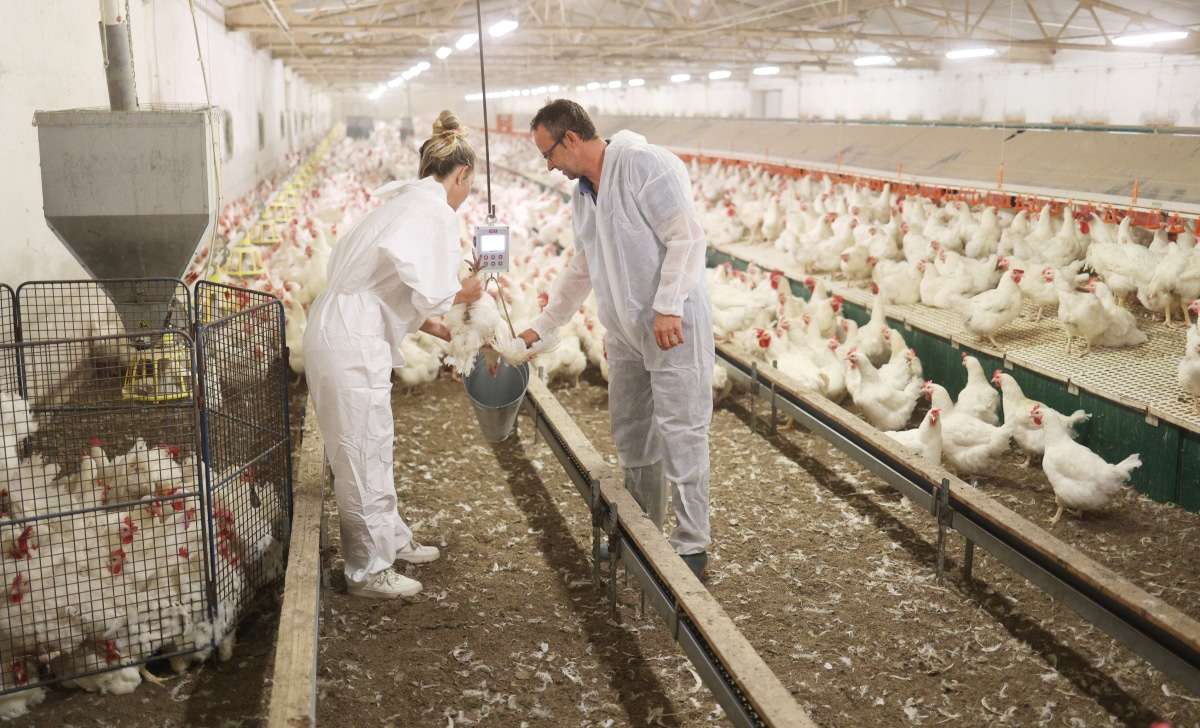
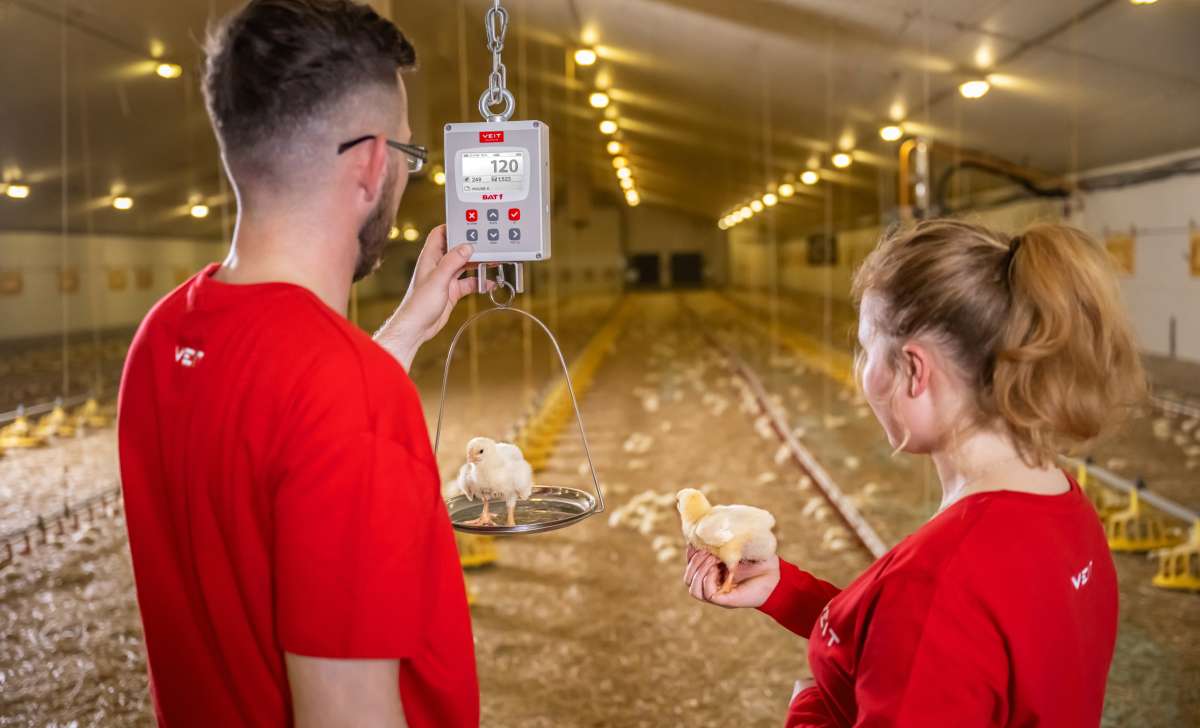
The lighting programme depends on bird weight. Cobb advises weighing at least weekly, on the days the programme is adjusted, and setting changes from the average weight (Cobb-Vantress, 2021). The BAT1 manual poultry scale supplies that weight, and it also records a fleshing score and the sex of each bird during weighing, so the same session gives hands-on information about condition.
Automating the house: controls, sensors and weight data
Automation links the stages above into one routine. A cycle timer runs minimum ventilation, then the thermostat overrides the timer and stages the transition fans. Cooling pumps should follow temperature and humidity limits, not a cycle timer, because frequent drying of the pads builds up scale. Feeder pans work best on an interval timer, and Cobb recommends a dawn-to-dusk dimming system where possible (Cobb-Vantress, 2021).
Weight is the measurement that links these settings to the result. The BAT2 Connect automatic poultry scale records flock-level average weights as birds step on voluntarily. It needs only mains power in the house, and it sends data by WiFi, 4G or ethernet, depending on the model. The power point and network route can go into the electrical plan during construction.
Manual and automatic weighing answer different questions. Hands-on weighing of individual birds is the only way to score fleshing and physical condition, and some farms use it as their sole weighing method. An automatic scale adds continuous coverage of flock-level averages.
BAT Cloud collects weights from BAT1 WiFi, from uploads of standard BAT1 data and from BAT2 Connect in one place. Because results from several flocks and seasons sit side by side, a manager can compare year on year how growth responds to choices made at the design stage, such as the heating system or the ventilation capacity. BAT2 Connect is MTech-ready, and other farm management systems can be connected using the integration guide.
References
- Ayres, V.E., Boltz, T.P., Bowen, K.M., Grushecky, S., Wang, J., Moritz, J.S. (2025). Applied research note: Heating system and feed additive effects on foot pad quality, broiler performance, and immune status. Journal of Applied Poultry Research, 34, 100557. https://doi.org/10.1016/j.japr.2025.100557
- Cobb-Vantress (2021). Cobb Broiler Management Guide. Cobb-Vantress, Inc., Siloam Springs, Arkansas. https://www.cobb-vantress.com/assets/Cobb-Files/045bdc8f45/Broiler-Guide-2021-min.pdf
- Donald, J.O. (2009). Environmental management in the broiler house. Aviagen, Inc. https://eu.aviagen.com/assets/Uploads/Environmental-Management-Broiler.pdf
- Shynkaruk, T., Long, K., LeBlanc, C., Schwean-Lardner, K. (2023). Impact of stocking density on the welfare and productivity of broiler chickens reared to 34 d of age. Journal of Applied Poultry Research, 32, 100344. https://doi.org/10.1016/j.japr.2023.100344