
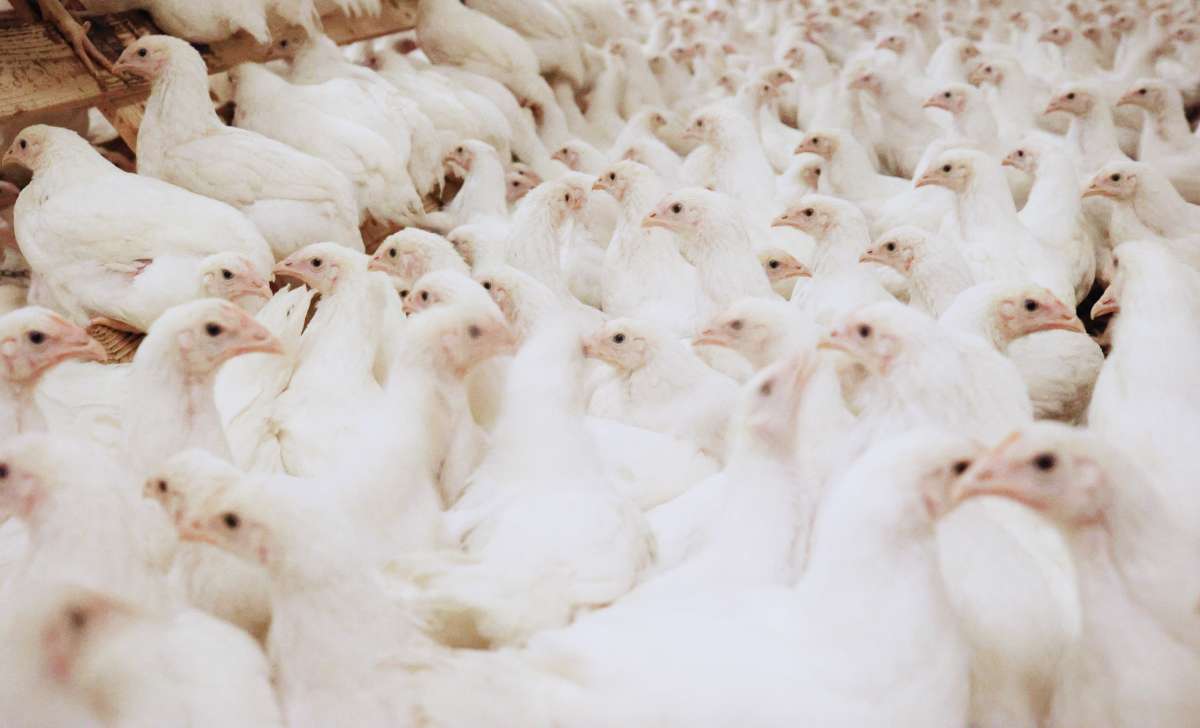
Gumboro disease, known clinically as infectious bursal disease (IBD), is a highly contagious viral infection that targets the bursa of Fabricius, the organ where young chickens build their antibody defences (WOAH, 2024). Left unmanaged, it undermines flock immunity long before visible illness appears. The question for producers is not whether to vaccinate, but how to time protection correctly and confirm it has worked.
Gumboro Disease: Causes and Transmission
The causative agent is an avibirnavirus that survives for months in litter and equipment, resisting many disinfectants (WOAH, 2024). Chickens spread it through faecal-oral contact, contaminated feed, or people and vehicles moving between houses. Susceptibility peaks at three to six weeks of age, though infection in younger birds often passes unnoticed while still damaging the bursa (WOAH, 2024).
Signs of Gumboro Disease in Chickens
Acute cases show a sudden drop in feed and water intake, watery diarrhoea, ruffled feathers, and birds huddling with beaks against the floor (WOAH, 2024). Subclinical infection in chicks under three weeks rarely shows symptoms, yet causes the most lasting damage: a weakened immune system that leaves flocks vulnerable to secondary infection (WOAH, 2024).
Because subclinical cases give so few outward clues, weight performance often signals trouble before plumage or droppings do. A Japanese field study found bursa-impacted broilers had reduced bursa-to-bodyweight ratios and slower growth from 21 days onward (Myint et al., 2021). Continuous live weight monitoring lets producers catch that early growth check well before condemnation figures confirm it at slaughter.
How to Prevent Gumboro Disease in Poultry
Prevention rests on biosecurity: cleaning and disinfection between flocks, all-in all-out placement, and controlled house traffic (WOAH, 2024). Breeder vaccination matters equally, since maternal antibodies protect chicks for their first two weeks, before their own immunity develops (Ceva Santé Animale, 2024).
Flock uniformity matters here too. Chronic stress alone reduces bursa size and slows immune development in broilers (Carvalho et al., 2025), so grading pullets for even body weight early in rearing, which lowers social stress within a flock, helps preserve immune capacity Gumboro will also be attacking. The BAT1 Sorting Machine supports that early grading, sorting pullets by live weight into more uniform cohorts.
Gumboro Vaccination Schedule: What Works
Live intermediate and intermediate-plus vaccines are timed to break through maternal antibody as it declines, since vaccinating too early leaves the vaccine neutralised (Sedeik et al., 2019). Immune-complex and HVT-vector formulations offer alternative routes to the same goal, with different effects on field virus shedding (Sedeik et al., 2019).
Confirming a vaccination programme has taken hold benefits from direct observation. Spot-checks with the BAT1 manual scale let staff assess bird condition and weight together, flagging pullets that lag after a dose.
Gumboro in Chicken Flocks: Reading the Growth Curve
The cost of unmanaged Gumboro is measurable. A five-year Canadian study found infected broiler flocks averaged 8.6 percent mortality and 1.5 percent condemnation, against 6.1 percent and 1.1 percent in clean flocks, with live weight per square metre at 37 days falling from 34.0 to 29.3 kilograms (Zachar et al., 2016).
No specific treatment exists for Gumboro, so biosecurity and vaccination remain the only levers. Weight tracking still matters, confirming whether they held. The BAT2 Connect automatic scale logs daily flock averages, showing how growth compares with the expected curve.
Hands-on flock weighing adds the individual-bird view flock averages cannot, confirming which pullets in an impacted group still lag.
Comparing those figures against previous cycles is easier with centralised weight records, which help producers judge whether a recurring dip signals a circulating field strain rather than a one-off event.
Gumboro control rests on three layers: biosecurity, vaccination timed against maternal antibodies, and vigilance, from diarrhoea and reduced water intake to daily weight data. None substitutes for the others.
References
Ceva Santé Animale (2024). Gumboro disease control: vaccination of the broilers. Poultry World. https://www.poultryworld.net/health-nutrition/health/gumboro-disease-control-vaccination-of-the-broilers/
Myint, O., Suwanruengsri, M., Araki, K., Izzati, U.Z., Pornthummawat, A., Nueangphuet, P., Fuke, N., Hirai, T., Jackwood, D.J., Yamaguchi, R. (2021). Bursa atrophy at 28 days old caused by variant infectious bursal disease virus has a negative economic impact on broiler farms in Japan. Avian Pathology, 50(1), 6-17. https://www.tandfonline.com/doi/full/10.1080/03079457.2020.1822989
Sedeik, M.E., El-Shall, N.A., Awad, A.M., Abd El-Hack, M.E., Alowaimer, A.N., Swelum, A.A. (2019). Comparative evaluation of HVT-IBD vector, immune complex, and live IBD vaccines against vvIBDV in commercial broiler chickens with high maternally derived antibodies. Animals, 9(3), 72. https://www.mdpi.com/2076-2615/9/3/72
WOAH (2024). Infectious bursal disease (Gumboro disease). Manual of Diagnostic Tests and Vaccines for Terrestrial Animals, Chapter 3.3.12. https://www.woah.org/fileadmin/Home/fr/Health_standards/tahm/3.03.12_IBD.pdf
Zachar, T., Popowich, S., Goodhope, B., Knezacek, T., Ojkic, D., Willson, P., Ahmed, K.A., Gomis, S. (2016). A 5-year study of the incidence and economic impact of variant infectious bursal disease viruses on broiler production in Saskatchewan, Canada. Canadian Journal of Veterinary Research, 80(4), 255-261. https://pmc.ncbi.nlm.nih.gov/articles/PMC5052876/