
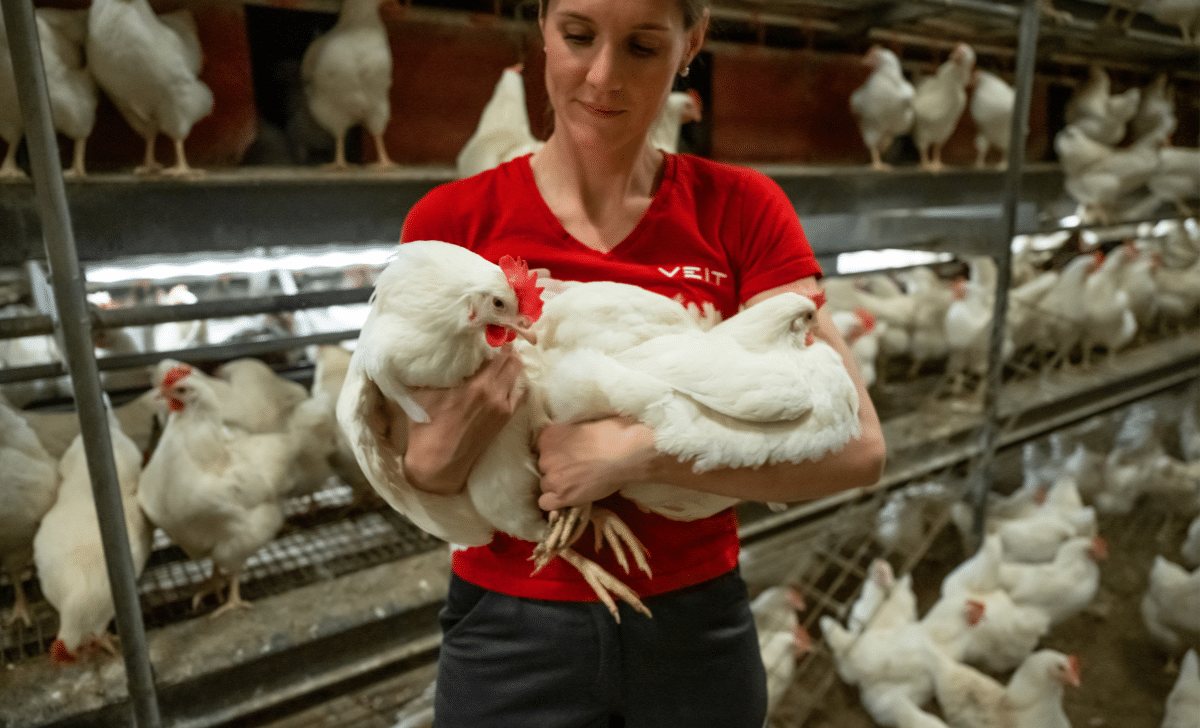
What a broiler breeder hen eats shapes far more than her own productivity. The nutrients she consumes are passed on to her eggs and, through those eggs, directly influence the health, growth rate, and carcass quality of the next generation. While the links between maternal nutrition and egg quality, fertility, and hatchability are well established, research into the “carry-over” effect on subsequent generations is a developing and increasingly important field.
Emerging evidence suggests that breeder diets do more than sustain the parent flock: they fundamentally shape chick quality and progeny performance. This article examines how specific nutritional strategies (optimizing energy-to-protein ratios, incorporating organic trace minerals) can enhance offspring growth, immunity, and carcass yield. By tracing the influence of maternal diets from the rearing phase through the laying period, it makes the case that breeder nutrition should be understood as the first step of broiler production, not merely a support function for egg output (Damaziak et al., 2021).
How Breeder Hen Nutrition Shapes Chick Quality
Producing high-quality day-old chicks is a multifaceted challenge. The hen’s physiological condition, hatchery management practices, and environmental stressors all play a role, but at the center of this process is the transfer of nutrients from the breeder to the egg. For the developing embryo, the egg is the only source of sustenance, making the nutritional composition of that egg a critical determinant of what the chick will become.
That transfer, however, is often compromised by poor flock uniformity, inconsistent feed allocation, or premature photo-stimulation. Research consistently shows that the age and physical maturity of the breeder flock are among the strongest predictors of offspring performance. Eggs from younger flocks tend to have a lower yolk-to-albumen ratio and a smaller fat content, resulting in chicks with significantly lower final body weights compared to those hatched from older, more mature breeders (Gregrova et al., 2024). While the roles of incubation practices and breeder genotype are increasingly well understood, data on how specific maternal protein and energy levels affect progeny remains sparse, a gap that grows more pressing as modern genotypes continue to evolve.
Key Nutritional Factors and Their Effects on Progeny
Protein Intake and Egg Quality
Getting protein levels right is a careful balancing act: too little, and egg size and bird weight suffer; too much, and other problems emerge. Research by Lopez and Leeson (1995) found no negative impact on fertility across a wide range of crude protein levels, from 10% to 16%. However, diets at the low end (around 10% crude protein) significantly reduced both bird weight and egg size, ultimately producing smaller day-old chicks. The downstream effect is substantial: a 2-gram increase in egg weight produces a 1.5-gram heavier day-old chick, which translates to a 100–150 gram increase in broiler body weight by 42–45 days of age (Joseph et al., 2000). Those numbers add up quickly at commercial scale.
Weight Control and Hatchability
Excessive weight gain in breeders after peak production (typically beyond 40 weeks) creates its own set of management problems, primarily through reduced fertility. Raising crude protein from 14.5% to 17.4% can increase daily body weight gain by 12% between 43 and 55 weeks of age (Mohiti-Asli et al., 2012), which may sound beneficial but risks compounding these issues. On the other end of the spectrum, when egg size exceeds 65 grams, hatchability begins to decline (Shafey, 2002). Precision, not maximization, is the goal.
Energy and Protein Balance
The ratio between energy and protein in the hen’s diet is one of the strongest predictors of chick size and eventual meat yield. High dietary energy (around 450 kcal ME/kg) significantly improves early growth and Day 41 carcass composition in male chicks when compared to low-energy diets (325 kcal ME/kg). Critically, the relationship is not linear: chick size is reduced whether the energy-to-protein ratio is too low (high protein relative to energy) or excessively high (Spratt and Leeson, 1987). This underscores the importance of managing both values together, not in isolation.
Low-Density Diets
Counterintuitively, reducing the energy density of breeder diets can improve certain aspects of progeny performance. Lowering metabolizable energy by 11–12% or 21–23% relative to standard density (2,600–2,800 kcal AME/kg) has been associated with higher day-old chick weights, improved liveweight at day 38 (particularly for 29-week-old breeders), and lower offspring mortality from 60-week-old parent stock. Diluting diets with 12% oat hulls has also been shown to improve litter quality and water intake behavior in offspring (Enting et al., 2007), a benefit that ripples through flock health and welfare.
Rearing Phase Growth Targets
The nutritional decisions made during the rearing phase carry long-term consequences. Van Emous et al. (2015) demonstrated that aiming for a higher growth pattern during rearing, targeting 2,400 g at 20 weeks rather than the standard 2,200 g, results in greater offspring bodyweight at day 34, higher fertility rates, and decreased embryonic mortality. Setting the right weight trajectory early in a pullet’s life, it turns out, is an investment in the generation that follows.
Dietary Lysine and Muscle Development
Lysine is the amino acid most directly linked to muscle growth, and its presence in the breeder diet casts a long shadow over how broiler offspring will develop. Chicks from young breeders (around 26 weeks) fed only 600 mg of lysine per bird per day showed lower body weights and reduced breast yield compared to those from better-nourished flocks (Mejia et al., 2013). A strong correlation between digestible lysine intake and offspring performance at day 21 has also been established (Ciacciariello et al., 2013). An important caveat: increasing feed allocation simply to boost egg production can inadvertently undermine offspring performance if the nutrient balance, particularly lysine, is not carefully maintained.
L-Carnitine and Carcass Quality
Supplementing parent flocks with L-carnitine, beginning at 21 weeks of age at an inclusion rate of 25 mg/kg, has been shown to improve the economic value of the progeny’s carcass. Offspring from supplemented hens had significantly higher breast meat yields and lower abdominal fat deposits (Kidd et al., 2005), a result with clear implications for profitability in breast-meat-focused markets.
Omega-3 Fatty Acids (n-3 PUFAs)
Supplementing breeder diets with long-chain omega-3 polyunsaturated fatty acids has been shown to yield meaningful reproductive improvements. PUFA supplementation improves both the number of eggs laid and overall fertilization rates, and because yolk composition is enhanced, embryos have access to a better fatty acid profile, potentially increasing hatchability and day-old chick quality (Koppenol et al., 2014).
There is, however, an important caveat. PUFAs are chemically unstable and highly susceptible to peroxidation, a breakdown process that generates harmful free radicals. To use PUFAs safely, both maternal and paternal diets must include adequate antioxidant supplementation to protect at three critical stages (Rocha et al., 2010):
– The integrity of sperm.
– The nutritional content of the yolk.
– The health of the neonatal chick.
Vitamins and Minerals: Building the Foundation for Progeny Health
Vitamin and trace mineral levels in breeder diets are critical not only for preventing embryonic deformities, but for maximizing the growth, skeletal health, and immune function of the offspring (Rebel et al., 2004).
Fat-Soluble Vitamins D and E
Vitamins D and E are the primary drivers of skeletal integrity and immune transfer from parent to chick. For Vitamin D3, supplementation between 2,800 and 3,500 IU/kg is recommended for optimal development (Atencio et al., 2006). Maternal levels of 2,000–4,000 IU/kg have been shown to maximize weight gain and reduce the incidence of tibial dyschondroplasia (a skeletal disorder) in chicks from young breeders (Atencio et al., 2005). The bioavailable form 25-OH-D3 is now recognized as superior to standard D3 for reducing embryo mortality and improving bone ash content.
For Vitamin E, a concentration of 100 IU/kg is the standard recommendation for optimal health (Cobb, 2025). Beyond its antioxidant role, Vitamin E facilitates the transfer of antibodies from parent to chick, making it essential for early immune function. Increasing vitamins E, K, and B by 20% above standard recommendations has been shown to reduce offspring mortality by 2.2% (Chang et al., 2016).
Essential Trace Minerals: Selenium, Zinc, and Manganese
The form in which trace minerals are delivered (organic versus inorganic) matters considerably for progeny outcomes.
For selenium, Zorzetto et al. (2021) found that supplementing diets with just 0.2 mg Se/kg of hydroxy-selenomethionine (OH-SeMet) outperformed 0.3 mg Se/kg of sodium selenite (SS) across multiple measures, despite providing 33% less total selenium by weight. The advantages included higher egg production in aging breeders (55–65 weeks), greater selenium content in eggs, improved eggshell strength, better hatchability, and measurably improved FCR in 520 chicks over a 41-day trial.
For zinc and manganese, organic forms offer similarly compelling benefits. Compared to their inorganic counterparts, organic Zn and Mn have been linked to improved progeny livability from hatch to day 34, higher breast meat yield, and stronger cellular immune function in early life (Virden et al., 2003). The message is consistent: bioavailability drives results.
The Often-Overlooked Role of Male Nutrition
Most of the research in this area focuses on the hen, but breeder male nutrition is equally important. Paternal energy and protein intake directly influence both fertility and the growth potential of the offspring. High-energy diets in males have been linked to significantly increased bodyweights in 6-week-old broilers (Attia et al., 1995), while inadequate feed allocation not only reduces male mating activity and fertility, but can result in a substantial 100-gram reduction in progeny bodyweight. To prevent these losses, breeder males should receive a minimum cumulative intake of 29,600 kcal of metabolizable energy and 1,470 g of crude protein across the rearing-to-production period (Romero-Sanchez et al., 2008).
Conclusion
Breeder nutrition, both maternal and paternal, is a primary determinant of embryo survival, chick quality, and final broiler performance. Its influence is most critical during periods of environmental stress or poor flock uniformity, when the nutritional “buffer” provided by the parent generation determines how resilient the offspring will be.
The implications for the industry are clear: breeder feeding can no longer be viewed simply as a means of sustaining egg production. It must be reframed as the first stage of broiler performance management. This shift requires precise control of energy-to-protein ratios, widespread adoption of bioavailable organic mineral sources, and further research into amino acid profiles and in ovo technologies, all with the goal of unlocking the full genetic potential of modern broiler lines.
References
Atencio, A., Edwards Jr, H. M., & Pesti, G. (2005). Effects of vitamin D3 dietary supplementation of broiler breeder hens on the performance and bone abnormalities of the progeny.
Poultry Science, 84(7), 1058–1068.
Atencio, A., Edwards Jr, H. M., Pesti, G. M., & Ware, G. O. (2006). The vitamin D3 requirement of broiler breeders.
Poultry Science, 85(4), 674–692.
Attia, Y. A., Burke, W. H., Yamani, K. A., & Jensen, L. S. (1995). Daily energy allotments and performance of broiler breeders.: 2. Females.
Poultry Science, 74(2), 261–270.
Chang, A., Halley, J., & Silva, M. (2016). Can feeding the broiler breeder improve chick quality and offspring performance?
Animal Production Science, 56(8), 1254–1262.
Ciacciariello, M., & Tyler, N. C. (2013). The effects of maternal dietary lysine intake on offspring performance to 21 days of age.
Journal of Applied Poultry Research, 22(2), 238–244.
Cobb (2025). Cobb500 Fast Feather Breeder Management Supplement. Available at: https://www.cobbgenetics.com/assets/Cobb-Files/Cobb500-Fast-Feather-Breeder-Management-Supplement.pdf
Damaziak, K., Musielak, M., Musielak, C., Riedel, J., & Gozdowski, D. (2021). Reproductive performance and quality of offsprings of parent stock of layer hens after rearing in open and closed aviary system.
Poultry Science, 100(2), 1120–1131.
Enting, H., Boersma, W. J. A., Cornelissen, J. B. W. J., Van Winden, S. C. L., Verstegen, M. W. A., & Van Der Aar, P. J. (2007). The effect of low-density broiler breeder diets on performance and immune status of their offspring.
Poultry Science, 86(2), 282–290.
Gregrova, M., Lichovníková, M., Foltyn, M., Tvrdon, Z., & Hampel, D. (2024). Interactions between broiler parent stock age and egg pre-incubation duration: effects on embryo development, hatchability, day-old chick weight, and yolk sac weight.
animal, 18(11), 101333.
Joseph, N. S., Robinson, F. E., Korver, D. R., & Renema, R. A. (2000). Effect of dietary protein intake during the pullet-to-breeder transition period on early egg weight and production in broiler breeders.
Poultry Science, 79(12), 1790–1796.
Kidd, M. T., McDaniel, C. D., Peebles, E. D., Barber, S. J., Corzo, A., Branton, S. L., & Woodworth, J. C. (2005). Breeder hen dietary L-carnitine affects progeny carcase traits.
British Poultry Science, 46(1), 97–103.
Koppenol, A., Delezie, E., Aerts, J., Willems, E., Wang, Y., Franssens, L., & Buyse, J. (2014). Effect of the ratio of dietary n-3 fatty acids eicosapentaenoic acid and docosahexaenoic acid on broiler breeder performance, egg quality, and yolk fatty acid composition at different breeder ages.
Poultry Science, 93(3), 564–573.
Lopez, G., & Leeson, S. (1995). Response of broiler breeders to low-protein diets.: 2. Offspring performance.
Poultry Science, 74(4), 696–701.
Mejia, L., McDaniel, C. D., Kidd, M. T., Lopez, K., & Corzo, A. (2013). Evaluation of carryover effects of dietary lysine intake by Cobb 500 broiler breeder hens.
Poultry Science, 92(3), 709–718.
Mohiti-Asli, M., Shivazad, M., Zaghari, M., Rezaian, M., Aminzadeh, S., & Mateos, G. G. (2012). Effects of feeding regimen, fiber inclusion, and crude protein content of the diet on performance and egg quality and hatchability of eggs of broiler breeder hens.
Poultry Science, 91(12), 3097–3106.
Rebel, J. M. J., Van Dam, J. T. P., Zekarias, B., Balk, F. R. M., Post, J., Flores Minambres, A., & Ter Huurne, A. A. H. M. (2004). Vitamin and trace mineral content in feed of breeders and their progeny: effects of growth, feed conversion and severity of malabsorption syndrome of broilers.
British Poultry Science, 45(2), 201–209.
Rocha, J. S. R., Lara, L. J. C., Baiao, N. C., Vasconcelos, R. J. C., Barbosa, V. M., Pompeu, M. A., & Fernandes, M. N. S. (2010). Antioxidant properties of vitamins in nutrition of broiler breeders and laying hens.
World’s Poultry Science Journal, 66(2), 261–270.
Romero-Sanchez, H., Plumstead, P. W., Leksrisompong, N., Brannan, K. E., & Brake, J. (2008). Feeding broiler breeder males. 4. Deficient feed allocation reduces fertility and broiler progeny body weight.
Poultry Science, 87(4), 805–811.
Spratt, R. S., & Leeson, S. (1987). Effect of protein and energy intake of broiler breeder hens on performance of broiler chicken offspring.
Poultry Science, 66(9), 1489–1494.
Van Emous, R. A., Kwakkel, R. P., Van Krimpen, M. M., Van Den Brand, H., & Hendriks, W. H. (2015). Effects of growth patterns and dietary protein levels during rearing of broiler breeders on fertility, hatchability, embryonic mortality, and offspring performance.
Poultry Science, 94(4), 681–691.
Virden, W. S., Yeatman, J. B., Barber, S. J., Zumwalt, C. D., Ward, T. L., Johnson, A. B., & Kidd, M. T. (2003). Hen mineral nutrition impacts progeny livability.
Journal of Applied Poultry Research, 12(4), 411–416.
Zorzetto, P. S., Araújo, C. S. D. S., Araújo, L. F., Roque, F. D. A., Granghelli, C. A., Leite, B. G. D. S., & Surai, P. F. (2021). Replacing dietary sodium selenite with a lower level of hydroxy-selenomethionine improves the performance of broiler breeders and their progeny.
Italian Journal of Animal Science, 20(1), 1749–1758.