The transition from a developing embryo to a functional chick in domestic chickens (Gallus gallus domesticus) represents one of the most critical and dynamic periods of avian development, characterized by profound physiological and metabolic shifts during the internal and external pipping stages. These milestones (Figure 1) mark the boundary between two distinct biological states: dependence on the egg’s finite internal resources, including yolk-derived nutrients and chorioallantoic gas exchange, and the emergence of an independent, air-breathing existence. As the embryo perforates the inner shell membrane to initiate pulmonary ventilation and then breaches the calcified shell, it undergoes a rapid systemic reorganization, including activation of thermoregulation and circulatory transition, that prepares the neonate to survive the immediate demands of the external environment (Ori, 2011).
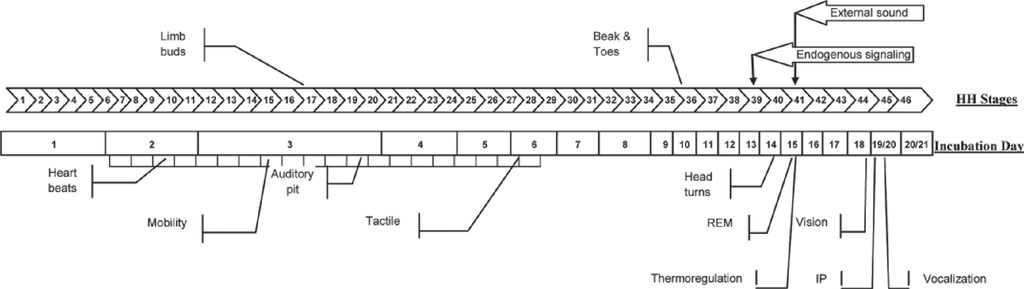
Figure 1. Timeline of major functional milestones in embryonic development. HH = Hamburger and Hamilton; REM: rapid-eye movement; IP: internal pipping (Tong et al., 2013).
1. Respiratory Transformation
The most significant change during pipping is the transition from membrane-based gas exchange to pulmonary (lung) respiration.
- Pre-Pipping Phase: Until approximately day 19, the embryo relies entirely on the chorioallantoic membrane (CAM) for oxygen exchange.
- Internal Pipping (IP): Around days 19–20 of incubation, the embryo uses its beak to pierce the inner air-space membrane, initiating pulmonary respiration (Tzschentke, 2008).
- Dual Respiration: From IP until hatching is complete, the chick relies on both the CAM and its lungs for oxygen. CAM contribution gradually declines as lung respiration increases 1.5- to 2-fold to compensate.
- External Pipping: The chick uses its egg tooth and hatching muscle to break through the eggshell, gaining direct access to atmospheric air and meeting the sharply increasing oxygen demands of the hatching process (Tong et al., 2013).
2. Metabolic and Thermoregulatory Shifts
Metabolism and heat production are closely tied to the embryo’s developmental stage and respiratory status.
- The Plateau Phase: Between days 17 and 19, embryonic growth slows and metabolic rate typically reaches a plateau (Janke et al., 2004).
- Post-Pipping Surge: Once internal pipping occurs and pulmonary respiration begins, heat production increases continuously until hatch, driven by rising oxygen consumption and metabolic activity (Sato et al., 2006).
- Thermoregulation Transition: The embryo’s thermoregulatory capacity matures progressively. By day 15, it operates as an open-loop system, reacting to temperature changes without feedback control. By day 20, it transitions to a closed feedback control system in which lung respiration, through adjustments in breathing rate and tidal volume, becomes more effective at regulating body temperature than heat production mechanisms alone (Tschentke et al., 2008).
3. Hormonal Drivers of Development
The endocrine system coordinates the complex shifts required for hatching, with thyroid and adrenal hormones playing central roles (McNabb, 2007).
- Thyroid Hormones: Plasma levels of thyroxine (T4) and triiodothyronine (T3) begin rising significantly around day 15 of incubation. T4 peaks during internal pipping and then declines, while T3 reaches its maximum during the hatch itself. Both hormones are essential for maturation and for stimulating the onset of lung respiration (Lu et al., 2007).
- Corticosterone (CORT): This adrenal hormone is detectable by day 10 and increases sharply around day 16. Elevated CORT levels, often triggered by the stress of the changing internal environment, such as hypoxia or elevated CO₂, help initiate the hatching process (Bossis and Porter, 2000).
4. Acoustic Communication and Synchronization
The final stages of development are marked by behaviors that help synchronize hatching within a clutch.
- Clicking Sounds: After penetrating the inner membrane at IP, embryos begin producing regular clicking sounds caused by the egg tooth tapping against the shell. These clicks are synchronized with breathing movements.
- Synchronization Mechanism: Embryos within a clutch can perceive these clicks and adjust their own rates, establishing a common rhythm that promotes hatching together (Reed and Clark, 2011).
- CO₂ Stimulation: Rising partial pressure of CO₂ in the air cell serves as a critical stimulus. High CO₂ concentrations during the hatching phase can trigger the embryo to begin pipping and emerging from the egg (Bruggeman et al., 2007).
5. Factors Directly Influencing the Pipping Process
Several endogenous and exogenous factors can influence the timing and success of pipping.
- Gas Environment (CO₂ and Oxygen): Rising partial pressure of CO₂ (pCO₂) in the air cell serves as a critical trigger for pipping and emergence. Hypoxic conditions (low oxygen) can stimulate CORT secretion, potentially advancing hatching time (Decuypere and Bruggeman, 2007).
- Acoustic Communication (Clicking): After internal pipping, embryos produce regular clicking sounds by tapping their egg tooth against the shell. Synchronized with breathing movements, these clicks allow embryos within a clutch to perceive each other and align their developmental rhythms, helping to synchronize the hatching window (Rumpf and Tschentke, 2010).
- Incubation Conditions: External factors such as temperature, humidity, and ventilation directly affect embryonic metabolic rate and heat production.
- Genetics: Different genetic strains, such as layers versus broilers, exhibit different heat production rates, which can affect the duration of developmental stages and overall hatching time (Tona et al., 2022).
Conclusion
The journey from internal pipping to a fully emerged chick is a sophisticated and tightly coordinated biological process. Understanding the key physiological markers, such as the T3 peak and the onset of pulmonary respiration, provides essential insights for both scientific research and practical hatchery management. The hatching window is not a fixed biological point but a flexible phase shaped by incubation conditions such as CO₂ levels and temperature. By aligning these external stimuli with the embryo’s own developmental milestones, hatchery managers can promote a synchronized, healthy hatch that supports uniform flock growth and performance.
Cited Sources
Bossis, I., & Porter, T. E. (2000). Ontogeny of corticosterone-inducible growth hormone-secreting cells during chick embryonic development. Endocrinology, 141(7), 2683–2690.
Bruggeman, V., Witters, A., De Smit, L., Debonne, M., Everaert, N., Kamers, B., … & Decuypere, E. (2007). Acid–base balance in chicken embryos (Gallus domesticus) incubated under high CO₂ concentrations during the first 10 days of incubation. Respiratory Physiology & Neurobiology, 159(2), 147–154.
Decuypere, E., & Bruggeman, V. (2007). The endocrine interface of environmental and egg factors affecting chick quality. Poultry Science, 86(5), 1037–1042.
Janke, O., Tzschentke, B., & Boerjan, M. (2004). Comparative investigations of heat production and body temperature in embryos of modern chicken breeds.
Lu, J. W., McMurtry, J. P., & Coon, C. N. (2007). Developmental changes of plasma insulin, glucagon, insulin-like growth factors, thyroid hormones, and glucose concentrations in chick embryos and hatched chicks. Poultry Science, 86(4), 673–683.
McNabb, F. A. (2007). The hypothalamic-pituitary-thyroid (HPT) axis in birds and its role in bird development and reproduction. Critical Reviews in Toxicology, 37(1–2), 163–193.
Ori, A. K. (2011). Review of the factors that influence egg fertility and hatchability in poultry. International Journal of Poultry Science, 10(6), 483–492.
Reed, W. L., & Clark, M. E. (2011). Beyond maternal effects in birds: responses of the embryo to the environment. Integrative and Comparative Biology, 51(1), 73–80.
Rumpf, M., & Tzschentke, B. (2010). Perinatal acoustic communication in birds: why do birds vocalize in the egg. Open Ornithology Journal, 3(1), 141–149.
Sato, M., Tachibana, T., & Furuse, M. (2006). Heat production and lipid metabolism in broiler and layer chickens during embryonic development. Comparative Biochemistry and Physiology Part A: Molecular & Integrative Physiology, 143(3), 382–388.
Tona, K., Voemesse, K., N’nanlé, O., Oke, O. E., Kouame, Y. A. E., Bilalissi, A., … & Oso, O. M. (2022). Chicken incubation conditions: role in embryo development, physiology and adaptation to the post-hatch environment. Frontiers in Physiology, 13, 895854.
Tong, Q., Romanini, C. E., Exadaktylos, V., Bahr, C., Berckmans, D., Bergoug, H., … & Demmers, T. (2013). Embryonic development and the physiological factors that coordinate hatching in domestic chickens. Poultry Science, 92(3), 620–628.
Tzschentke, B. (2008). Monitoring the development of thermoregulation in poultry embryos and its influence by incubation temperature. Computers and Electronics in Agriculture, 64(1), 61–71.