
Building a profitable poultry operation takes more than land and birds. Starting a chicken farm business at an industrial scale demands careful planning across site selection, biosecurity, nutrition, and flock data management. This guide covers key decisions that separate successful operations from early failures.
Poultry Farm Setup Guide: Site, Housing, and Biosecurity
Location is the first critical decision. Sites should be isolated from other poultry farms, rivers, and open water to limit disease exposure and wild bird contact (Cobb-Vantress, 2022). Each farm requires a perimeter fence with a locked gate, and housing should use concrete floors for effective cleaning and disinfection between flocks.
Biosecurity is non-negotiable. All-in, all-out management prevents multi-age flocks from sharing disease exposure. Dedicated equipment must be assigned to each age group and never moved between units. Personnel must change footwear between houses and follow strict protocols for off-farm bird contact (Cobb-Vantress, 2022).
Another important consideration is proximity to necessary infrastructure, such as hatcheries and slaughterhouses. The goal is to ensure that the production cycle can be repeated efficiently and reliably.
Feed Selection Is a Core Investment
Feed costs can represent up to 70% of total production costs in commercial operations (Alqaisi et al., 2017). A well-structured poultry farming business links feed formulation to breed and growth stage rather than sourcing the cheapest available mix.
Phase-feeding programs that adjust nutrient profiles across starter, grower, and finisher stages improve efficiency over two-phase approaches (Mehmood et al., 2014; Hauschild et al., 2015). Formulations must address the requirements of the genetic line: energy, amino acids, vitamins, and minerals (Cobb-Vantress, 2022).
Starting a Chicken Farm from Scratch: Equipment That Matters
A commercial farm requires feeding systems, drinkers, climate control, ventilation, and much more. This section focuses on weighing, one of the most consistently overlooked poultry farm investment requirements, though the full list of essential equipment is considerably longer.
Bodyweight data drives feed allocation, growth curve management, and flock uniformity, which the Cobb Breeder Management Guide targets above 70% from weeks 3 to 20.
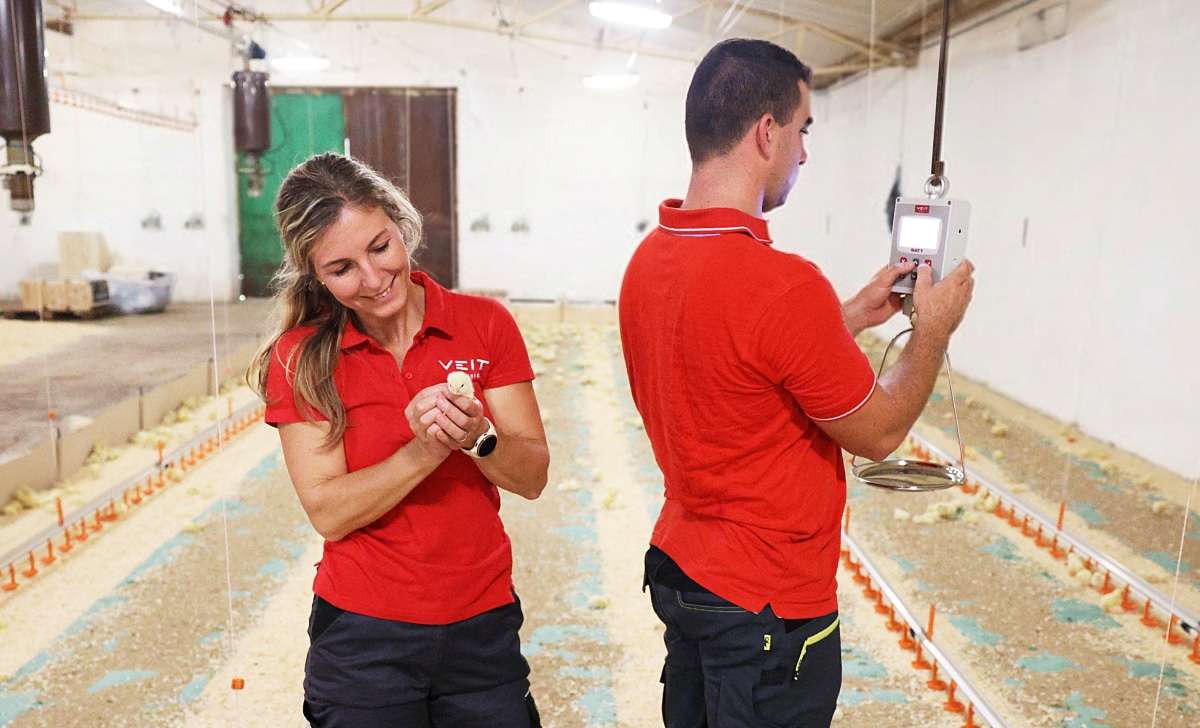
For scheduled manual sessions, the BAT1 manual poultry scale is built for live, moving birds, accurate to within 1g. Its internal computer records each weight automatically, calculates uniformity and coefficient of variation, and captures fleshing scores at a button press.
Farms requiring continuous coverage can deploy the BAT2 Connect automatic scale, which weighs birds around the clock without additional labor. Positioned one unit per 500 m² between feeders and drinkers, it feeds data into any farm management system or BAT Cloud in real time.
Flock Weight Data in a Commercial Poultry Business Model
A credible poultry business model requires weight monitoring beyond weekly snapshots. The Cobb guide recommends weighing no fewer than 2% of the flock to accurately estimate average bodyweight and uniformity.
For larger operations, automated daily weight recording provides flock-wide coverage between manual sessions. Research applying a BAT2 automatic scale in a commercial pullet program found consistent weight and uniformity tracking enabled early welfare interventions before problems escalated (Mels et al., 2023).
Individual bird handling during manual sessions provides something automated tools cannot: hands-on welfare assessment and the statistical integrity of weighing each bird separately. For those sessions, a scale purpose-built for live poultry remains among the most important instruments on the farm.
References
1.) Alqaisi, O., Ndambi, O. A., & Williams, R. B. (2017). Time series livestock diet optimization: cost-effective broiler feed substitution using the commodity price spread approach. Agricultural and Food Economics, 5(1), 25. https://doi.org/10.1186/s40100-017-0094-9
2.) Cobb-Vantress. (2021). Cobb Broiler Management Guide. Cobb-Vantress Inc. https://www.cobb-vantress.com
3.) Cobb-Vantress. (2022). Cobb Breeder Management Guide. Cobb-Vantress Inc. https://www.cobb-vantress.com
4.) Hauschild, L., Bueno, C. F. D., Remus, A., de Paula Gobi, J., Isola, R. D. G., & Sakomura, N. K. (2015). Multiphase feeding program for broilers can replace traditional system. Scientia Agricola, 72(3), 210–214. https://doi.org/10.1590/0103-9016-2014-0207
5.) Mehmood, S., Sahota, A., Akram, M., Javed, K., & Hussain, J. (2014). Growth performance and economic appraisal of phase feeding at different stocking densities in sexed broilers. Journal of Animal and Plant Sciences, 24(3).
6.) Mels, C., Niebuhr, K., Futschik, A., Rault, J.-L., & Waiblinger, S. (2023). Development and evaluation of an animal health and welfare monitoring system for veterinary supervision of pullet farms. Preventive Veterinary Medicine, 217, 105929. https://doi.org/10.1016/j.prevetmed.2023.105929