
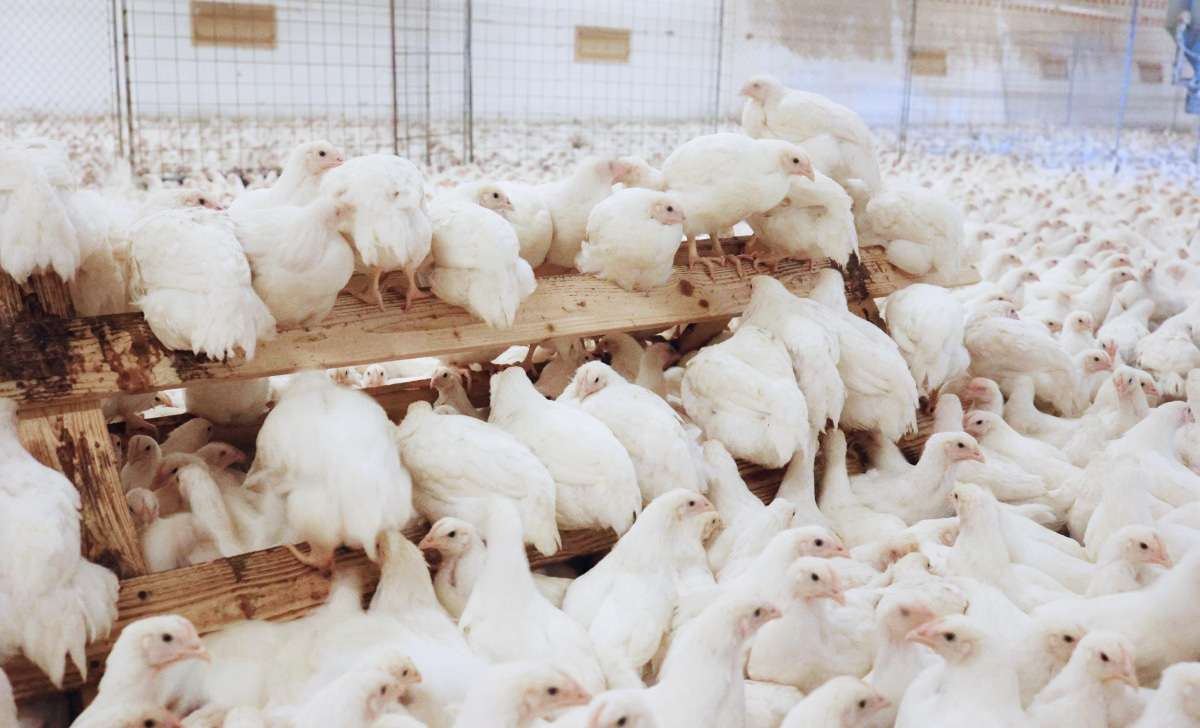
For small-flock keepers exploring chicken nesting box ideas, a standard coop nesting box should measure roughly 30 cm x 30 cm internally, with one box per four hens, mounted above roost height to prevent overnight roosting and soiled eggs. A raised instep retains bedding and gives hens the enclosed environment they seek.
Why Nesting System Design Matters in Commercial Production
At commercial scale, the stakes are considerably higher. Nesting is a behavioural priority for laying hens, not a preference: hens denied a suitable nest exhibit stereotypic pacing, extended searching, and reduced welfare (Cooper and Appleby, 1995). This recognition drove the development of enriched cages, which added a nest, litter, and perch to the otherwise barren conventional cage. Conventional cages remain the dominant system in regions where cage-free legislation has not taken effect (Guyonnet, 2022). A functional nest is now a regulatory baseline in most commercial production contexts.
Manual, Mechanical, and Community Nesting Systems
Commercial floor-based operations use one of three main poultry nesting systems, each suited to a different scale and housing type. Nest provision ratios are governed by local legislation that varies by jurisdiction: the EU Directive 1999/74/EC requires at least one nest per seven hens in alternative systems, while Cobb recommends one position per four hens in manual breeder houses (Cobb-Vantress, 2021; EU Directive 1999/74/EC, 1999). Producers should verify the applicable local standard.
Individual mechanical nests and community nest systems share a key defining feature: both integrate an egg collection belt that transports eggs away from the hens automatically, reducing contamination, breakage, and manual labour. Community units are positioned centrally with slats on either side. A 40 cm deep unit accommodates up to 230 females per unit across four entrance holes; a 45 cm deep unit serves up to 260 (Cobb-Vantress, 2021). Floor eggs are a risk specific to floor-based systems; in cage housing the sloped cage floor routes eggs directly onto the collection belt, eliminating this problem.
Nest Placement, Lighting, and Floor Egg Management
In floor-based systems, most out-of-nest eggs are deposited at first light, when hens compete for preferred positions (Hy-Line International, 2025). Uniform light distribution across the entire house is critical: hens actively seek dark, shadowed areas to lay, and any poorly lit corner or zone beneath aviary tiers becomes a de facto nesting site regardless of nest availability (Cobb-Vantress, 2021). Feed distribution shortly before lights-on directs hens toward feeders rather than litter, and keeping scratch area litter depth to no more than 2 to 3 cm at the onset of lay limits the formation of comfortable floor nesting sites.
Body Weight Uniformity and Nest Access
An underappreciated driver of floor egg rates is bodyweight variation within the flock. At the onset of lay, undersized pullets are often displaced from nest boxes by heavier dominant birds, pushing them onto the litter (Novogen, 2022). Regular weight monitoring during rearing is therefore a precondition for good nest use at the start of production.
The BAT1 manual poultry scale provides precise individual weight data alongside hands-on bird assessment each session, identifying uniformity problems while there is still time to adjust feed allocation before transfer.
For continuous coverage between manual sessions, automated daily weighing records weight trends without disturbing the flock during the critical pre-laying period. When variation widens, teams can cross-reference floor egg counts and weight data to isolate whether the cause is structural, nutritional, or social.
The BAT2 Connect automatic poultry scale and the BAT1 function as complementary layers of the same management system, not competing approaches.
Individual flock weighing data from manual sessions adds statistical integrity and welfare context that automated platforms cannot replicate.
Centralising records through the BAT Cloud data platform gives production managers a single view across houses and cycles, making patterns in floor egg rates and bodyweight performance visible before they compound into broader productivity losses.
References
1.) Cobb-Vantress. (2021). Cobb breeder management guide. Cobb-Vantress. https://www.cobb-vantress.com/assets/Cobb-Files/product-guides/656e79e68c/Breeder-Management-Guide.pdf
2.) Cooper, J. J., and Appleby, M. C. (1995). Nesting behaviour of hens: Effects of experience on motivation. Applied Animal Behaviour Science, 42(4), 283–295. https://www.sciencedirect.com/science/article/abs/pii/016815919400543N
3.) European Union. (1999). Council Directive 1999/74/EC of 19 July 1999 laying down minimum standards for the protection of laying hens. Official Journal of the European Communities, L 203, 53–57. https://eur-lex.europa.eu/legal-content/EN/TXT/?uri=CELEX:01999L0074-20191214
4.) Guyonnet, V. (2022). How laying hens are kept around the world. WATT Poultry. https://www.wattagnet.com/egg/egg-production/article/15535764/how-laying-hens-are-kept-around-the-world
5.) Hy-Line International. (2025). Understanding nesting behavior: Managing for fewer floor eggs in layers (Technical Update). https://hylinena.com/wp-content/uploads/2025/03/Tech-Update-HLNA-Nesting-Behavior57-2025-Update.pdf
6.) Novogen. (2022). Management of nesting behaviour in breeder flocks. Novocenter by Novogen Layers. https://novocenter.novogen-layers.com/experts-articles/management-of-nesting-behaviour-in-breeder-flocks/