
How Smart Scales Support Compliance
Whether triggered by routine scheduling or a specific concern, poultry farm inspections follow a broadly consistent pattern worldwide. Inspectors evaluate biosecurity protocols, environmental conditions, flock health indicators, and record keeping. Understanding these poultry inspection requirements is the first step toward passing every audit with confidence.
What Do Inspectors Check on Poultry Farms?
Regulatory visits typically cover several core areas. Biosecurity checklists assess access controls, cleaning and disinfection procedures, pest management, and personnel hygiene (Delpont et al., 2023). Environmental parameters such as temperature, humidity, ammonia levels, and stocking density are verified against legal thresholds set by frameworks like EU Directive 2007/43/EC (European Commission, 2007). In the United States, FSIS inspection teams focus on processing plant food safety, HACCP compliance, and pathogen sampling (USDA FSIS, 2024).
At the farm level, animal welfare protocols require the assessment of mortality rates, feather condition, gait scoring, footpad health, as well as any other visual signs of injury or illness (Butterworth et al., 2009). Critically, body weight and flock uniformity are among the most objective indicators veterinarians and auditors rely on for poultry compliance monitoring (Mels et al., 2023). These data points reveal whether nutrition, health, and management are on track.
Why Weight Data Matters for Regulatory Compliance
Flock weight is not just a production metric. It directly reflects welfare status. Sudden drops in average weight can signal disease, feed quality issues, or environmental stress, all of which inspectors are trained to identify (Castro et al., 2023). The Welfare Quality® protocol and national self-monitoring guidelines both list body weight and uniformity as essential indicators during veterinary visits (Knierim et al., 2020).
Manual weighing remains an irreplaceable part of effective poultry management. Scheduled sessions with a reliable scale like the BAT1 manual poultry scale give farm staff direct, hands-on contact with the birds while capturing precise individual weights. Researchers at the University of Camerino used the BAT1 to weigh 200 birds per house each week, calculating uniformity and feed conversion across full production cycles (Galosi et al., 2023). No farm should operate without this foundation.
The challenge is that manually weighing entire flocks at high frequency is not economically feasible. Between scheduled sessions, automated poultry weighing systems bridge the gap by providing continuous flock-level insights.
How Smart Weighing Scales Fill the Gaps Between Manual Sessions
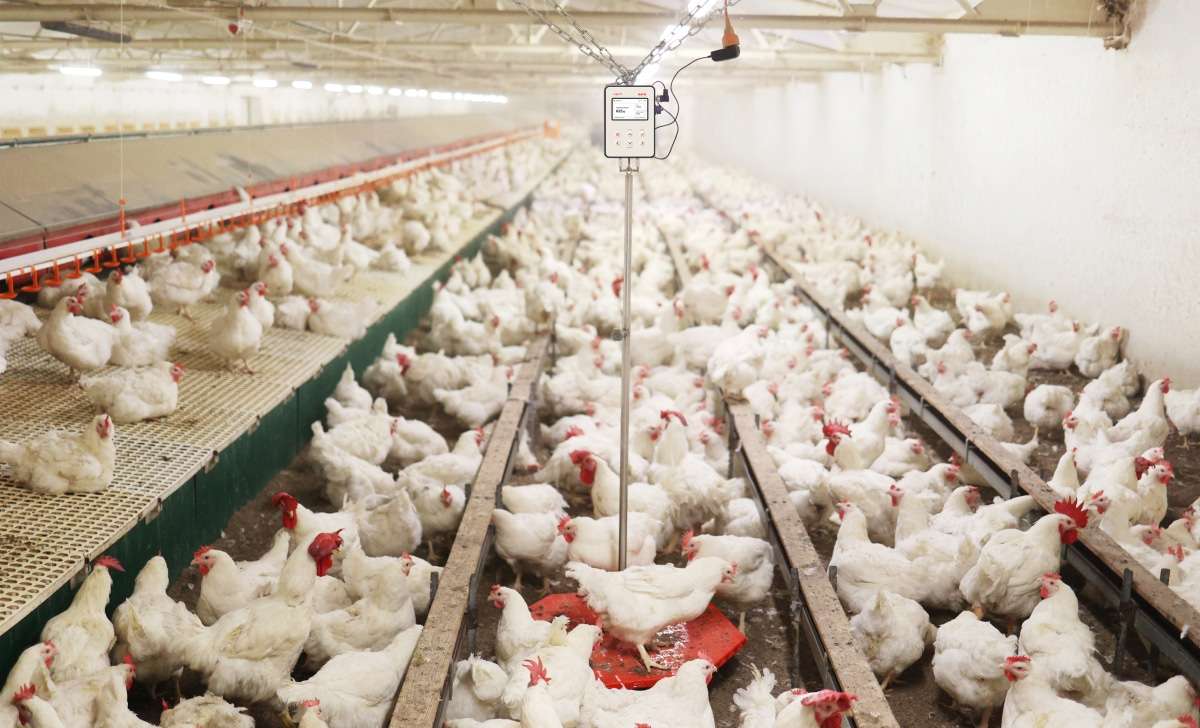
The BAT2 Connect automatic poultry scale records live weights around the clock, automatically calculating flock averages and uniformity between manual weighing events. In a study of 100 pullet flocks across Austrian farms, veterinarians relied on the BAT2 automatic scale to track body weight and uniformity at routine visits, with 500 to 3,000 individual weighings captured per day (Mels et al., 2023). That depth of daily data transforms a periodic inspection snapshot into a verifiable growth history.
Because the data transfers in real time via WiFi or 4G, farm managers and auditors can review digital weighing solutions remotely through BAT Cloud or integrated management platforms. This supports poultry farm regulatory compliance by creating a transparent, tamper-resistant audit trail. When an inspector asks for weight records between scheduled weighing sessions, the answer is already documented.
Together, accurate hands-on weighing and continuous automated flock monitoring form a complete poultry quality control system. One gives you precision and bird-level detail. The other gives you daily coverage across the entire flock.
Turning Inspection Readiness into Daily Practice
The most inspection-ready farms are not scrambling before an audit. They combine regular manual weighing with smart scales for poultry that capture performance data every day in between. This layered approach turns compliance monitoring from a periodic event into continuous oversight. Combined with proper biosecurity and environmental management, that unbroken record of flock weight ensures that when inspectors arrive, the data speaks for itself.
References
Butterworth, A., Blokhuis, H., Jones, B., Sherwin, C., Velarde, A., & Weeks, C. (2009). Welfare Quality® Assessment Protocol for Poultry. Welfare Quality Consortium. https://edepot.wur.nl/233471
Castro, F. L. S., Chai, L., Arango, J., Owens, C. M., Smith, P. A., Reichelt, S., DuBois, C., & Menconi, A. (2023). Poultry industry paradigms: connecting the dots. Journal of Applied Poultry Research, 32(1), 100310. https://doi.org/10.1016/j.japr.2022.100310
Dawkins, M. S., Donnelly, C. A., & Jones, T. A. (2004). Chicken welfare is influenced more by housing conditions than by stocking density. Nature, 427(6972), 342–344. https://doi.org/10.1038/nature02226
Delpont, M., Salazar, L. G., Dewulf, J., Zbikowski, A., Szeleszczuk, P., Dufay-Lefort, A.-C., Rousset, N., Spaans, A., Amalraj, A., Tilli, G., Piccirillo, A., Devesa, A., Sevilla-Navarro, S., van Meirhaege, H., Kovács, L., Jóźwiak, Á. B., Guérin, J.-L., & Paul, M. C. (2023). Monitoring biosecurity in poultry production: an overview of databases reporting biosecurity compliance from seven European countries. Frontiers in Veterinary Science, 10, 1231377. https://doi.org/10.3389/fvets.2023.1231377
European Commission. (2007). Council Directive 2007/43/EC laying down minimum rules for the protection of chickens kept for meat production. Official Journal of the European Union, L 182, 19–28. https://eur-lex.europa.eu/eli/dir/2007/43/oj
Galosi, L., Falconi, R., Biagini, L., Corrales Barrios, Y., & Roncarati, A. (2023). LED Light Applied to the Feeder: Impact on Growth Performances of Chickens under Productive Conditions. Veterinary Sciences, 10(4), 306. https://doi.org/10.3390/vetsci10040306
Knierim, U., Gieseke, D., Michaelis, S., Keppler, C., Spindler, B., & Rauch, E. (2020). Assessment of animal welfare in broiler fattening: a framework for a self-monitoring tool used in Germany. Berliner und Münchener Tierärztliche Wochenschrift, 133. https://doi.org/10.2376/1439-0299-2020-1
Mels, C., Niebuhr, K., Waiblinger, S., Bartussek, H., & Winckler, C. (2023). Animal welfare monitoring in pullet rearing: Variability in body weight, uniformity and mortality and potential influencing factors. Preventive Veterinary Medicine, 217, 105929. https://doi.org/10.1016/j.prevetmed.2023.105929
USDA FSIS. (2024). Inspection of Poultry Products. U.S. Department of Agriculture, Food Safety and Inspection Service. https://www.fsis.usda.gov/inspection/inspection-programs/inspection-poultry-products