
Correct egg incubation temperature is the single most critical variable in artificial hatching. Chicken embryos are poikilothermic, meaning their metabolic development relies entirely on surrounding heat (Yalcin et al., 2022). Even brief deviations of one degree can disrupt development, reduce hatch rates, or produce weak chicks. Humidity matters equally: too little causes excessive moisture loss through the shell; too much restricts air cell development and prevents correct hatching position.
Chicken Egg Incubation Temperature and Humidity
A forced-air setter should maintain 37.5 to 38°C (99.5 to 100°F) throughout the first 18 days of chicken egg incubation. Relative humidity during the setter phase should be 55 to 60 percent (MSU Extension, 2004). They spend the final three days in a hatcher with a lower temperature (36.1 to 36.7°C) and a higher humidity (65 to 75%). This softens the shell membrane and supports a clean hatch (Agriculture.Institute, 2026). The complete incubation period for chickens is 21 days.
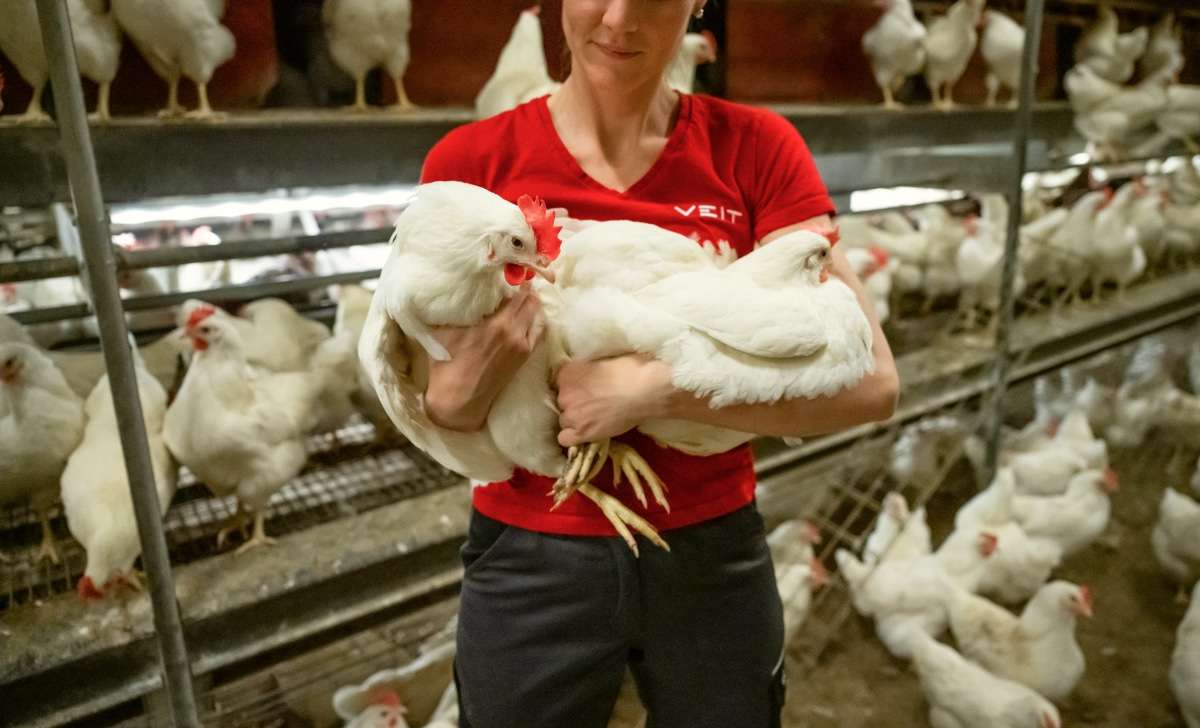
For commercial broiler breeder operations, consistent flock bodyweight through the lay period affects egg size and shell thickness, both influencing moisture loss during incubation. Monitoring live weight with the BAT2 Connect automatic poultry scale gives production teams a continuous daily record, enabling early detection of weight deviations before they affect hatch quality.
Turkey Egg Incubation Temperature and Humidity
Turkey egg incubation temperature follows the same requirement as chickens: 37.5°C (99.5°F) in a forced-air incubator (MSU Extension, 2004). The incubation period extends to 28 days. Relative humidity from day one through day 25 should be 55 to 60 percent, rising to 65 to 70 percent during lockdown (Farmkeep, 2024). Turkey poults are especially temperature-sensitive near hatch, and some commercial programs avoid humidity sprays in the hatcher to prevent evaporative cooling (Petersime, 2020). Weight and uniformity data from breeder turkey flocks logged through automated daily weighing in the BAT Cloud data platform supports hatchery planning across production cycles.
Duck and Goose Egg Incubation Temperature and Humidity
Duck egg incubation temperature requirements closely match chickens at 37.5°C, but humidity requirements are meaningfully higher. Standard breeds need 28 days; Muscovy ducks require 35 to 37 days. Humidity should be 55 to 60 percent, rising to 70 to 80 percent at hatching (K-State Extension, n.d.). Because these requirements are incompatible with chicken or turkey settings, waterfowl eggs should not be set in the same incubator. Goose egg incubation temperature runs at 37.2 to 37.5°C (99 to 99.5°F) for 28 to 34 days, with some programs recommending gentle misting twice weekly through day 25 (K-State Extension, n.d.).
Quail Egg Incubation Temperature and Humidity
Quail egg incubation is the fastest among common commercial species. Coturnix quail eggs hatch in 17 days at 37.5°C, with humidity at 45 to 55 percent for days one through 14 and 65 to 70 percent for lockdown (Dantcheva et al., 2023).
Peacock Egg Incubation Temperature and Humidity
Peafowl egg incubation spans 28 to 30 days at 37.5°C (99.5°F), with humidity at 55 to 60 percent until day 25, then raised to 65 to 70 percent for hatching (United Peafowl Association, n.d.).
Why Breeder Flock Bodyweight Matters for Hatch Quality
For chicken and turkey breeder operations specifically, flock bodyweight uniformity during the laying period determines egg size consistency. When hens vary significantly in body weight, they lay eggs of different sizes. Egg size drives variation in embryonic development rate and hatching time within the same set, producing an undesired spread of day-old chick weights and poor uniformity from placement onward. Using the BAT1 manual poultry scale for individual bird assessments during the breeding season lets producers detect weight deviations early and correct feeding before size variation compounds at the hatchery.
Between manual sessions, continuous flock weight data from the breeder house provides population-level coverage across the lay period.
Individual bird weighing also captures fleshing scores and behavioral cues that automated systems cannot replicate, giving managers the per-bird resolution needed to fine-tune feeding decisions.
References
1.) Agriculture.Institute (2026). Incubation and hatching: Critical requirements for setter and hatcher phases. https://agriculture.institute/poultry-housing-and-management/incubation-hatching-requirements-setter-hatcher/
2.) Dantcheva, P., Milanova, A., Yotova, I., & Hristova, S. (2023). Effects of long-term storage on hatchability and incubation length of game farmed quail eggs. Animals, 13(13), 2117. https://pmc.ncbi.nlm.nih.gov/articles/PMC10340007/
3.) Farmkeep (2024). Hatching turkey eggs and the incubation process. https://www.farmkeep.com/farm-guides/care/hatching-turkey-eggs
4.) Kansas State University Extension (n.d.). Incubation and reproduction. Department of Animal Sciences and Industry. https://www.asi.k-state.edu/extension/poultry/frequently-asked-questions/incubation-and-reproduction.html
5.) Mississippi State University Extension Service (2004). Important incubation factors. https://extension.msstate.edu/agriculture/livestock/poultry/important-incubation-factors
6.) Petersime (2020). The specific requirements and sensitivities of turkey egg incubation. https://www.petersime.com/expertise/the-specific-requirements-and-sensitivities-of-turkey-egg-incubation
7.) United Peafowl Association (n.d.). Artificial incubation of peafowl eggs. https://unitedpeafowlassociation.org/articles/artificial-incubation-of-peafowl-eggs/
8.) Yalcin, S., Özkan, S., & Shah, T. (2022). Incubation temperature and lighting: Effect on embryonic development, post-hatch growth, and adaptive response. Frontiers in Physiology, 13, 899977. https://www.frontiersin.org/journals/physiology/articles/10.3389/fphys.2022.899977/full