Poultry weighing scales are chosen by matching the weighing method to the flock and to the decision the weights must support. Three questions settle most of it: how accurate the scale is at your birds‘ weights, how many birds it covers, and where the data goes afterwards. Cobb specifies hand-weighing scales for breeders at a capacity of up to 5 kg (11 lb) and an accuracy of ±20 g (0.7 oz), with 3 to 5% of the flock weighed from three weeks of age (Cobb-Vantress, n.d.). Manual and automatic weighing serve different purposes: manual scales assess individual birds in hand, while automatic scales monitor the flock around the clock and report the statistics. The sections below show how to weigh up each option and where it earns its cost.
Start with the decision the weights feed
Feed allocation, grading and sale timing all start from weight data. Cobb notes that accurate feed amounts can only be set if bodyweight is measured accurately every week (Cobb-Vantress, n.d.). That makes the first question practical: do you need the flock average, the spread around it, or both? The coefficient of variation (CV) and uniformity are the two common measures of how weights are spread across a flock. Uniformity is the share of birds within 10% of the mean weight, and in commercial broiler flocks it typically reaches about 90% between days 14 and 49 (Choi et al., 2026). A scale worth considering calculates average weight, CV and uniformity itself.
Flock type narrows the field. In breeder flocks males and females are sampled at different rates, and Cobb recommends weighing 3% of the females and 10% of the males, or at least 50 birds (Cobb-Vantress, n.d.). Scales for broiler flocks have to deliver useful weights within a cycle that typically ends between four and eight weeks of age (Choi et al., 2026). Pullets and layers sit between the two: the flock average guides feeding, and the spread decides whether grading is needed.
How accurate the scale needs to be
Scale accuracy is the first figure to ask for, and it should be stated at the weights of your own birds. Cobb’s benchmark for hand weighing breeders is ±20 g (0.7 oz) with regular calibration, and it favours electronic scales that keep a record of each weight, because this reduces human error (Cobb-Vantress, n.d.). Resolution is a separate figure. The BAT2 Connect, for example, resolves weights to 1 g (0.002 lb).
Accuracy also depends on how the sample is taken. Cobb advises catching pens at the front, middle and back of the house, and warns against placing one near the main hopper, because birds there weigh above average from eating (Cobb-Vantress, n.d.). In one Cobb example, hand weights taken near the feed hopper at 16 and 17 weeks ran above the readings of a fixed automatic scale, and the gap closed when hand weighing moved next to the scale (Cobb-Vantress, n.d.).
Ask every supplier what accuracy it states for your bird weights, whether weighing is its main business, and which customers weigh flocks like yours. A practical observation, not research-confirmed: these answers come more readily from a supplier whose main business is poultry weighing than from one that sells scales as an add-on to a wider system.
Manual scales for individual birds
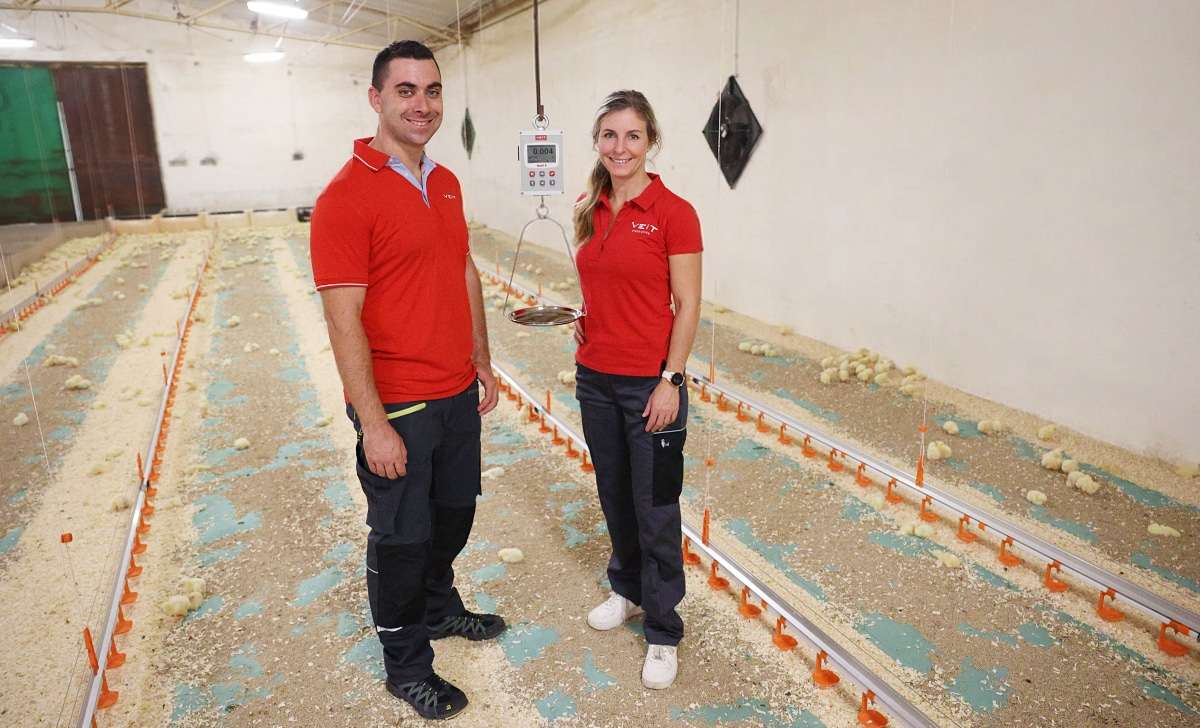
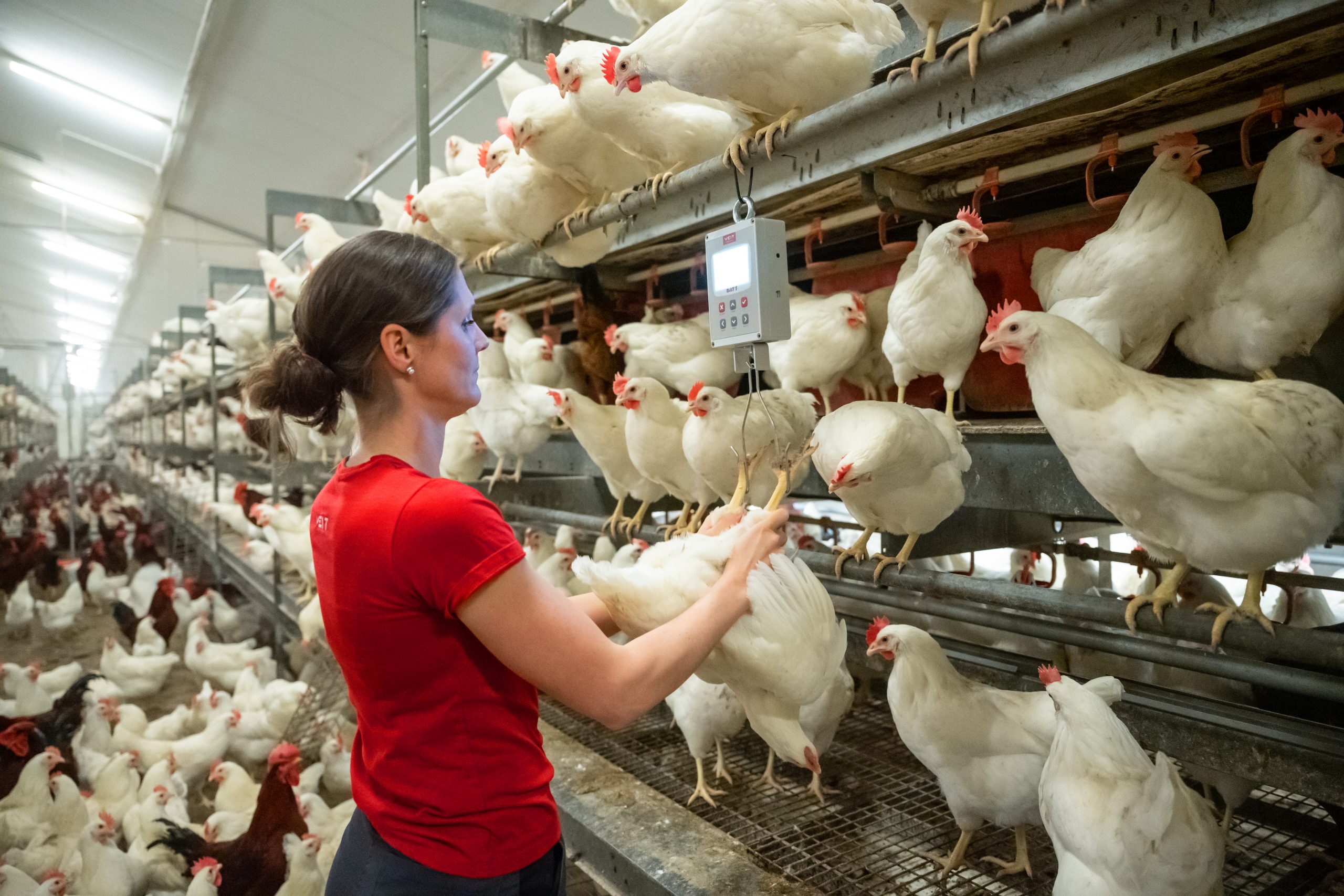
The BAT1 manual poultry scale is a lightweight, battery-powered digital scale that one person can carry between houses. It records a fleshing score on a 1 to 5 scale and the sex of each bird alongside the weight, and it calculates average weight, CV and uniformity on the unit. Some farms weigh entire flocks with several BAT1 scales and rely on manual weighing as their main method.
Individual weights show what an average hides. In a study of 7,708 laying hens, each hen was leg-banded and weighed on BAT1 manual scales at 16, 22 and 74 weeks (Sibanda et al., 2020). Hens grouped by their weight at 74 weeks were already 0.126 kg (0.28 lb) apart at 16 weeks, and the lightest and heaviest quarters differed by 0.422 kg (0.93 lb) by 74 weeks. In the lightest quarter, 90.0% of hens had ovaries in full follicle production, against 94.7% in the medium group and 95.3% in the heaviest quarter (Sibanda et al., 2020). Only weighing by hand identifies the birds behind an average, and it allows a hands-on check of condition at the same time.
Hand weighing also covers males. Cobb lists unsuitability for males among the limits of automatic scales, which is why breeder programmes keep weighing males by hand (Cobb-Vantress, n.d.).
Automatic systems that weigh birds without handling them
The BAT2 Connect automatic scale is a platform that birds step on voluntarily. It runs around the clock without an operator and reports flock-level averages. It cannot identify or flag individual birds. Systems that weigh poultry automatically trade that detail for coverage and continuity: Cobb lists daily weights, more consistent data than hand weighing, and less labour among their advantages, with fewer people entering the house as a biosecurity gain (Cobb-Vantress, n.d.).
It also reports daily gain, histograms and the difference from the standard growth curve. Manufacturer guidance is one scale for every 500 m² (5,382 ft²) of floor, placed between feeders and drinkers.
An automatic scale is a significant capital investment, so it should answer a specific need: a daily trend across several houses, weights from remote sites, or fewer visits into the flock. Cobb adds two separate limits for breeders. Automatic scales are not suitable for males. For females, they keep good accuracy only until about 30 to 35 weeks of age, because heavier females tend to avoid them after peak production (Cobb-Vantress, n.d.).
Connectivity and where the data ends up
The BAT2 Connect sends data by WiFi, 4G or ethernet, depending on the model, so wireless data transfer reaches houses that sit far from the office. It is MTech-ready and integrates with other farm management systems, with support from the BAT team where needed, so the scale delivers every weight straight to your farm management system without anyone copying figures by hand.
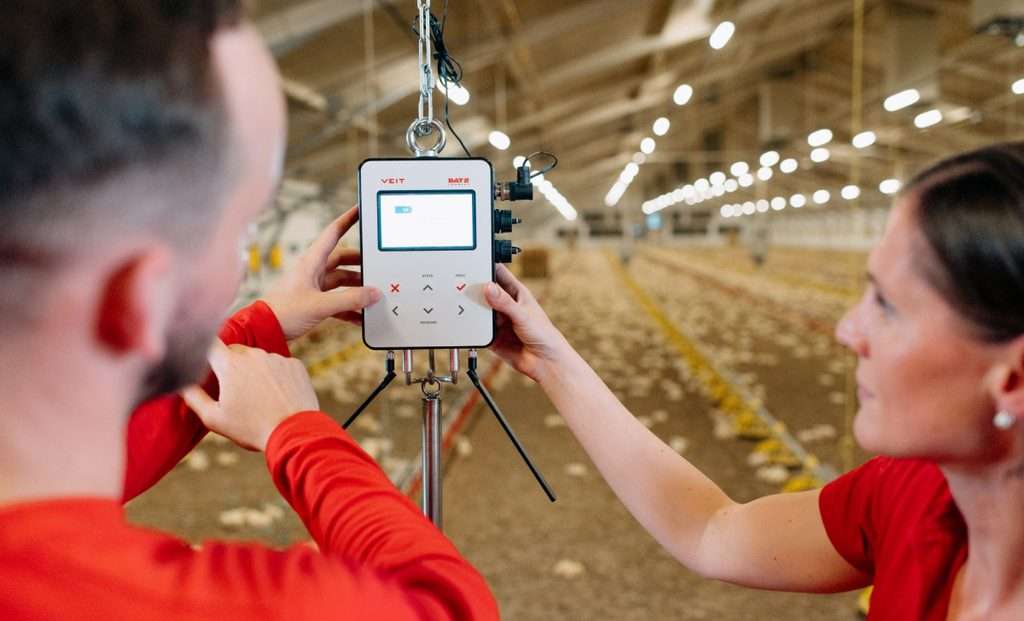
On the manual side, BAT1 WiFi is a separate model that sends weights across the farm network. A standard BAT1 passes its data on by upload from a PC. BAT Cloud takes the data from BAT1 WiFi, from a standard BAT1 and from the BAT2 Connect, which makes monitoring flock weights remotely possible and lets you compare farm performance over time, including year on year.
Weight grading in breeder, pullet and layer flocks
Grading starts from a sample. Cobb recommends weighing 3 to 5% of the flock before grading, even where automatic scales are installed, and setting cut-off weights from the sample’s average and standard deviation (Cobb-Vantress, n.d.). That makes a scale that calculates average weight and CV on the unit the natural starting point.
Cobb reports uniformity above 90% in sorted groups, a return to a typical 70 to 72% as the pecking order re-forms, and a further grading when uniformity falls to 65% or below (Cobb-Vantress, n.d.). Farms that grade know this, so the obstacle is the work. Practical observation, not research-confirmed, suggests that sorting by hand with a BAT1 takes at least three people: one bringing birds, one weighing and one placing them in the right pen. Without a specialised scale, a fourth person also has to record the weights, so the BAT1 already saves one person.
The BAT1 Sorting Machine is an accessory that attaches to the BAT1 scale. The operator places each bird head down into a funnel, the scale weighs it, a slide turns to the matching category and the funnel releases the bird. For a farm already sorting with a BAT1, the machine removes the person who places birds in pens, about a third of the crew by the same observation, and it streamlines the process further. It sorts into two, three or four categories at 900 to 1,100 birds an hour when operated smoothly, and two funnel sizes cover birds of 0.25 to 1.2 kg (0.55 to 2.6 lb) at 2 to 10 weeks and of 1 to 3 kg (2.2 to 6.6 lb) at 8 to 24 weeks.
Manual and automatic weighing compared
Manual and automatic weighing complement each other in practice. A farm can weigh with BAT1 for individual data and add BAT2 Connect for round-the-clock flock trends.
| Question | Non-specialised scale | BAT1 (manual) | BAT2 Connect (automatic) |
|---|---|---|---|
| What the data shows | Check what it records | Individual weights, fleshing score and sex | Flock-level averages |
| Average, CV and uniformity | Ask if calculated | Calculated on the unit | Calculated, with daily gain and growth-curve comparison |
| Coverage | Check the sampling method | Scheduled sessions, or whole flocks with several scales | Continuous, no operator |
| Suited to | Check fit to your bird weights | Individual data, grading, males | Daily trends, several houses, remote sites |
| Data route | Ask what it connects to | WiFi model or PC upload, to a farm system or BAT Cloud | WiFi, 4G or ethernet by model, to a farm system or BAT Cloud |
Facts to settle before you order
Bring four facts to the first conversation: the flock type, the house size, the decision the weights feed and where the data must end up. Those four settle whether manual, automatic or both fit, and how many scales a house needs. The BAT team can help with set-up and with integration into the farm management system you already run.
References
- Choi, J., Goo, D., Ko, H., Lee, J., Kim, W.K. (2026). Factors affecting flock uniformity in broiler production: individual, environmental, and management characteristics. Animals, 16(2), 185. https://doi.org/10.3390/ani16020185
- Cobb-Vantress. (n.d.). Cobb Breeder Management Guide. Cobb-Vantress, Inc. https://www.cobb-vantress.com
- Sibanda, T.Z., Kolakshyapati, M., Walkden-Brown, S.W., de Souza Vilela, J., Courtice, J.M., Ruhnke, I. (2020). Body weight sub-populations are associated with significant different welfare, health and egg production status in Australian commercial free-range laying hens in an aviary system. European Poultry Science, 84. https://doi.org/10.1399/eps.2020.295