
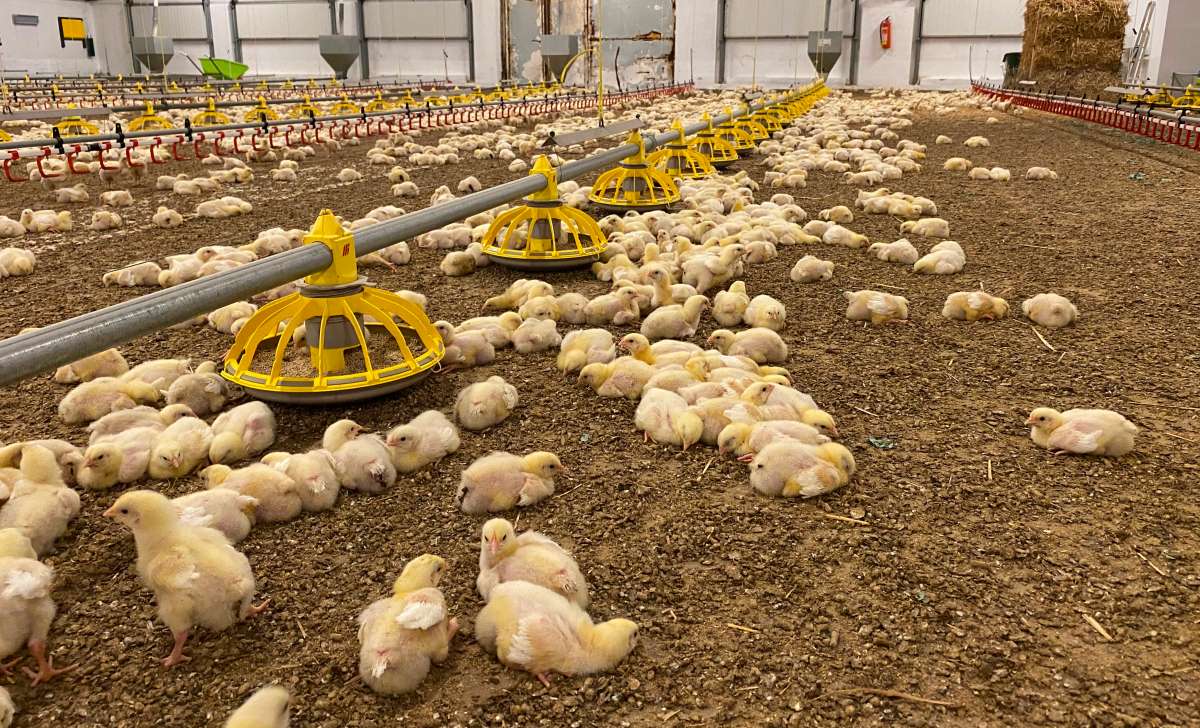
Conventional broiler breeder management has long favoured skip-a-day feeding, but a rigorous 60-week trial now puts that practice under serious scrutiny.
What the trial measured
Avila et al. (2023) tracked 1,778 Ross 708 pullets across a 60-week study comparing everyday (ED) and skip-a-day (SAD) feeding regimens. The trial was designed to capture differences in body composition, gastrointestinal development, and reproductive performance between the two programs. By following birds from rearing through to late lay, the researchers were able to assess not only growth outcomes but downstream production quality, providing one of the more comprehensive datasets available on this management question.
Feed efficiency and growth outcomes
On feed efficiency, the everyday feeding group required significantly less feed per live pullet: 6.853 kg compared to 6.997 kg for skip-a-day birds. That 2.6% improvement in feed conversion represents a meaningful cost reduction when applied across a full flock.
Growth differences were consistent throughout rearing. Birds on daily feeding were 4.5% heavier at week 10, 3.5% heavier at week 15, and 4.4% heavier at week 20. These were not isolated early-stage advantages. The performance gap persisted across the full rearing period, indicating a structural rather than transient effect of feeding frequency.
Egg quality, hatch rate, and the uniformity question
The production benefits associated with everyday feeding extended well beyond rearing. Hens raised on daily feeding produced eggs with significantly better shell quality during late lay, specifically between weeks 46 and 60. Hatch of fertile eggs was also higher in this group: 94.1% compared to 93.1% for skip-a-day birds. Over a commercial setting, that one percentage point difference in hatch rate compounds into a substantial number of additional viable chicks per setting.
Perhaps the most consequential finding concerns flock uniformity. The primary industry justification for skip-a-day feeding has been that restricted access encourages more uniform intake and, by extension, more uniform body weight development[EDIT]. The Avila et al. data does not support this. Coefficient of variation remained statistically similar between the two groups throughout the trial. Everyday feeding achieved equivalent uniformity without the associated feed efficiency and production penalties.
Taken together, the trial results indicate that skip-a-day feeding carries measurable costs on FCR, growth, shell quality, and hatch rate, without delivering the uniformity benefit that has historically justified its use. Reliable weight data collected at regular intervals throughout the rearing period is what makes it possible to detect these differences and act on them. Precise, consistent monitoring at flock level is the foundation on which evidence of this kind is built.
References
Avila, L.P., et al. (2023). Body composition, gastrointestinal, and reproductive differences between broiler breeders fed using everyday or skip-a-day rearing programs. Poultry Science, 102, 102853. https://www.sciencedirect.com/science/article/pii/S0032579123004273