
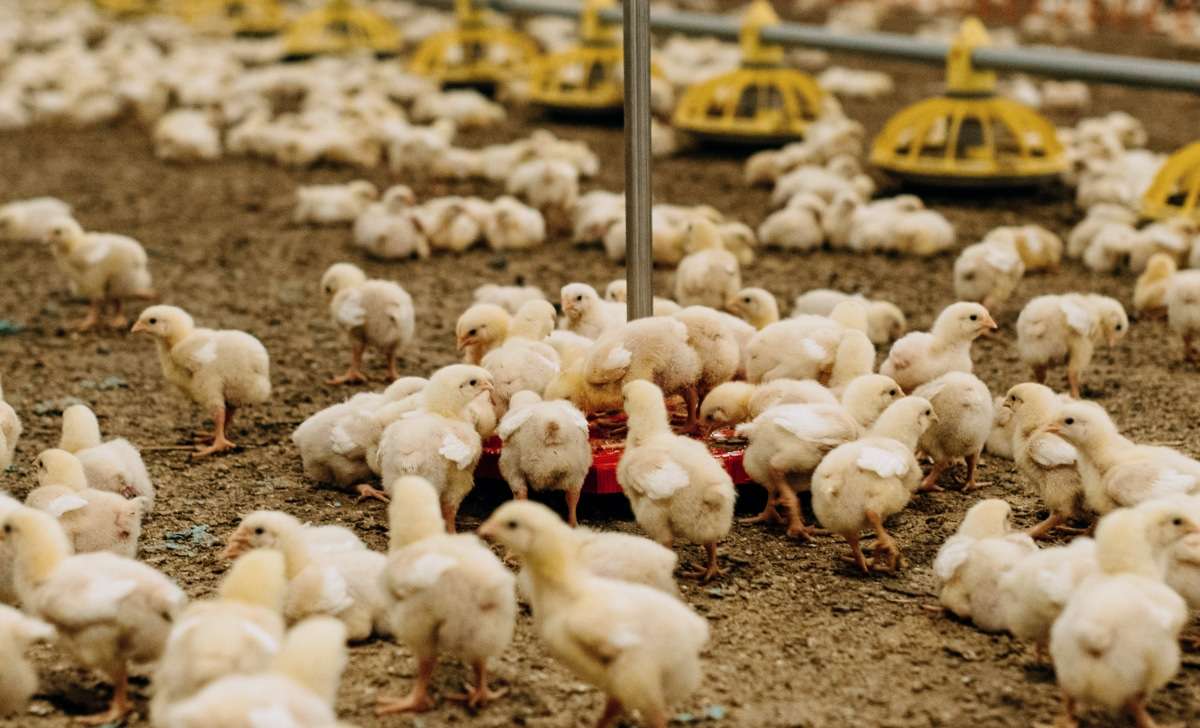
Poultry litter management decides how much ammonia a flock breathes, because the gas forms when microbes in wet litter break down uric acid and organic nitrogen (Li et al., 2013). Ammonia in the poultry house is widely recommended to stay below 25 ppm at bird height for welfare and performance (Atapattu et al., 2017), though EU welfare rules cap it at 20 ppm in houses stocked above 33 kg/m² (European Union, 2007). Damp litter also raises the risk of footpad dermatitis, since prolonged contact between skin and wet bedding is what causes the lesions (Sonnabend et al., 2022). Ventilation, drinker maintenance and litter amendments are the main levers producers have over both problems at once.
How Wet Litter Turns Into Ammonia
Poultry litter starts generating ammonia once moisture, temperature and pH cross a threshold favouring the microbes that break down uric acid (Li et al., 2013). Generation does not rise in step with moisture: past roughly 25 percent, each further five-point rise can multiply ammonia output several times over (USDA-ARS, n.d.). Extension guidance recommends a 20 to 25 percent moisture band, checked with a squeeze test: litter that packs into a ball is too wet, litter that will not hold together is too dry (Ritz et al., 2024).
Litter Moisture and Footpad Dermatitis
Footpad dermatitis develops where skin on the plantar surface sits in damp litter for extended periods, and footpad health is tied directly to litter moisture (Sonnabend et al., 2022). A trial on slatted flooring beneath drinker lines found litter dry matter significantly higher in the treated group during the first two weeks, and by slaughter age, camera-scored footpad lesions were far lower there (8.80) than under conventional litter (22.0) (Sonnabend et al., 2022). Separately, a trial comparing a wood-boiler heat exchanger against radiant propane brooders, which release water vapour as they burn, found the heat exchanger produced lower day 21 litter moisture and significantly lower day 35 footpad scores (Ayres et al., 2025).
Ventilation and Litter Amendments
Poultry house ventilation removes the moist air that keeps litter wet, working alongside leak-free drinker lines and managed cooling pads to limit new water reaching the litter (Ritz et al., 2024). Where ventilation alone falls short, litter moisture control can be reinforced with an acidifying amendment such as sodium bisulfate, which lowers litter pH and slows the microbial conversion of nitrogen to ammonia. Repeated application across a flock cycle has been shown to cut cumulative ammonia emissions and improve footpad quality without harming feed conversion (Li et al., 2013). Poultry litter treatment of this kind supplements good ventilation, rather than replacing it.
Weighing Birds to Track Growth Impact
Litter and ventilation changes matter only if a producer can see whether they work, and bird weight is one of the clearest signals. Weekly weighing with the BAT1 manual poultry scale combines a weight check with a hands-on look at the birds, since footpad dermatitis in broilers is a physical lesion a scale alone cannot detect. Continuous, hands-off coverage comes from BAT2 Connect, which logs flock-level averages as birds step onto the platform, so a slowdown after a wet litter event is not missed between visits.
Turning Litter and Weight Records Into Decisions
A second, hands-on weighing session is the surest way to catch footpad lesions before they show up in growth figures, since early-stage dermatitis can appear before feed conversion slips.
Between visits, continuous flock-level weighing flags a performance depression the same week litter conditions change. Logging weight and litter records together in BAT Cloud lines up a growth dip against the week litter moisture rose, showing whether a ventilation setting or amendment schedule is paying off in performance, not just in a lower ammonia reading.
References
- Ayres, V.E., Boltz, T.P., Bowen, K.M., Grushecky, S., Wang, J., Moritz, J.S. (2025). Applied research note: Heating system and feed additive effects on foot pad quality, broiler performance, and immune status. Journal of Applied Poultry Research, 34, 100557. https://doi.org/10.1016/j.japr.2025.100557
- Atapattu, N.S.B.M., Lakmal, L.G.E., Perera, P.W.A. (2017). Effects of two litter amendments on air NH3 levels in broiler closed-houses. Asian-Australasian Journal of Animal Sciences, 30(10), 1500-1506. https://doi.org/10.5713/ajas.16.0873
- European Union. (2007). Council Directive 2007/43/EC of 28 June 2007 laying down minimum rules for the protection of chickens kept for meat production. Official Journal of the European Union, L 182, 19-28. https://eur-lex.europa.eu/legal-content/EN/TXT/?uri=CELEX:32007L0043
- Li, H., Lin, C., Collier, S., Brown, W., White-Hansen, S. (2013). Assessment of frequent litter amendment application on ammonia emission from broilers operations. Journal of the Air & Waste Management Association, 63(4), 442-452. https://doi.org/10.1080/10962247.2012.762814
- Ritz, C.W., Fairchild, B.D., Lacy, M.P. (2024). Litter Quality and Broiler Performance. University of Georgia Extension, Bulletin 1267. https://extension.uga.edu/publications/detail.html?number=B1267
- Sonnabend, S.-J., Spieß, F., Reckels, B., Ahmed, M.F.E., Abd El-Wahab, A., Sürie, C., Lingens, J.B., Visscher, C. (2022). Influence of using perforated plastic flooring beneath the waterline on growth performance, litter quality, and footpad health of broiler chickens: A field study. Animals, 12, 1749. https://doi.org/10.3390/ani12141749
- USDA Agricultural Research Service. (n.d.). Poultry Litter Moisture Management to Reduce Ammonia. https://www.ars.usda.gov/ARSUserFiles/np212/LivestockGRACEnet/LitterMoisture.pdf