
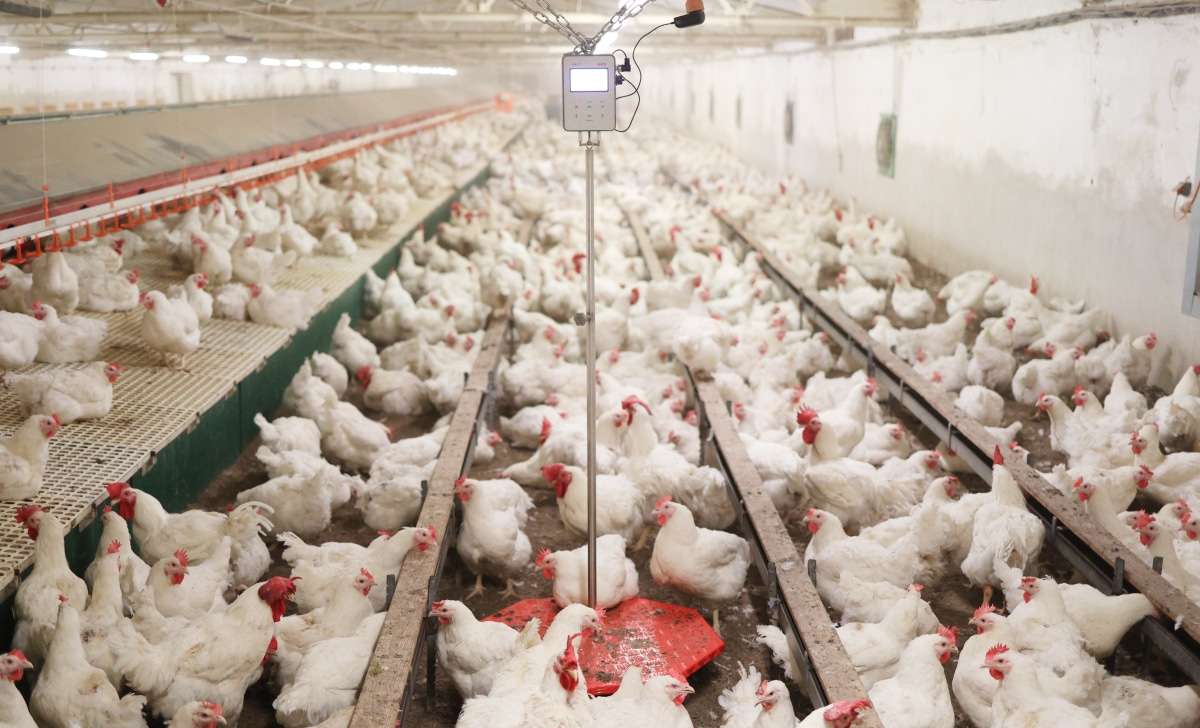
Heat stress in broilers occurs when birds cannot dissipate metabolic heat fast enough to hold a stable body temperature, typically once conditions pass the thermoneutral zone of 18 to 24°C (Nambapana and Jayasena, 2024). Exposure is commonly classed as acute when it lasts under seven days and chronic when it lasts seven days or more, and chronic exposure brings wider physiological change and tissue damage (Liu et al., 2023). In one chronic exposure study, heat cut feed intake by 16.4 percent, lowered body weight by 32.6 percent and raised feed conversion ratio by 25.6 percent by 42 days of age (Lara and Rostagno, 2013). Birds respond by panting, spreading their wings and drinking more while eating less. Ventilation, water and stocking density are the levers producers control, and summer heat exposes any gap in the three.
Spotting the Early Signs of Heat Stress in Broilers
The first visible sign is usually panting, open-mouthed breathing that evaporates moisture from the respiratory tract once radiant and convective heat loss can no longer keep pace (Lara and Rostagno, 2013). Wings held away from the body, reduced activity and more time lying down follow (Nambapana and Jayasena, 2024).
Feeding drops off before drinking does. A fall in daily feed intake alongside a rise in water consumption is often the earliest measurable signal available to a stockperson, well ahead of any change in scale readings.
What Summer Heat Costs in Growth and Feed Efficiency
Prolonged panting drives up blood pH, a state called respiratory alkalosis, which interferes with calcium regulation on top of the behavioural cost (Lara and Rostagno, 2013).The size of the loss depends on the pattern of exposure. Feed intake falls by about 1.5 percent for each 1°C under cyclic heat and by about 3.5 percent under constant heat (Nambapana and Jayasena, 2024).
The damage reaches the carcass too. Chronic heat has been linked to a smaller share of breast muscle, less protein and more fat in the meat (Lara and Rostagno, 2013), and cyclical heat has been reported to cut breast muscle weight by 16 percent (Nambapana and Jayasena, 2024).
Heat stress is not a marginal cost. It has been estimated to cause $1.69 to $2.36 billion in annual losses across the United States livestock sector, of which $128 to $165 million falls on the poultry industry (Lara and Rostagno, 2013).
Ventilation as the First Line of Defence
Air exchange removes the heat, moisture and carbon dioxide birds generate, and house carbon dioxide should never exceed 3,000 parts per million (Cobb-Vantress, 2021). In hot weather, tunnel ventilation is the main cooling tool, since fast air across the birds creates a wind-chill effect that can make them feel 1 to 8°C cooler than the ambient reading (Cobb-Vantress, 2021).
Target air velocity of 2 to 2.5 metres per second, with fresh air supplied at 6 to 7 cubic metres per kilogram of body weight per hour, has been recommended for hot-weather management (Nambapana and Jayasena, 2024).
Water and Stocking Density: the Two Levers Producers Control
Water intake rises sharply with temperature. Broilers typically drink 2 to 3 millilitres of water per gram of feed at moderate temperatures, rising to 4 to 5 millilitres per gram once conditions turn hot, with total intake up roughly 7 percent for every 1°C above 21°C (Nambapana and Jayasena, 2024). Drinker space and flow rate matter more once a heat event starts[EDIT].
Stocking density compounds the problem from the other direction. In their review, Lara and Rostagno (2013) describe density as a major factor interacting with heat stress on productivity and welfare (Lara and Rostagno, 2013).
Weighing Through a Heat Event: What to Track
Feed intake and drinking shift within hours, but average daily gain lags by days. Manual sessions on the BAT1 manual poultry scale let staff combine a weight check with a hands-on look at individual birds, catching condition loss a flock average would mask.
Between sessions, the BAT2 Connect automatic scale tracks the flock-level trend continuously, so a dip in average daily gain shows up as soon as it starts. Conditions differ across a house, so with several scales spread along it, the data can be split by location to help pinpoint the zones where birds are struggling with heat.
Turning Weight Data Into Faster Decisions
Continuous live weight monitoring flags a slowdown early enough to adjust ventilation, water access or stocking before the flock falls further behind target.
A second, hands-on weighing session then confirms whether individual birds are recovering once conditions ease.
Feeding both readings into the BAT Cloud data platform turns them into one recovery curve per flock, showing how much a heat event cost and how fast the birds recovered. Overlaying curves from previous summers shows how each flock’s weight responded to heat, which helps a farm judge whether a cooling upgrade would pay back.
References
- Cobb-Vantress. (2021). Broiler Management Guide. Cobb-Vantress Inc. https://www.cobb-vantress.com/assets/Cobb-Files/4d0dd628b7/Broiler-Guide_English-2021-min.pdf
- Lara, L. J., & Rostagno, M. H. (2013). Impact of heat stress on poultry production. Animals, 3(2), 356–369. https://pmc.ncbi.nlm.nih.gov/articles/PMC4494392/
- Nambapana, M., & Jayasena, D. (2024). Heat stress management via nutritional strategies for broilers. In Modern Technology and Traditional Husbandry of Broiler Farming. IntechOpen. https://www.intechopen.com/chapters/1189812