
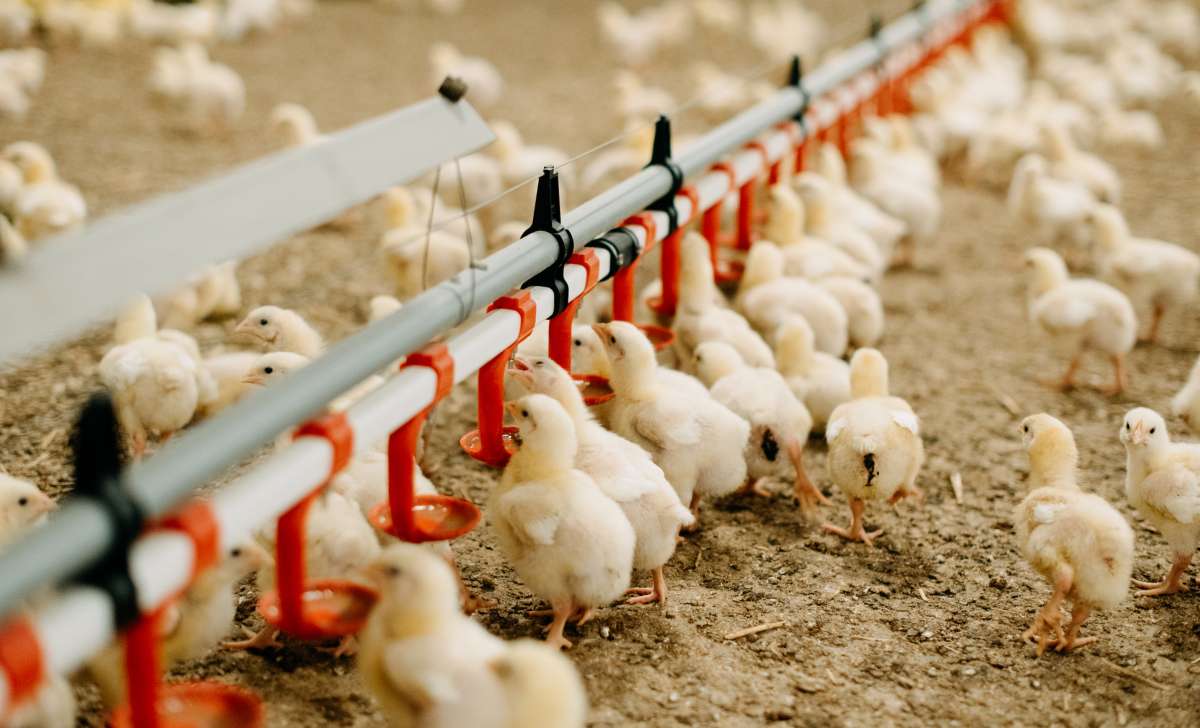
A chicken feeder is not a minor line item, and broiler feed management starts with getting this decision right. Feed accounts for 60 to 70 percent of total production cost in a commercial operation (Gautam and Baker-Cook 2026). The feeder installed shapes how evenly that feed reaches every bird, and uneven access later shows up as poor uniformity and a weaker feed conversion ratio.
Trough and Pan Feeders Dominate Commercial Houses
In almost any large scale operation, the poultry house feed line will be one of two designs: a trough style chain feeder or a round pan feeder (Cobb-Vantress 2021). Both count as commercial chicken feeding equipment, built for daily use across many flock cycles. Homemade or improvised feeders have no real place on a production farm. They lack the feed depth control, corner design, and durability a commercial flock requires, and cannot integrate with a modern poultry feeder system.
Chain vs Pan Feeders by Production Phase
Chain feeder poultry house layouts are typically the primary system across breeder and layer categories, used across rearing and production for both males and females, since high corners limit spillage and hold higher feed levels in the trough (Cobb-Vantress 2021). A pan feeder for broilers is generally preferred during grow out, since this broiler feeder equipment allows unrestricted bird movement, reduces spillage, and improves feed conversion compared with older trough systems (Cobb-Vantress 2021).
Feeder Space Drives Behavior and Growth
Feeder space allowance is not a fixed number. Raising broiler space from a nominal 2.3 cm per bird to 4.6 or 6.9 cm improved body weight in the starter and grower phases (Purswell et al. 2021). Commercial breeder flocks follow a published target of a minimum 15 cm of chain feeder per female, per side of the feeder, once birds reach production (Cobb-Vantress 2021). Industrial poultry feeders in layer housing show a similar pattern: more feeder space cut aggression and jostling in an aviary system, while feed conversion declined slightly as space increased (Sirovnik et al. 2018). Tighter feeder space produced more agonistic pecking in an earlier broiler trial, though overall growth was unaffected at the ranges tested (Olukosi et al. 2001).
Feeder Height Matters as Much as Space
Space alone will not fix a poorly managed feeder. The lip of a chain or pan feeder should stay level with the birds‘ backs, and needs raising incrementally throughout the flock as birds grow (Cobb-Vantress 2021). Set too high, and feed spills and is wasted. Left too low, or outpaced by rising litter beneath it, birds struggle to reach the trough and intake drops, a direct hit to feed cost and uniformity (Cobb-Vantress 2021). Feeder height is therefore a welfare lever as much as an economic one.
Automatic Feeding Systems and Flock Data
An automatic poultry feeding system is now the default in most modern houses, with auger driven pan lines and chain systems running with minimal staff presence. Once a feed line is in place, the next question is how growth against that feed gets verified, and many operations pair an automatic chicken feeder line directly with weighing hardware to check the answer. Continuous live weight monitoring through the BAT2 Connect automatic scale shows a manager, day by day, whether the chosen feeder type and spacing are hitting the target growth curve, without adding labor to daily rounds.
Real time flock data also flags a feeder problem early, before it costs a full production cycle. If average daily gain flattens after a switch from trough to pan feeding, a manager sees it within days rather than at the next scheduled catch.
Verifying Feeder Performance with Individual Checks
Averages do not tell the whole story. A subset of birds can be underweight even when the flock average looks correct, particularly near a crowded trough where smaller birds get displaced (Olukosi et al. 2001). Individual bird weighing with the BAT1 manual scale catches this variation, because each bird caught produces its own weight entry rather than a pooled average.
That same catch also allows hands on fleshing and condition checks the moment a bird is in hand, something no automatic feeder or scale can replace.
Records from either method can be reviewed together through the BAT Cloud data platform, keeping feed and growth history in one place for comparing feeder types or house layouts across flock cycles.
Matching the Feeder to the Flock
There is no universal best feeder among the many feeder types for chickens available today. Pan systems suit broiler grow out, where movement and low spillage matter most. Chain systems remain standard across breeder and layer flocks, in both rearing and production. Whatever feeder is installed, the only way to confirm it works is to weigh the birds it feeds, consistently and at a scale matching the operation.
References
Cobb-Vantress. (2021). Cobb Broiler Management Guide. https://www.cobbgenetics.com/assets/Cobb-Files/Broiler-Guide_English-2021-min.pdf
Cobb-Vantress. (2021). Cobb Broiler Breeder Management Guide. https://www.cobbgenetics.com/assets/Cobb-Files/Breeder-Management-Guide.pdf
Gautam, A., & Baker-Cook, B. (2026). Feeder management: A vital part of broiler welfare. Modern Poultry. https://modernpoultry.media/feeder-management-a-vital-part-of-broiler-welfare/
Olukosi, O. A., Daniyan, O. C., & Matanmi, O. (2001). Effects of feeder space allowance on agonistic behaviour and growth performance of broilers. Livestock Research for Rural Development, 13(1). https://www.lrrd.org/lrrd13/1/oluk131.htm
Purswell, J. L., Olanrewaju, H. A., & Zhao, Y. (2021). Effect of feeder space on live performance and processing yields of broiler chickens reared to 56 days of age. Journal of Applied Poultry Research, 30(3), 100175. https://www.sciencedirect.com/science/article/pii/S1056617121000386
Sirovnik, J., Würbel, H., & Toscano, M. J. (2018). Feeder space affects access to the feeder, aggression, and feed conversion in laying hens in an aviary system. Applied Animal Behaviour Science, 198, 75–82. https://www.sciencedirect.com/science/article/abs/pii/S0168159117302678