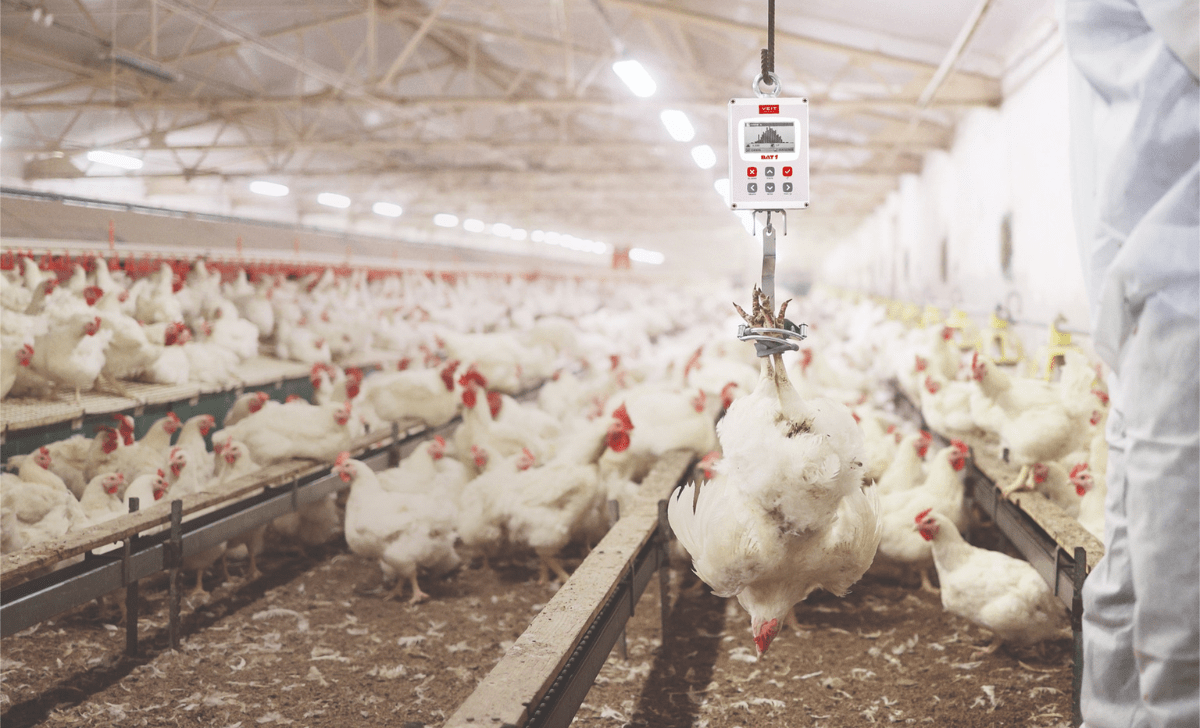
The transition to cage-free housing is the move of laying flocks from conventional or enriched cages into floor, partially slatted or multi-tier aviary houses, and law and buyers now drive it as much as welfare concerns do. In the United States, cage-free hens made up 47.7% of the table-egg flock in April 2026, or 146.6 million birds (USDA Agricultural Marketing Service, 2026). Rules differ by country and by state, so the first step is to know which ones apply to the eggs a farm sells. The second is to maintain flock uniformity in multi-tier housing where hens must move in three dimensions. Regular weighing shows early when hens grow too fat, which can cut laying and feed efficiency and prompt a feed review (practical observation, not research-confirmed).
How cage-free rules differ by region
Buyers moved first. Large US food chains and grocers pledged to source only cage-free eggs by 2025 (Castro et al., 2023). Public regulations covering cage-free housing now vary widely, as the table shows.
| Region | Current position | Key requirement |
|---|---|---|
| European Union | Conventional cages banned since 1 January 2012. Enriched cages remain legal. | Enriched cages: 750 cm² per hen. Alternative systems: up to nine hens per m² of usable area (Council Directive 1999/74/EC). |
| EU outlook | The Commission plans a targeted revision for laying hens by the end of 2026, focused on phasing out cages. | No transition dates published yet (European Commission, 2026). |
| Canada | Only conventional cages are being phased out. | All hens in enriched or non-cage systems by 1 July 2036 (NFACC, 2017). |
| California, US | Eggs sold in the state must come from compliant hens, including hens on farms in other states. | 0.14 m² (1.5 ft²) per hen on single-level floors, 0.09 m² (1 ft²) in partially slatted or multi-tier systems. Nest boxes, scratch area, dust bathing area and perches required (CDFA, 2024). |
| Michigan, US | No cage housing after 31 December 2024 for farms with 3,000 or more hens. | Sale of non-compliant shell eggs banned, including eggs from other states (MDARD, n.d.; Feedstuffs, 2026). |
State laws on cage-free eggs have survived federal challenge so far. The US Department of Justice sued California and Michigan, arguing that the federal Egg Products Inspection Act overrides the state rules. Courts dismissed both suits for lack of standing, the California case by March 2026 and the Michigan case on 7 October 2026, so neither ruling tested the federal argument itself (Agri-Pulse, 2026; Feedstuffs, 2026). Avian influenza in chickens and high egg prices have also bent enforcement. Nevada suspended its rule from 20 February 2025 and reinstated it after 20 June 2025 (Bakker, 2025; Nevada Department of Agriculture, 2025). Arizona’s agriculture department proposed in May 2025 to move its start date to 1 January 2032, a change whose final adoption is unconfirmed (Feedstuffs, 2025). Producers should confirm the current status before committing capital.
What the change costs
For a commercial farm that keeps laying hens cage-free, the best public cost comparison comes from one California farm studied over two flock cycles (Matthews & Sumner, 2015). Total cost per dozen eggs was 36% higher in an aviary house than in a conventional cage house, and 13% higher in an enriched colony house. All cost amounts below are in US dollars at 2011 prices.
Total cost per dozen was 0.913 in the aviary, 0.756 in the enriched house and 0.670 in the conventional house. Labour added 0.074 per dozen in the aviary against 0.019 in the conventional house. Pullets cost 0.221 against 0.148, because aviary pullets cost about 1.85 more per bird and the hens laid fewer eggs. Capital added 0.162 against 0.058.
Feed differed little, at 0.436 against 0.425. The aviary flocks also lost 13.3% of birds by the end of the cycle, against 4.8% in the conventional house. The authors note that the trial did not allow full optimisation of management, and the houses were built in 2011 and 2004. Read the numbers as one farm’s benchmark, not a forecast.
Producers elsewhere report similar pressure points when converting conventional cage barns to cage-free systems. Land availability, cost, management and disease control were the main barriers among cage producers surveyed in China, Japan, Indonesia, Malaysia, the Philippines and Thailand, and 72% of them said more support was needed, mainly training, knowledge and access to experts, alongside financial help (Tan de Luna et al., 2022). Asia produces about 60% of the world’s eggs, so these views matter for the market for eggs from cage-free flocks well beyond the West. Cages also still dominate there: about 90% of the eggs produced in China and 80% of those in India come from caged systems (Tan de Luna et al., 2022).
What changes in flock performance
Mortality in the new houses is not fixed. A meta-analysis of commercial data from 16 countries linked each year of experience with cage-free aviaries to a 0.35 to 0.65% drop in cumulative mortality, and recent years showed no difference between caged and cage-free systems, at 3 to 5% by 60 weeks (Schuck-Paim et al., 2021). Injurious pecking remains a recognised risk in these houses, and preventive measures reduce it. The aviary loss of 13.3% on the California farm, described in the cost section, is one farm’s result, not a rule.
Welfare assessment in cage-free systems covers a different set of welfare indicators. In Ontario, healed keel fractures reached 48.3% of hens in floor-housed flocks against 24.8% in caged flocks, and most occurred by 50 weeks. Floor-housed hens were lighter, at 1,827 g (4.03 lb) against 1,888 g (4.16 lb), but more uniform, with a coefficient of variation of 9.43% against 10.10% (Petrik et al., 2015). In pen trials in Belgium and the United States and on one commercial farm in the United Kingdom, ramps lowered keel fractures or their severity (Heerkens et al., 2016; Toscano et al., 2024; Norman et al., 2021). In the Belgian trial, the gap narrowed as hens aged. The hybrid matters. In a Swiss trial, Dekalb White hens laid 93.7% against 83.6% and used 126.7 g of feed per egg against 145.0 g for ISA Brown hens (Stratmann et al., 2015). White hens also landed more often and more successfully than brown hens in an Italian aviary trial, and roosted higher at night in a United States comparison of four strains (Ciarelli et al., 2023; Ali et al., 2016). Keel fractures, however, varied with age and between studies (Stratmann et al., 2015; Heerkens et al., 2016). Air quality is the other known weak point, since cage-free houses face high ammonia and particulate matter (Castro et al., 2023).
Day-to-day management of flocks housed without cages depends on seeing these trends early. Continuous flock-level weight data without handling birds shows early if the flock average is rising too fast, which is a practical observation, not research-confirmed.
Rearing pullets for the new house
Hens must learn the house before they lay. Pullets moved from cages to aviaries lack experience of navigating in three dimensions, which raises the risk of cachexia, dehydration and floor eggs. The review concludes that hens destined for aviaries should be reared in aviaries, and that cage rearing followed by loose housing is not commonly practised (Janczak & Riber, 2015). Birds reared without perches also lay more floor eggs and show more pecking at the cloaca, which can lead to aggression and cannibalism in laying hens. The Canadian Code calls for pullets destined for aviary systems to be reared in systems with similar features, with perches from day one in multi-tier rearing (NFACC, 2017). The Lohmann guide adds that perch access before four weeks reduces injurious pecking and that transfer is ideal at week 17 (LOHMANN Breeders, n.d.). Rearing pullets for cage-free houses is therefore decided at chick placement, not at transfer.
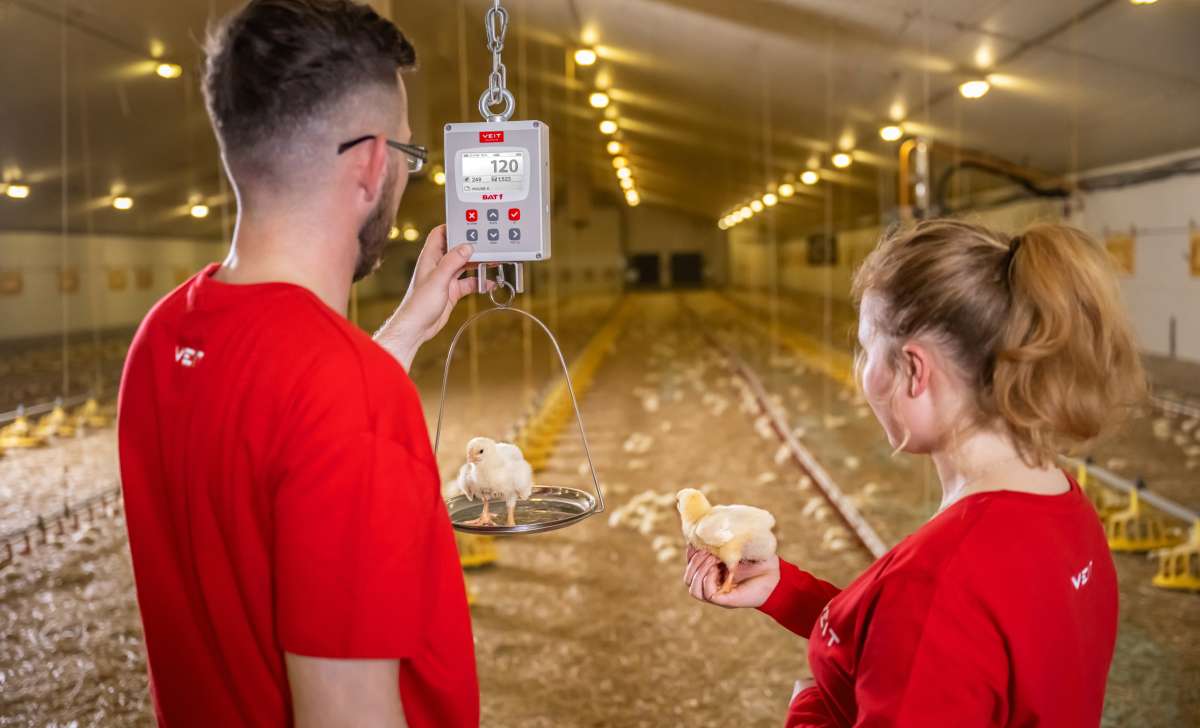
Uniformity depends on this stage. Among Australian free-range aviary hens at 74 weeks, 90.0% of the lightest quarter, at 1.65 kg (3.64 lb), were in full follicle production, against 94.7 to 95.3% of medium and heavy hens. Light hens also carried more gastrointestinal worms, while heavy hens, at 2.08 kg (4.59 lb), showed more fatty liver (Sibanda et al., 2020). The authors stress that pullet rearing is where uniformity is built. LOHMANN Breeders advises weighing weekly from week one, always at the same time of day, because mealtimes change body weight (LOHMANN Breeders, n.d.). Hands-on weighing with the BAT1 manual poultry scale records the weight and sex of each bird, and the handler can feel the keel for the calcium deposits that mark healed fractures (Petrik et al., 2015).
Pullets that fall behind can be graded into weight categories before transfer. For farms that already weigh with BAT1, the BAT1 Sorting Machine removes the person who places birds in the right pen, about a third of the sorting crew (practical observation, not measured). The funnel is designed for females.
Weighing in the cage-free house
Birds step onto the BAT2 Connect automatic scale voluntarily, so it records weights through the whole laying period and reports flock-level averages. It cannot flag individual birds.
A hands-on weighing session fills that gap, and some farms weigh whole flocks this way with several scales.
BAT Cloud collects weights from BAT1 WiFi, from standard BAT1 uploads and from BAT2 Connect. That suits comparing a converted house with a cage house, or one year with the next, while the farm changes over.
References
- Agri-Pulse. (2026, March 19). DOJ lawsuit challenging California hen welfare laws dismissed. https://www.agri-pulse.com/articles/24399-doj-lawsuit-challenging-california-hen-welfare-laws-dismissed
- Ali, A. B. A., Campbell, D. L. M., Karcher, D. M., & Siegford, J. M. (2016). Influence of genetic strain and access to litter on spatial distribution of 4 strains of laying hens in an aviary system. Poultry Science, 95(11), 2489 to 2502. https://doi.org/10.3382/ps/pew236
- Bakker, K. (2025, March 26). Some states back off cage-free mandates during bird flu crisis. Feedstuffs. https://www.feedstuffs.com/agribusiness-news/some-states-back-off-cage-free-mandates-during-bird-flu-crisis
- California Department of Food and Agriculture (CDFA). (2024, July). Chicken egg producer enclosure guidance. Animal Care Program. https://www.cdfa.ca.gov/AHFSS/AnimalCare/docs/Prop12_ChickenEggEnclosureProducerGuidance.pdf
- Castro, F. L. S., Chai, L., Arango, J., Owens, C. M., Smith, P. A., Reichelt, S., DuBois, C., & Menconi, A. (2023). Poultry industry paradigms: connecting the dots. Journal of Applied Poultry Research, 32, 100310. https://doi.org/10.1016/j.japr.2022.100310
- Ciarelli, C., Bordignon, F., Pillan, G., Xiccato, G., & Trocino, A. (2023). Risk factors for navigation ability of laying hens at housing in an aviary system. In Book of Abstracts of the 74th Annual Meeting of the European Federation of Animal Science (p. 371). Wageningen Academic. https://doi.org/10.3920/978-90-8686-936-7
- Council Directive 1999/74/EC of 19 July 1999 laying down minimum standards for the protection of laying hens. Official Journal of the European Communities, L 203, 53. https://eur-lex.europa.eu/eli/dir/1999/74
- European Commission. (2026). Revision of EU animal welfare legislation. Food Safety. https://food.ec.europa.eu/animals/animal-welfare/evaluations-and-impact-assessment/revision-eu-animal-welfare-legislation_en
- Feedstuffs. (2025, May 8). Arizona publishes proposed rule to delay cage-free egg requirements. https://www.feedstuffs.com/agribusiness-news/arizona-publishes-proposed-rule-to-delay-cage-free-egg-requirements
- Feedstuffs. (2026). Judge rejects DOJ suit against Michigan cage-free egg law. https://www.feedstuffs.com/policy/judge-rejects-doj-suit-against-michigan-cage-free-egg-law
- Heerkens, J. L. T., Delezie, E., Ampe, B., Rodenburg, T. B., & Tuyttens, F. A. M. (2016). Ramps and hybrid effects on keel bone and foot pad disorders in modified aviaries for laying hens. Poultry Science, 95, 2479 to 2488. https://doi.org/10.3382/ps/pew157
- Janczak, A. M., & Riber, A. B. (2015). Review of rearing-related factors affecting the welfare of laying hens. Poultry Science, 94(7), 1454 to 1469. https://doi.org/10.3382/ps/pev123
- LOHMANN Breeders GmbH. (n.d.). Management guide: Recommendations for barn, aviary and free-range systems (edition 06/21_V02-24). https://lohmann-breeders.com/files/downloads/MG/Alternative%20breeds/LB_MG_Alternative%20Haltung_Printversion_EN_06.21_V02-24_high.pdf
- Matthews, W. A., & Sumner, D. A. (2015). Effects of housing system on the costs of commercial egg production. Poultry Science, 94(3), 552 to 557. https://doi.org/10.3382/ps/peu011
- Michigan Department of Agriculture and Rural Development (MDARD). (n.d.). Cage-free egg law. https://www.michigan.gov/mdard/faqs/animals/cage-free-egg-law
- National Farm Animal Care Council (NFACC). (2017). Code of practice for the care and handling of pullets and laying hens. https://www.nfacc.ca/pdfs/pullets_and_laying_hens_code_of_practice.pdf
- Nevada Department of Agriculture. (2025, June 5). Nevada shifts back to cage-free regulations as egg prices drop. https://agri.nv.gov/News/2025/Nevada_shifts_back_to_cage-free_regulations_as_egg_prices_drop
- Norman, K. I., Weeks, C. A., Tarlton, J. F., & Nicol, C. J. (2021). Rearing experience with ramps improves specific learning and behaviour and welfare on a commercial laying farm. Scientific Reports, 11, 8860. https://doi.org/10.1038/s41598-021-88347-9
- Petrik, M. T., Guerin, M. T., & Widowski, T. M. (2015). On-farm comparison of keel fracture prevalence and other welfare indicators in conventional cage and floor-housed laying hens in Ontario, Canada. Poultry Science, 94(4), 579 to 585. https://doi.org/10.3382/ps/pev039
- Schuck-Paim, C., Negro-Calduch, E., & Alonso, W. J. (2021). Laying hen mortality in different indoor housing systems: a meta-analysis of data from commercial farms in 16 countries. Scientific Reports, 11, 3052. https://doi.org/10.1038/s41598-021-81868-3
- Sibanda, T. Z., Kolakshyapati, M., Walkden-Brown, S. W., de Souza Vilela, J., Courtice, J. M., & Ruhnke, I. (2020). Body weight sub-populations are associated with significant different welfare, health and egg production status in Australian commercial free-range laying hens in an aviary system. European Poultry Science, 84. https://doi.org/10.1399/eps.2020.295
- Stratmann, A., Fröhlich, E. K. F., Harlander-Matauschek, A., Schrader, L., Toscano, M. J., Würbel, H., & Gebhardt-Henrich, S. G. (2015). Soft perches in an aviary system reduce incidence of keel bone damage in laying hens. PLoS ONE, 10(3), e0122568. https://doi.org/10.1371/journal.pone.0122568
- Tan de Luna, M. C., Yang, Q., Agus, A., Ito, S., Idrus, Z., Iman, R. H. S., Jattuchai, J., Lane, E., Nuggehalli, J., Hartcher, K., & Sinclair, M. (2022). Cage egg producers‘ perspectives on the adoption of cage-free systems in China, Japan, Indonesia, Malaysia, Philippines, and Thailand. Frontiers in Veterinary Science, 9, 1038362. https://doi.org/10.3389/fvets.2022.1038362
- Toscano, M. J., Jalali, A. S., Siegford, J. M., & Stratmann, A. (2024). Providing ramps during lay has larger impacts on laying hens than ramps at rearing. Poultry Science, 103(10), 104101. https://doi.org/10.1016/j.psj.2024.104101
- USDA Agricultural Marketing Service. (2026, April 24). Egg markets overview. https://mymarketnews.ams.usda.gov/filerepo/sites/default/files/3725/2026-04-24/1320060/ams_3725_00128.pdf