
Two hybrids dominate global broiler production: the Cobb 500 and the Ross 308. Producers raising either bird face the same practical question. Is the flock actually tracking the growth curve its breeder publishes, or is it falling behind? Answering that means comparing live weights against the published standard at the same age, week after week.
Ross 308 vs Cobb 500 Broiler Weight Chart by Age
Age(days) |
Cobb 500,as hatched (g) |
Ross 308,as hatched (g) |
| 7 | 202 | 214 |
| 14 | 570 | 540 |
| 21 | 1116 | 1033 |
| 28 | 1783 | 1657 |
| 35 | 2521 | 2360 |
| 42 | 3278 | 3086 |
Sources: Cobb-Vantress (2022); Aviagen (2022).
The two curves track closely but are not identical. Cobb-Vantress data place the Cobb 500 ahead of the Ross 308 from around two weeks of age, a pattern also reported in field trials (Khalid et al., 2021). Neither hybrid is objectively superior. Each should be judged against its own broiler growth standard, not the other’s.
Why the Two Standards Diverge
Genetic selection, feed formulation, and target market all shape a breeder’s growth curve, which is why the numbers differ without changing the underlying goal of efficient, welfare-sound broiler performance. One open-housing trial recorded Cobb 500 birds carrying more weight than Ross 308 through the first four weeks, though results vary with climate, stocking density, and diet (Khalid et al., 2021). The practical lesson is not which hybrid wins on paper, but how closely your own flock tracks the standard it was bought to meet.
How to Benchmark Your Flock Against the Standard
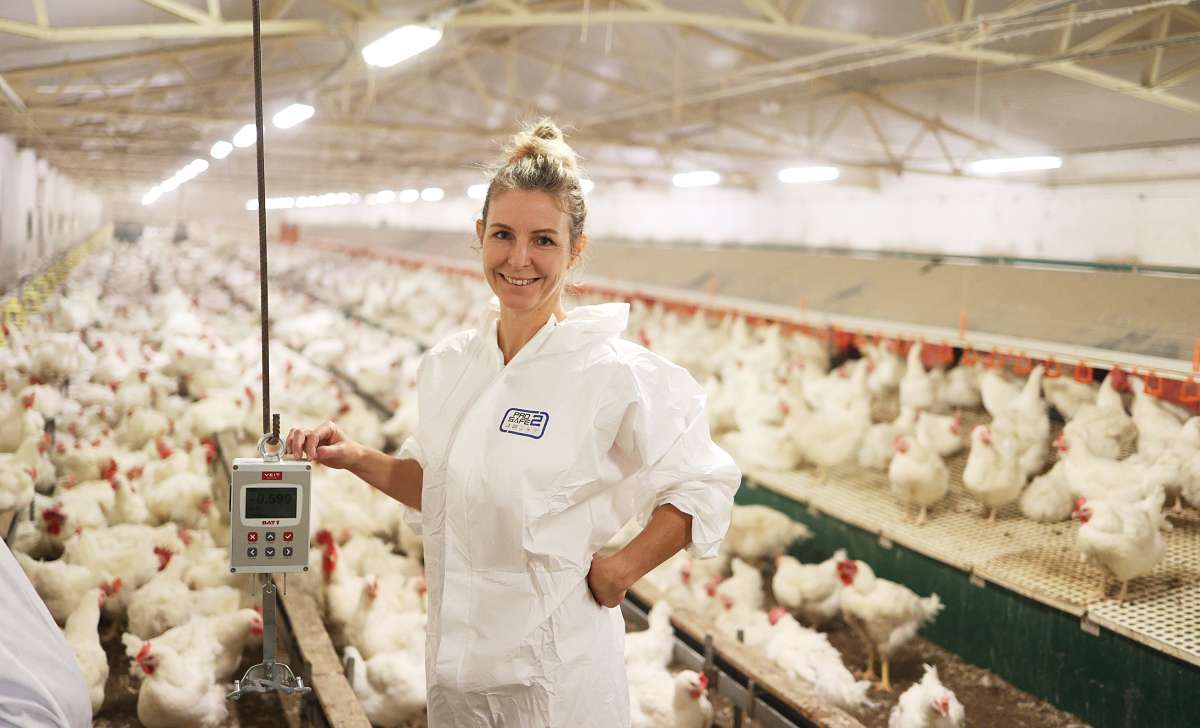
Benchmarking starts with a representative sample. Cobb-Vantress recommends weighing approximately 2% of the birds in a flock and comparing the average against the target weight for age on the chart (Cobb-Vantress, 2021). Catching each bird by hand with the BAT1 manual poultry scale lets a flock supervisor check leg health and fleshing at the same time, so a low reading can be traced to disease, nutrition, or genetics before it spreads.
The average alone can hide a problem. A bird counts within a flock’s uniformity band when its weight falls within 10 percent of the sample mean, and Cobb-Vantress treats roughly 80 percent uniformity, a coefficient of variation near 8, as the reference point even at hatch (Cobb-Vantress, 2021). Pairing that weekly sample with hands-on fleshing and leg checks catches welfare issues that a scale reading alone would miss, since two birds can share a weight but differ sharply in condition.
Hand sampling is accurate but only a snapshot. The BAT2 Connect automatic scale records every voluntary step onto the platform and reports a daily flock average, so a house that starts drifting below target shows up well before the next scheduled sample.
That kind of continuous live weight monitoring turns the weight chart from a static reference into a daily check. A two- or three-day dip against target is usually still correctable. A week-long dip rarely is.
Recording each session’s average, whether from manual or automatic weighing, only pays off if the numbers are compared over time. BAT Cloud centralises weight and uniformity data across houses and flocks, making it straightforward to overlay this week’s curve against the breed standard and last cycle’s result.
Whichever hybrid is in the house, the standard itself is only a reference point. Weekly sampling, checked against the correct Ross 308 or Cobb 500 table and tracked for both average weight and uniformity, is what actually tells a flock supervisor whether the birds are on target or drifting away from it.
References
Aviagen. (2022). Ross 308 AP broiler: Performance objectives. https://aviagen.com/assets/Tech_Center/Ross_Broiler/RossxRoss308AP-BroilerPerformanceObjectives2022-EN.pdf
Cobb-Vantress. (2021). Cobb broiler management guide. https://www.cobbgenetics.com/assets/Cobb-Files/Broiler-Guide_English-2021-min.pdf
Cobb-Vantress. (2022). Cobb500 broiler performance & nutrition supplement. https://www.cobbgenetics.com/assets/Cobb-Files/2022-Cobb500-Broiler-Performance-Nutrition-Supplement.pdf
Khalid, N., Ali, M. M., Ali, Z., Amin, Y., & Ayaz, M. (2021). Comparative productive performance of two broiler strains in open housing system. Advancements in Life Sciences, 8(2), 124-127. https://www.als-journal.com/825-21/