
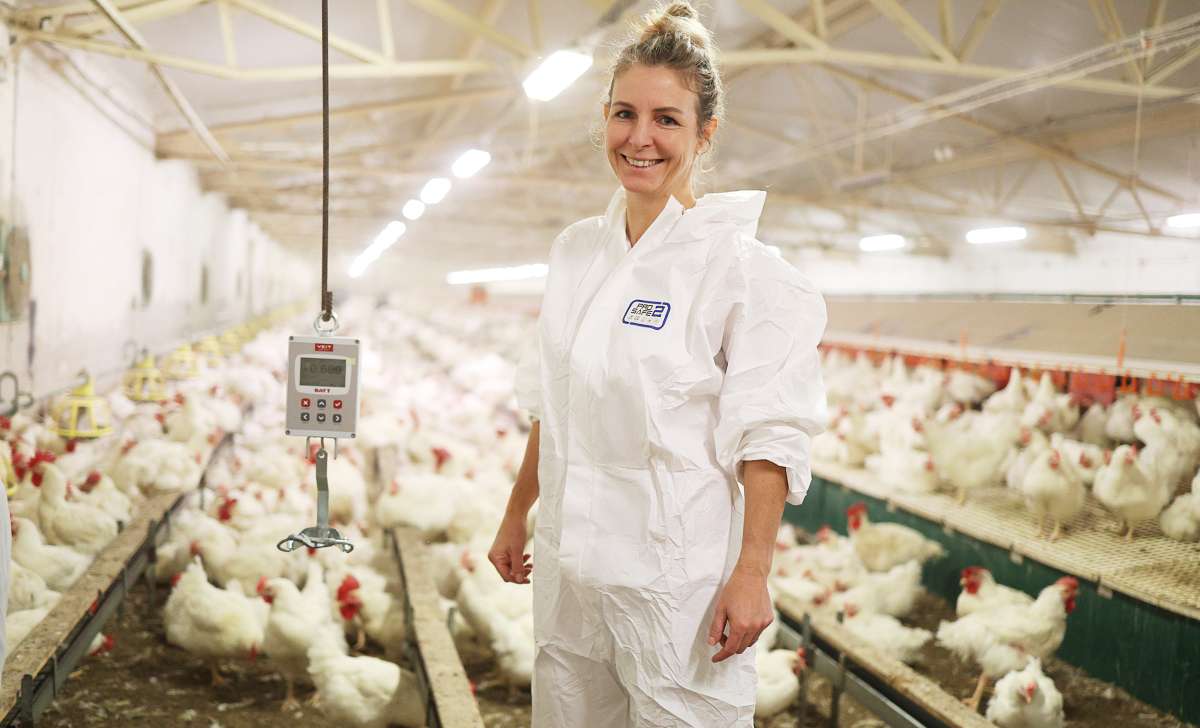
Feed structure is one of the most consequential and least scrutinised variables in commercial broiler production. While genetics and nutrition receive close attention, the physical form of feed and the consistency of its delivery create performance gaps that show up at processing before their cause is ever identified.
Feed form and flock uniformity
The difference between pelleted and mash diets is not marginal. Research demonstrates that broilers fed pelleted diets achieve 15–20% higher feed intake and growth rates compared to those receiving mash (Naderinejad et al., 2016). The advantage extends to flock uniformity, where pelleted feed delivers 5% better consistency across the entire flock (Sena et al., 2013). In commercial production, where uniformity determines grading outcomes and processing efficiency, that gap carries direct financial weight.
Pellet specifications: diameter, length, and age-appropriate sizing
Not all pellets perform equally. Chicks under seven days require pellets no larger than 2mm for optimal intake (Cerrate et al., 2008). For older broilers, 3mm diameter pellets are the established benchmark, but length introduces a variable that is often overlooked. Birds receiving shorter 3mm pellets show 8–10% higher feed intake and 5–10% superior weight gain compared to those fed longer pellets of the same diameter (Abdollahi and Ravindran, 2013b). Specifying diameter without controlling length leaves a measurable performance gap on the table.
Mixing quality and the coefficient of variation
Feed mixing uniformity produces some of the starkest disparities in the data. Operations with poorly mixed diets record a coefficient of variation of 13%, corresponding to a weight spread of 116 grams across the flock. Where mixing is properly controlled, CV falls to 2.5% and the weight spread narrows to 57 grams (McCoy et al., 1994). This single processing step can determine flock profitability before birds reach five days of age. Early nutrition compounds the effect: pre-starter diets with optimised calcium levels during the first four days generate 2.54% higher body weights maintained through to market age and produce 2.2% heavier carcasses (Franco-Rosselló et al., 2022).
Feed consumption patterns as a performance indicator
Consumption timing functions as a real-time signal of feed structure alignment. When flocks consume their daily ration in under 30 minutes or require more than three hours, performance problems are predictable. Neither extreme reflects optimal intake behaviour, and weight monitoring during these periods identifies whether growth acceleration or decline will follow.
The connection between feed structure decisions and measurable outcomes becomes visible only through systematic weight tracking. Without
consistent weighing protocols, performance differentials from pellet specification errors, mixing failures, or poorly timed feed transitions remain undetected until processing results reveal the cost. Reliable weight data identifies mixing quality problems before they compound across a flock, confirms when pellet specifications align with age and intake requirements, and validates whether feed form changes are generating the returns the data predicts.
Sources
Abdollahi, M. R., & Ravindran, V. (2013b). Influence of pellet length on pellet quality and performance of broiler starters. Journal of Applied Poultry Research, 22(3), 516–522. https://www.sciencedirect.com/science/article/pii/S1056617119302508
Cerrate, S., Wang, Z., Coto, C., Yan, F., & Waldroup, P. W. (2008). Effect of pellet diameter in broiler prestarter diets on subsequent performance. Journal of Applied Poultry Research, 17(2), 264–272. https://www.sciencedirect.com/science/article/pii/S1056617119304234
Franco-Rosselló, R., Navarro-Villa, A., Polo, J., Solà-Oriol, D., & García-Ruiz, A. I. (2022). Improving broiler performance at market age regardless of stocking density by using a pre-starter diet. Journal of Applied Poultry Research, 31(1), 100232. https://www.sciencedirect.com/science/article/pii/S1056617121001124
McCoy, R. A., Behnke, K. C., Hancock, J. D., & McEllhiney, R. R. (1994). Effect of mixing uniformity on broiler chick performance. Poultry Science, 73(3), 443–451. https://www.sciencedirect.com/science/article/pii/S0032579119368655
Naderinejad, S., Zaefarian, F., Abdollahi, M. R., Hassanabadi, A., Kermanshahi, H., & Ravindran, V. (2016). Influence of feed form and particle size on performance, nutrient utilisation, and gastrointestinal tract development and morphometry in broiler starters fed maize-based diets. Animal Feed Science and Technology, 215, 92–104. https://www.sciencedirect.com/science/article/pii/S0377840115300882
Sena, L., Peti, D., & Nikolova, N. (2013). The effect of physical feed structure on the commercial broilers‘ performance.