
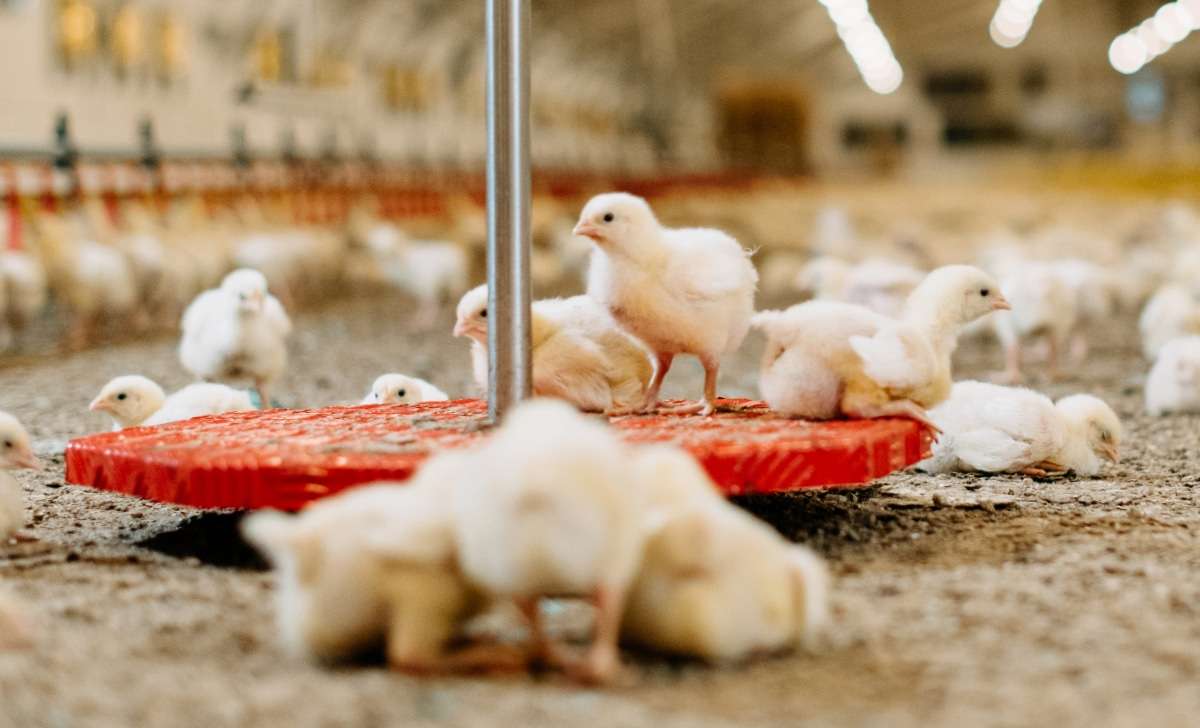
Necrotic enteritis is an intestinal disease of broilers caused by toxins from Clostridium perfringens, and it takes two forms (Hargis, 2023). The clinical form kills fast, with diarrhoea and flock mortality of 2% to 50% (Hargis, 2023). The subclinical form kills few birds but is probably the more costly, because it slows growth and worsens feed conversion across the whole flock, often without being noticed (Hofacre & Rosales, 2022).
Control starts with preventing coccidiosis, the main trigger, and with avoiding sudden feed changes that upset the gut (Hargis, 2023). Outbreaks are treated with antimicrobials in drinking water under veterinary prescription (Hargis, 2023). Because the subclinical form shows up as lost growth, flock weight data can give an early warning.
What Causes Necrotic Enteritis? Clostridium in Poultry
The cause is Clostridium perfringens, a bacterium found in soil, dust, feed, litter and the gut of healthy birds (Hargis, 2023). Its presence alone does not cause disease. Necrotic enteritis in chickens starts when something damages the gut lining or upsets the gut flora, so the bacterium can multiply and release toxins. Other clostridia cause separate diseases, such as ulcerative enteritis (Cooper et al., 2013).
The main trigger is coccidiosis. Eimeria parasites damage the intestinal wall and leak plasma proteins into the gut, which likely feed C. perfringens (Van Immerseel et al., 2004). This is why coccidiosis and necrotic enteritis so often appear together. Diets high in wheat, barley, rye or fish meal add further risk (Hargis, 2023).
Signs of Necrotic Enteritis in Broilers
Necrotic enteritis in broilers appears between 2 and 5 weeks of age, most often at 11 to 18 days, often after the change from starter to grower feed (Hofacre & Rosales, 2022).
In the clinical form, signs are short-lived. Birds may show depression, ruffled feathers and diarrhoea, but often the only sign is a sudden rise in deaths. Outbreaks usually last 5 to 14 days, with mortality from 2% to 50% (Hargis, 2023). Wet litter is both a sign and a risk: diarrhoea wets the litter, and wet litter helps C. perfringens multiply (Tabler, 2019). Weight data has no useful role here.
The subclinical form brings no spike in deaths, only poor performance: slower growth and worse feed conversion (Shojadoost et al., 2012). One economic model estimated a 12% loss in body weight and a 10.9% worse FCR for affected birds (Skinner et al., 2010). Some experimental Necrotic enteritis challenges have also reduced flock uniformity (Choi et al., 2026). This is where daily flock weight data can show a problem the mortality sheet misses.
Diagnosing Necrotic Enteritis in Poultry
A slow growth curve does not name the cause. Coccidiosis, feed problems and heat stress look the same on a weight chart. Diagnosis of necrotic enteritis in poultry needs a post-mortem. The small intestine is ballooned and fragile, often lined with a tan to yellow membrane (Hargis, 2023). Open fresh dead or euthanised birds, because lesions are harder to see once the gut starts to decompose (Hofacre & Rosales, 2022).
A hands-on weighing session can help choose which live birds to sample. In practice, light birds found during weighing are good candidates for a post-mortem.
Using Weight Data to Catch Subclinical Forms
Subclinical necrotic enteritis costs money through lost weight and wasted feed, and feed makes up 65 to 75% of broiler production cost (Hofacre & Rosales, 2022). Weight data cannot diagnose NE, but it can tell you when to look.
The BAT2 Connect automatic scale weighs birds around the clock and compares daily gain with the growth standard. A flock that falls behind its curve during the peak risk window is a reason to check the gut. Automatic scales can miss sick birds that are reluctant to climb onto the platform (Fontana et al., 2017). The slower growth across the rest of the flock still shows in the trend.
The BAT1 manual poultry scale records individual weights with each bird in hand, so staff can check its condition at the same time. Handling also reveals signs of diarrhoea, such as wet or pasted feathers around the vent.
Storing results in the BAT Cloud data platform lets you compare growth across houses and flocks. A dip that returns at the same age each cycle is worth taking to your veterinarian.
Prevention, Control and Treatment
Prevention of necrotic enteritis starts with coccidiosis control, through anticoccidial programmes or vaccination (Hofacre & Rosales, 2022). Avoid sudden feed changes and feed outages, add enzymes to wheat-based diets, clean biofilm from water lines and keep litter dry (Hofacre & Rosales, 2022). Between flocks, clean the house and use a disinfectant that kills spores, because C. perfringens spores survive in the environment (Abd El-Hack et al., 2022). A sound concrete floor with few cracks is easier to clean properly. Selected probiotics and competitive exclusion cultures have also helped (Hargis, 2023).
Treatment for necrotic enteritis uses antimicrobials in drinking water, prescribed by a veterinarian under local rules. Outbreaks tend to end on their own, so the response to treatment can look better than it is (Hargis, 2023).
Clinical necrotic enteritis is a mortality problem. Subclinical necrotic enteritis is a performance problem, and it is the one that weight data can help you find early.
References
- Abd El-Hack, M. E., El-Saadony, M. T., Elbestawy, A. R., El-Shall, N. A., Saad, A. M., Salem, H. M., El-Tahan, A. M., Khafaga, A. F., Taha, A. E., AbuQamar, S. F., & El-Tarabily, K. A. (2022). Necrotic enteritis in broiler chickens: Disease characteristics and prevention using organic antibiotic alternatives – a comprehensive review. Poultry Science, 101(2), 101590. https://www.sciencedirect.com/science/article/pii/S0032579121006118
- Choi, J., Goo, D., Ko, H., Lee, J., & Kim, W. K. (2026). Factors affecting flock uniformity in broiler production: Individual, environmental, and management characteristics. Animals, 16(2), 185. https://www.mdpi.com/2076-2615/16/2/185
- Cooper, K. K., Songer, J. G., & Uzal, F. A. (2013). Diagnosing clostridial enteric disease in poultry. Journal of Veterinary Diagnostic Investigation, 25(3), 314-327. https://journals.sagepub.com/doi/10.1177/1040638713483468
- Fontana, I., Tullo, E., Carpentier, L., Berckmans, D., Butterworth, A., Vranken, E., Norton, T., Berckmans, D., & Guarino, M. (2017). Sound analysis to model weight of broiler chickens. Poultry Science, 96(11), 3938-3943. https://www.sciencedirect.com/science/article/pii/S0032579119311836
- Hargis, B. M. (2023). Necrotic enteritis in poultry. In Merck Veterinary Manual (last updated September 2024). https://www.merckvetmanual.com/poultry/necrotic-enteritis/necrotic-enteritis-in-poultry
- Hofacre, C. L., & Rosales, A. G. (2022). Antibiotic-free and reduced antibiotic use in broiler production: Predisposing factors and control strategies for necrotic enteritis. Aviagen. https://aviagen.com/assets/Tech_Center/Broiler_Breeder_Tech_Articles/English/Focus-ABF-NecroticEnteritis-2022-EN.pdf
- Shojadoost, B., Vince, A. R., & Prescott, J. F. (2012). The successful experimental induction of necrotic enteritis in chickens by Clostridium perfringens: A critical review. Veterinary Research, 43, 74. https://veterinaryresearch.biomedcentral.com/articles/10.1186/1297-9716-43-74
- Skinner, J. T., Bauer, S., Young, V., Pauling, G., & Wilson, J. (2010). An economic analysis of the impact of subclinical (mild) necrotic enteritis in broiler chickens. Avian Diseases, 54(4), 1237-1240. https://pubmed.ncbi.nlm.nih.gov/21313845/
- Tabler, T. (2019). Intestinal health and necrotic enteritis in broilers (Publication 2771). Mississippi State University Extension Service. https://extension.msstate.edu/publications/intestinal-health-and-necrotic-enteritis-broilers
- Van Immerseel, F., De Buck, J., Pasmans, F., Huyghebaert, G., Haesebrouck, F., & Ducatelle, R. (2004). Clostridium perfringens in poultry: An emerging threat for animal and public health. Avian Pathology, 33(6), 537-549. https://www.tandfonline.com/doi/full/10.1080/03079450400013162