
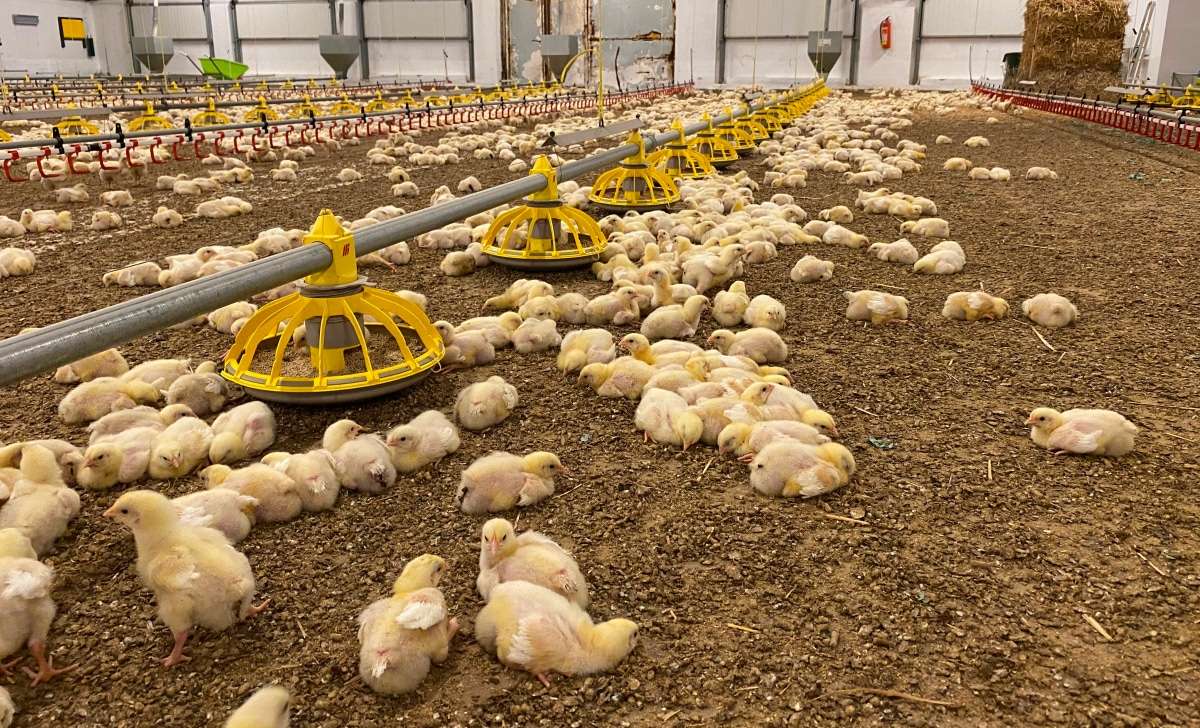
Flooring type beneath drinking lines is not a detail producers can afford to overlook. A field study from the University of Veterinary Medicine Hannover found that installing perforated plastic flooring under waterlines reduced broiler feed conversion ratio from 1.48 to 1.40, a 5.4% improvement that translates directly to production economics.
The field study design and FCR findings
The study compared broilers housed on perforated plastic flooring beneath drinking areas against birds on conventional littered floors. Feed conversion ratio in the experimental group reached 1.40 versus 1.48 in the control group. Given that feed accounts for 60 to 70% of total production costs in commercial operations, a difference of this magnitude carries substantial financial weight. When applied across thousands of birds per cycle, even modest FCR improvements accumulate into meaningful cost reductions.
Feed intake, growth rate, and what the numbers mean
Birds in the slatted flooring group consumed an average of 86.1g of feed per bird per day, compared to 92.1g in the control group. Despite the lower intake, growth rates between the two groups remained comparable. This divergence between intake and output is the critical finding: the experimental birds were converting feed more efficiently, not simply eating less to achieve the same body weight. The data suggests that flooring conditions were influencing nutrient utilisation rather than appetite or growth trajectory.
Footpad health as the connecting mechanism
The proposed mechanism centres on litter moisture management. Perforated flooring beneath drinkers reduces moisture accumulation in the zones where birds congregate most frequently, limiting the wet litter conditions that drive footpad dermatitis and restrict mobility. When birds can move to feeders without discomfort, energy that would otherwise be directed toward coping with pain or avoiding wet areas is available for productive growth.
Footpad scoring data from camera-based slaughterhouse assessments supports this interpretation. Birds on perforated flooring scored 2.11 on a 7-point scale compared to 2.88 for conventionally housed birds. Improved foot health correlates with more consistent feeding behaviour and reduces the energetic cost of compromised mobility. The flooring modification, in this reading, improved FCR primarily by removing a welfare constraint rather than by altering nutrition or feed access directly. Accurate weight monitoring across the production cycle remains essential for detecting performance shifts of this kind and quantifying the return on housing investment.
Sources
Sonnabend, S.-J., et al. „Influence of Using Perforated Plastic Flooring Beneath the Waterline on Growth Performance, Litter Quality, and Footpad Health of Broiler Chickens: A Field Study.“ Animals 2022, 12, 1749. https://www.mdpi.com/2076-2615/12/14/1749