
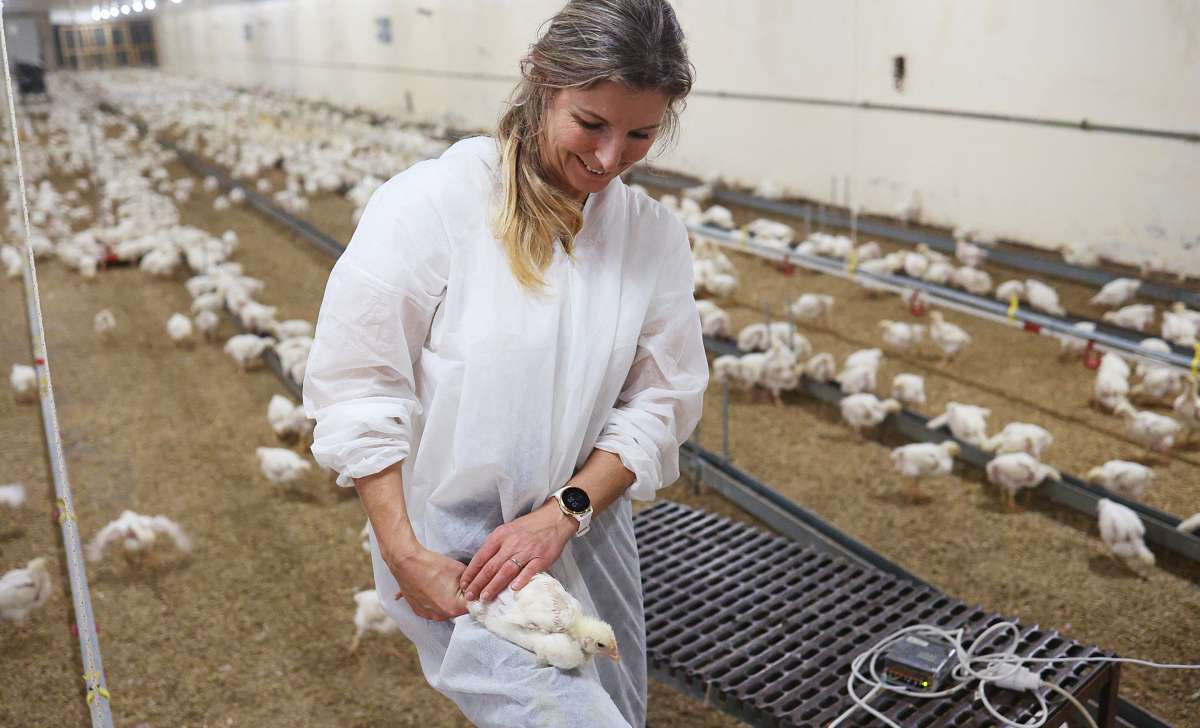
The hatchery occupies a unique position in the poultry production system: it collects eggs from various parent flocks and then distributes day-old chicks to farms for further rearing. This position makes the hatchery a virtual crossroads, which unfortunately also creates a risk of introducing and spreading pathogens. Effective biosecurity and hygiene measures in hatcheries are critical for reducing microbial entry and persistence, ultimately protecting the health of the progeny. Because resilient pathogens share transmission pathways with many other infectious agents, establishing rigorous contamination controls provides broad protection across the entire facility.
Below are the most important measures for preventing the introduction and spread of disease in modern hatchery operations.
Hatchery Design, Layout, and Workflow
The physical infrastructure and daily operational flow of a hatchery form the first line of defense against disease transmission.
- Location: Facilities should be securely fenced and isolated from major roads, feed mills, and other high-density poultry or livestock populations.
- Unidirectional workflow: The internal layout must enforce strict work patterns that prevent personnel and mobile equipment from moving from „dirty“ areas back into „cleaner“ ones.
- Air and water management: Ventilation systems should use pressure gradients to direct airflow from clean to dirty zones. Treating incoming air (through filters or UV light) and preventing air recirculation helps stop airborne spread.
- Filter maintenance: Air intake filters must be checked weekly and replaced on a strict schedule to prevent fungal spores from colonizing the ventilation ducts.
- Batch isolation: Hatchery capacity should allow for single-batch use of separate setter, incubator, and hatcher rooms, making thorough cleaning and disinfection between cycles possible. Multi-stage setters should be avoided, since they prevent „all-in-all-out“ sanitation.
- Physical barriers: Use distinct changing rooms, footwear-washing stations, or color-coded uniforms for personnel working in different sectors. Staff assigned to harvesting or waste areas should never re-enter the incubation rooms without a full shower and change of clothes (Aviagen, 2025).
Personnel and Mobile Equipment Biosecurity
Even when strict boundaries are in place, human traffic and mobile equipment present ongoing contamination risks. Key mitigation protocols include:
- Sanitation safeguards: Mandatory showering, hand sanitizing, footbaths, vehicle wheel-baths, and dedicated hatchery clothing.
- Visitor protocols: Visiting staff, such as transport drivers, should be equipped with disposable coveralls and foot covers.
- Traceability and separation: Egg trays should be clearly labeled and strictly dedicated to a single supply farm to prevent cross-farm contamination.
- Staff health: Employees must not work while ill, particularly after foreign travel (Wales and Davies, 2020).
Sanitation in the Hatchery
Effective sanitation depends on never disinfecting a surface without cleaning it first, since organic matter actively deactivates most disinfectants. Every room and piece of equipment must therefore go through a strict four-step process after each hatch cycle to ensure proper hygiene. The process begins with a dry clean to remove physical debris, shells, down, and organic waste; this prevents clogged drains and eliminates bulk organic material. Next comes a wet wash, applying a high-quality detergent with hot water or foamers to break down the fats, proteins, and biofilms clinging to surfaces. A thorough rinse follows, clearing away loosened dirt and detergent residue and preparing the clean surface for direct contact with disinfectant. Finally, the disinfection step applies a broad-spectrum disinfectant, such as glutaraldehyde, quaternary ammonium, or peracetic acid, to eliminate any remaining microscopic pathogens, bacteria, and viruses (Anon, 2016; Bennett, 2017).
Egg Hygiene and Disinfection
Bacterial control is most effective when it begins as close to the point of lay as possible, before bacteria can penetrate the eggshell. Hatchery biosecurity relies heavily on the breeding farm’s cleanliness, proper maintenance of nest boxes, and strict rejection of floor-laid eggs.
Formaldehyde has long been the gold standard for egg disinfection, though some concerns about its effects on human health remain. This has driven the industry toward alternative sanitation techniques, including:
- Aqueous disinfectants: Sequential pressure sprays of chlorine-based agents and quaternary ammonium compounds provide strong decontamination, though stabilized formulations are needed to prevent microbial regrowth after treatment.
- Synergistic physical treatments: Combining ultraviolet (UV) light with hydrogen peroxide (H₂O₂) has been shown to act synergistically against surface pathogens (Berrang et al., 1997).
- Comparative disinfection studies: Motola et al. (2023) evaluated four disinfection methods for commercial hatching eggs and found that formaldehyde, peracetic acid, and low-energy electron beam all significantly reduced eggshell bacterial loads, while a hydrogen peroxide plus alcohol treatment proved ineffective. Notably, only the low-energy electron beam achieved disinfection levels comparable to formaldehyde, though using electron beam technology remains highly complicated under realistic hatchery conditions.
Equipment Maintenance and Biofilm Prevention
Persistent bacterial biofilms within hatchery equipment present a major challenge to routine disinfection.
- Hatcher cabinet treatments: Antimicrobial fogging or chemical treatments (such as ozone or H₂O₂ fogging) and physical methods (UV irradiation or air ionization) applied during hatching help reduce airborne Enterobacteriaceae and Salmonella colonization in young chicks (Mitchell et al., 2002).
- Sanitation failures: Tray washing machines can become reservoirs for biofilms if operated at inadequate temperatures or with improper disinfectant concentrations. Egg transfer equipment is similarly susceptible to recontamination (Dorko et al., 2019).
- Equipment design: Hatchery machinery should ideally be built from heat-resistant materials to allow for steam or combined heat-and-chemical biocide treatments, ensuring deep sanitation in hard-to-clean areas (Yuan et al., 2020).
Water Quality and Vapor Control
Water is the lifeblood of a hatchery, used for humidity control, washing, and chemical dilution, which makes it a primary vector for pathogens if left unmanaged. All incoming water must be filtered and treated (via chlorination, UV irradiation, or ozone filtration) to eliminate waterborne bacteria and molds such as Pseudomonas or Aspergillus. Because standing water is a breeding ground for bacteria, humidification systems should use micro-droplet nozzles that evaporate quickly rather than leaving wet films on walls or floors (Wales and Davies, 2020).
Waste Management and Environmental Vectors
Contamination risks frequently concentrate around the back end of hatchery operations.
- Waste handling: Areas managing egg and chick waste (macerators, separators, holding skips) and waste pipes must be closely monitored for leaks and structural cleanliness.
- Cross-contamination loops: Dust extraction vents and waste skips are often placed too close to truck-washing facilities. This proximity can inadvertently contaminate transport vehicles and driver footwear, carrying pathogens back to breeding farms or out to grower facilities (Martelli et al., 2016).
- Wildlife control: Strict measures must be enforced to exclude pests, rodents, and wild birds from the premises, eliminating external biological vectors (Mueller-Doblies et al., 2013).
Surveillance, Monitoring, and Action Plans
A successful biosecurity program requires objective, routine verification alongside an established emergency protocol.
Environmental Monitoring
To assess whether cleaning and disinfection are adequate, hatcheries should regularly conduct total viable counts, coliform/fungal swabs, and air sampling (settle plates). Essential routine sampling sites include:
- Hatcher baskets and associated waste, including dead embryos
- Hatcher surfaces, chick transfer belts, and box liners
- Incubator and hatching room surfaces, water supplies, and trapped pests (McMullin et al., 2009)
Diagnostics and Intervention
While conventional culture and phenotypic typing remain the standard methods for isolating pathogens, Polymerase Chain Reaction (PCR) screening provides rapid, highly sensitive initial detection, and whole-genome sequencing offers the most precise strain discrimination available. Research-level surveillance increasingly relies on phenotypic and genotypic screening alongside metagenomic approaches to map the hatchery „resistome“ and track antimicrobial resistance (Osman et al., 2018).
Action plan trigger: If a pathogen such as Salmonella is isolated, a mandatory action plan must be triggered to trace the source. This often requires completely stripping down complex equipment, particularly hatchers and ventilation ducts, to uncover hidden reservoirs of ongoing contamination.
Flock and batch tracking: Maintaining detailed logs of egg sources is essential. If a specific supply farm introduces a pathogen, trace-back capability allows the hatchery to isolate the affected batches before they contaminate the rest of the facility.
Conclusion
Hatcheries offer a unique biological opportunity to act as a microbiological firebreak between poultry generations, but they also present a significant risk for the multiplication and spread of pathogens such as Salmonella and Escherichia coli. While individual studies confirm the hatchery’s role in flock colonization, its relative contribution compared to breeding flocks and environmental sources remains largely unquantified. Using advanced subtyping methods, such as next-generation sequencing, across multi-level generation studies could help clarify where control resources are best deployed. Ultimately, exercising real control over these infectious agents depends heavily on strict hygiene and biosecurity measures that extend beyond the hatchery itself to encompass breeder premises and transportation.
Cited sources
1.) Anon. 2016. „Prevention of Cross-contamination in the Hatchery. Hatchery Practice (Zootecnica International).“ July 3. Accessed 30 September 2019. https://zootecnicainternational.com/poultry-facts/steps-for-the-prevention-of-cross-contamination-in-the-hatchery
2.) Aviagen 2025, Hatchery tips. Available at: https://aviagen.com/assets/Tech_Center/BB_Resources_Tools/Hatchery_Tips/HatcheryTips-EN.pdf
3.) Bennett, B. 2017. „The Importance of Biosecurity in the Modern Day Hatchery.“ International Hatchery Practice 31: 21–23.
4.) Berrang, M. E., Frank, J. F., Buhr, R. J., Bailey, J. S., Cox, N. A., & Mauldin, J. M. (1997). Microbiology of sanitized broiler hatching eggs through the egg production period. Journal of Applied Poultry Research, 6(3), 298-305.
5.) Dorko, N. 2019. „Salmonella: How Do We Maintain Freedom in Our Poultry Flocks?“ International Hatchery Practice 33: 9–10.
6.) Martelli, F., Birch, C., & Davies, R. H. (2016). Observations on the distribution and control of Salmonella in commercial duck hatcheries in the UK. Avian Pathology, 45(2), 261-266.
7.) McMullin, P. F. (2009). Hygiene and microbiological control in hatcheries. Avian Biology Research, 2(1-2), 93-97.
8.) Mitchell, B. W., Buhr, R. J., Berrang, M. E., Bailey, J. S., & Cox, N. A. (2002). Reducing airborne pathogens, dust and Salmonella transmission in experimental hatching cabinets using an electrostatic space charge system. Poultry Science, 81(1), 49-55.
9.) Motola, G., Hafez, H. M., & Brüggemann-Schwarze, S. (2023). Assessment of three alternative methods for bacterial disinfection of hatching eggs in comparison with conventional approach in commercial broiler hatcheries. PloS one, 18(3), e0283699.
10.) Mueller‐Doblies, D., Clouting, C., & Davies, R. H. (2013). Investigations of the distribution and persistence of Salmonella and ciprofloxacin‐resistant Escherichia coli in turkey hatcheries in the UK. Zoonoses and Public Health, 60(4), 296-303.
11.) Osman, K. M., Kappell, A. D., Elhadidy, M., ElMougy, F., El-Ghany, W. A. A., Orabi, A., … & Yousef, H. M. (2018). Poultry hatcheries as potential reservoirs for antimicrobial-resistant Escherichia coli: A risk to public health and food safety. Scientific reports, 8(1), 5859.
12.) Wales, A., & Davies, R. (2020). Review of hatchery transmission of bacteria with focus on Salmonella, chick pathogens and antimicrobial resistance. World’s Poultry Science Journal, 76(3), 517-536.
13.) Yuan, L., Hansen, M. F., Røder, H. L., Wang, N., Burmølle, M., & He, G. (2020). Mixed-species biofilms in the food industry: current knowledge and novel control strategies. Critical reviews in food science and nutrition, 60(13), 2277-2293.