
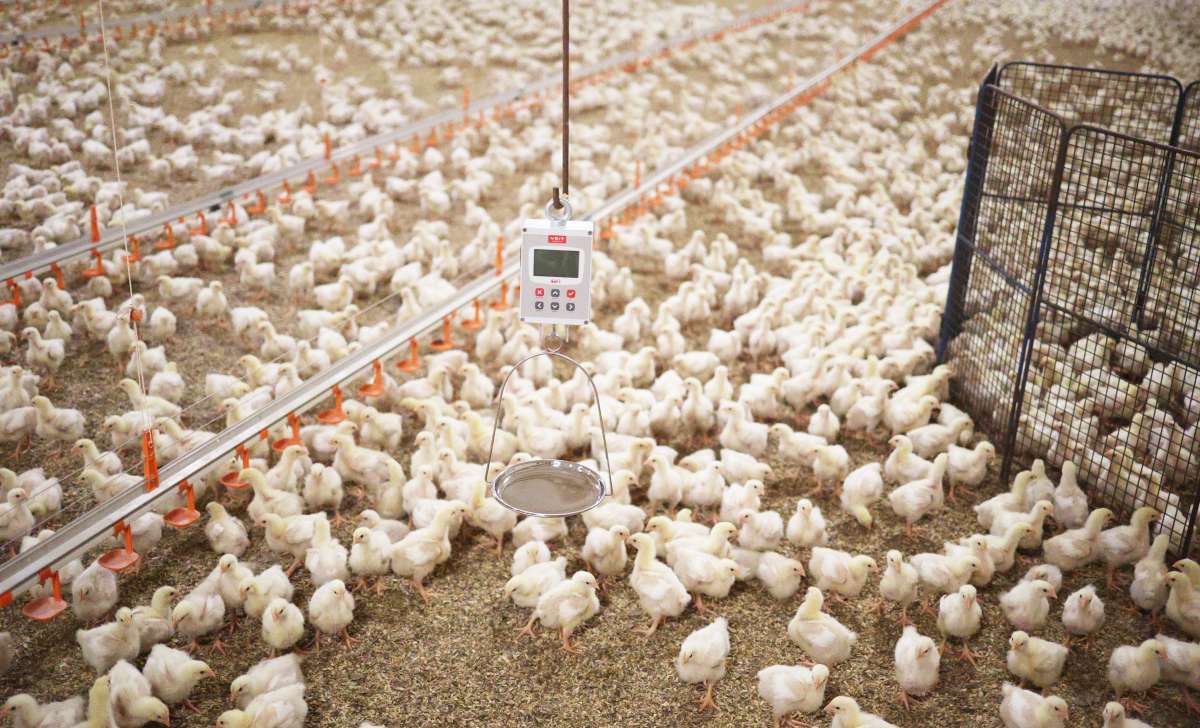
Ammonia in the broiler barn is one of the most damaging performance variables a producer can face, and one of the least visible. Research now quantifies the loss with precision: birds raised in environments with 35 ppm ammonia weigh 694 grams less at 43 days than birds raised in ammonia-free conditions. That gap represents lost revenue on every bird that leaves the farm.
A linear relationship between ammonia and weight loss
Zhou et al. (2020) exposed broilers to different ammonia concentrations from 22 days of age. At 43 days, birds in 35 ppm ammonia environments recorded a mean bodyweight of 1,522 grams, compared to 2,216 grams for birds in clean air. The weight suppression follows a linear pattern: as ammonia concentration rises, bodyweight falls proportionally. Performance does not plateau and then decline. It deteriorates continuously as exposure increases.
Research establishes 25 ppm as the threshold above which ammonia begins to drag on broiler performance (Miles et al., 2004). By the end of the fattening period, concentrations on many commercial farms commonly exceed 50 ppm. The gap between the performance threshold and typical end-of-cycle conditions is wide enough to represent a systematic and ongoing production loss.
Where the problem starts: litter moisture and ventilation
Ammonia generation is a function of microbial activity in litter. When litter moisture rises above 25%, bacteria break down nitrogen from excreta at an accelerating rate. Poor ventilation prevents gas dispersal at bird level, concentrating ammonia where the flock lives and breathes. The cycle compounds as birds under environmental stress consume more water, which raises litter moisture further and drives ammonia production higher.
Litter material influences ammonia output significantly. A systematic review and meta-analysis by Toledo et al. (2019) found that compact litter with a surface crust produces 49% less ammonia than loose, friable bedding. Wood shavings outperform alternative bedding materials for ammonia control. Maintaining litter moisture between 20% and 25% keeps bacterial activity within a range that limits gas generation.
What producers typically misattribute
Ammonia-related weight loss does not present with obvious clinical signs. Birds simply grow more slowly. Feed conversion deteriorates. Without environmental monitoring, the cause is easy to misidentify. Producers may attribute underperformance to genetics, feed quality, or subclinical disease pressure, and adjust inputs accordingly, without addressing the actual driver. Miles et al. (2004) confirmed that atmospheric ammonia is detrimental to the performance of modern commercial broilers, reinforcing that this is not an edge-case risk but a routine production challenge.
The sensory threshold for ammonia is also a poor proxy for flock exposure. By the time eye irritation is noticeable to a person entering the barn, ammonia has already reached concentrations that are damaging to the birds.
Weight monitoring as an early warning system
Regular bodyweight tracking provides an early signal that environmental conditions have deteriorated. When a growth curve flattens or feed conversion worsens without an obvious cause, elevated ammonia should be among the first variables investigated. Weight deviation from an expected growth trajectory can appear within days of an ammonia spike, ahead of any visible clinical signs.
Ammonia stress also suppresses immune function, increasing susceptibility to secondary disease challenges (Zhou et al., 2020). Flock uniformity suffers as individual birds respond differently to the same environmental load. Early detection through precise weight monitoring allows intervention through ventilation adjustment, fresh bedding application, or litter treatment before losses accumulate across the batch.
Sources
Zhou, Y., Liu, Q. X., Li, X. M., Ma, D. D., Xing, S., Feng, J. H., & Zhang, M. H. (2020). Effects of ammonia exposure on growth performance and cytokines in the serum, trachea, and ileum of broilers. Poultry Science, 99(5), 2485–2493. https://www.sciencedirect.com/science/article/pii/S0032579120300614
Miles, D. M., Branton, S. L., & Lott, B. D. (2004). Atmospheric ammonia is detrimental to the performance of modern commercial broilers. Poultry Science, 83(10), 1650–1654. https://www.sciencedirect.com/science/article/pii/S0032579119533854
Toledo, T. D. S. D., Pich, C. S., Roll, A. A. P., Dai Prá, M. A., Leivas Leite, F., Gonçalves Xavier, E., & Roll, V. F. B. (2019). The effect of litter materials on broiler performance: a systematic review and meta-analysis. British Poultry Science, 60(6), 605–616. https://www.tandfonline.com/doi/full/10.1080/00071668.2019.1639iraqi