
An egg bound chicken cannot pass a fully formed egg through the oviduct on schedule. The condition affects backyard layers and commercial flocks, and can turn serious in a day. Most cases trace back to excess body weight or a laying cycle that started before the hen‚s body was ready (Espinosa, 2024b).
Egg Binding Symptoms in Laying Hens
For backyard flock owners who can observe individual birds, egg binding symptoms often start quietly. A hen may sit apart from the flock, strain repeatedly, or stand upright with her back nearly vertical, a stance called the penguin posture (Espinosa, 2024b). Appetite drops, the vent may look swollen, and the abdomen can feel firm or distended.
Egg Binding: How to Tell at the Commercial Level
In commercial flocks, an individual case is rarely caught alive. A four-year necropsy survey found the syndrome in 2.74 percent of birds, yet affected hens died with no premonitory signs and no drop in production (Srinivasan et al., 2014). Because mortality gives no warning, systematic post-mortem categorisation is how producers track it (Lanthier, 2022).
What Causes Egg Binding: Obesity and Premature Photostimulation
Two conditions explain most cases. Overweight hens carry excess abdominal fat that crowds the reproductive tract, confirmed in commercial flock necropsies and more common in broiler breeders than table-egg layers (Espinosa, 2024b; Srinivasan et al., 2014). Pullets pushed into lay before their skeleton and oviduct mature face the same risk.
Photostimulation uses extended daylength to trigger onset of lay, but it only works safely when the hen is physiologically ready. A pullet needs a measurable body fat reserve before her hormones can trigger sexual maturity, not just a target age (Bahry et al., 2023; Hanlon et al., 2020). Applied too early, photostimulation can result in an oviduct that lacks the muscular development to pass a fully formed egg, and a skeleton that cannot yet meet the calcium demands of shell formation (Cobb-Vantress, 2021).
Calcium shortfalls compound the problem. Without enough circulating calcium, the shell gland cannot contract forcefully enough to move the egg, a condition called calcium tetany that recent oviduct studies link to calcium deficiency, stress, and aging alike (Espinosa, 2024a; Hosotani et al., 2023).
Calcium management is equally important. Diets formulated to meet lay-phase calcium requirements, supplemented with oyster shell where needed, maintain the shell gland function that prevents tetany (Espinosa, 2024a).
Preventing Egg Binding by Monitoring Weight Curves
Because individual cases give no warning, prevention beats detection. Continuous live weight monitoring through rearing gives producers a daily weight picture against the growth curve, closing the gaps that periodic sampling leaves.
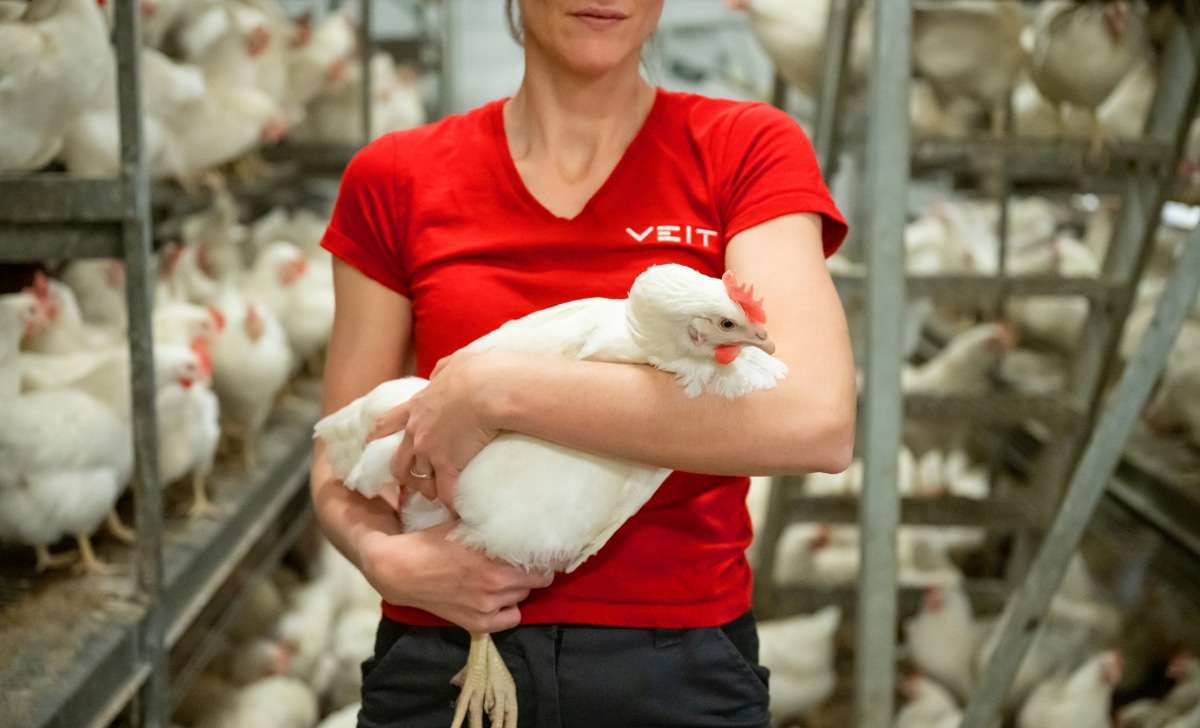
Manual weighing is the only way to identify individual birds with problematic weight development. The BAT1 manual scale provides that individual data while the handler simultaneously assesses abdominal fat deposits and abdominal distension, catching what a flock average cannot reveal.
Where uniformity drifts wide, the BAT1 Sorting Machine separates birds by weight class so feed and light programs can be tailored per group.
Comparing weight curves against breed targets makes outliers easier to catch before they become cases.
Egg Binding Treatment: From Home Care to Veterinary Help
In commercial flocks, an egg-bound hen found alive is typically culled. The intervention window is too narrow, and individual treatment is not viable at scale.
For backyard flocks, egg binding treatment starts with a warm bath and twenty minutes in a quiet, dark space to relax the muscles. Calcium supplements support uterine contractions under veterinary guidance (Espinosa, 2024a).
If the egg has not passed within 24 hours, a veterinarian can combine fluid therapy, lubrication, and pain control before mechanical removal (Espinosa, 2024b). Multiple strategies outperform a single approach in clinical cases (Vavlas et al., 2025).
For commercial producers, the only viable response is prevention.
References
Bahry, M. A., Hanlon, C., Ziezold, C. J., Schaus, S., & Bédécarrats, G. Y. (2023). Impact of growth trajectory on sexual maturation in layer chickens. Frontiers in Physiology, 14, 1174238. https://pmc.ncbi.nlm.nih.gov/articles/PMC10196195/
Cobb-Vantress. (2021). Cobb Breeder Management Guide. https://www.cobbgenetics.com/assets/Cobb-Files/Breeder-Management-Guide.pdf
Espinosa, R. A. (2024a). Calcium metabolism problems in hens. Merck Veterinary Manual. https://www.merckvetmanual.com/poultry/disorders-of-the-reproductive-system-in-poultry/calcium-metabolism-problems-in-hens
Espinosa, R. A. (2024b). Egg-bound or impacted oviducts in poultry. Merck Veterinary Manual. https://www.merckvetmanual.com/poultry/disorders-of-the-reproductive-system-in-poultry/egg-bound-or-impacted-oviducts-in-poultry
Hanlon, C., Ramachandran, R., Zuidhof, M. J., & Bédécarrats, G. Y. (2020). Should I lay or should I grow: Photoperiodic versus metabolic cues in chickens. Frontiers in Physiology, 11, 707. https://pmc.ncbi.nlm.nih.gov/articles/PMC7332832/
Hosotani, M., Hamano, S., Iwasaki, T., Hasegawa, Y., Ueda, H., & Watanabe, T. (2023). Oviduct histopathology of internal laying and egg-bound syndrome in laying hens. Veterinary Sciences, 10(4), 260. https://pmc.ncbi.nlm.nih.gov/articles/PMC10142957/
Lanthier, B. (2022). Broiler breeder hen mortality. Canadian Poultry Magazine. https://www.canadianpoultrymag.com/broiler-breeder-hen-mortality/
Srinivasan, P., Balasubramaniam, G. A., Gopala Krishna Murthy, T. R., & Balachandran, P. (2014). Prevalence and pathology of egg bound syndrome in commercial white leghorn chicken. Journal of World’s Poultry Research, 4(2), 30–36. http://jwpr.science-line.com/attachments/article/24/J%20World’s%20Poult%20Res%204(2)%2030-36,%202014.pdf
Vavlas, A., Galusha, H., Mayer, J., Speer, B., & Di Girolamo, N. (2025). Resolution of egg binding is possible in most client-owned parrots when multiple treatment strategies are considered. Journal of the American Veterinary Medical Association, 263(5), 628–634. https://pubmed.ncbi.nlm.nih.gov/39938214/