
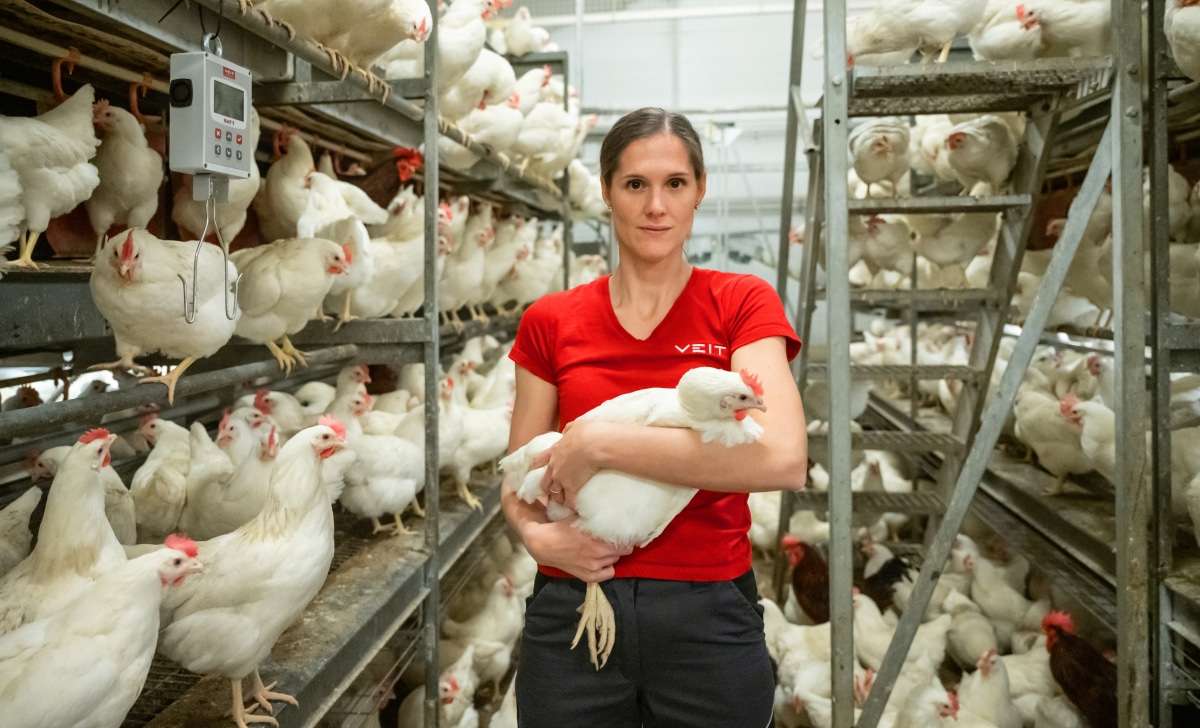
Research into commercial layer flocks has produced a finding that challenges one of the most ingrained assumptions in poultry production: heavier birds are not necessarily healthier birds.
The weight-welfare paradox in commercial laying flocks
A comprehensive study of 33 commercial layer flocks identified a striking pattern in the relationship between body weight and skeletal health. While lighter hens showed increased susceptibility to keel bone fractures early in the laying period, heavier hens showed a significantly higher occurrence of keel bone fractures at 65 weeks of age across both conventional cage and floor housing systems
(Petrik et al., 2015). The assumption that maximum weight gain equates to optimal performance does not hold when skeletal welfare is considered alongside production metrics.
Beyond fracture risk, excessive weight in laying hens is typically associated with increased fat deposition rather than productive tissue. Birds in this condition consume more feed without converting that intake into additional eggs, creating a direct drag on profitability that compounds the welfare burden.
Fracture prevalence across housing systems
The scale of keel bone damage in commercial flocks is substantial. Fracture prevalence reached 48.3% in floor-housed flocks compared to 24.8% in cage systems, with the majority of fractures occurring by 50 weeks of age (Petrik et al., 2015). By 65 to 74 weeks, damage prevalence ranged between 26% and 74% across flocks, with severe alterations affecting up to 15% of birds (Marggraff et al., 2024).
Housing system interacts with body weight in ways that are not straightforward. Mean body weight was significantly lower in floor-housed flocks at 1,827 g compared to 1,888 g in cage-housed flocks, yet floor systems recorded double the fracture rates (Petrik et al., 2015). This dissociation between weight and fracture burden across systems underscores that body weight alone does not determine risk, but that weight extremes within a flock remain a meaningful signal worth monitoring.
What excess body weight signals about feed efficiency and profitability
Keel bone damage carries consequences that extend well beyond welfare. Fractures affect laying performance, egg quality, and feed efficiency. The correlation between heavier birds and elevated fracture rates at end of lay suggests that injuries may reduce mobility while simultaneously increasing compensatory feed consumption, a combination that erodes both output and margin.
Regular weighing provides more than a production metric. Hands-on assessment during manual weighing sessions creates opportunities to identify weight extremes before they become flock-wide problems. Automated scales such as the BAT2 Connect can extend this oversight between manual sessions, providing a
continuous picture of flock weight development that allows producers to act on emerging trends rather than responding to established ones. In a welfare issue of this scale, where fracture prevalence can affect nearly half the birds in some systems, early detection is the most effective lever available.
Sources
Marggraff, J. et al. (2024). Factors associated with keel bone damage – a longitudinal study of commercial layer flocks during the laying period. British Poultry Science. https://www.tandfonline.com/doi/full/10.1080/00071668.2024.2305998
Petrik, M.T. et al. (2015). On-farm comparison of keel fracture prevalence and other welfare indicators in conventional cage and floor-housed laying hens in Ontario, Canada. Poultry Science. https://www.sciencedirect.com/science/article/pii/S0032579119305528