
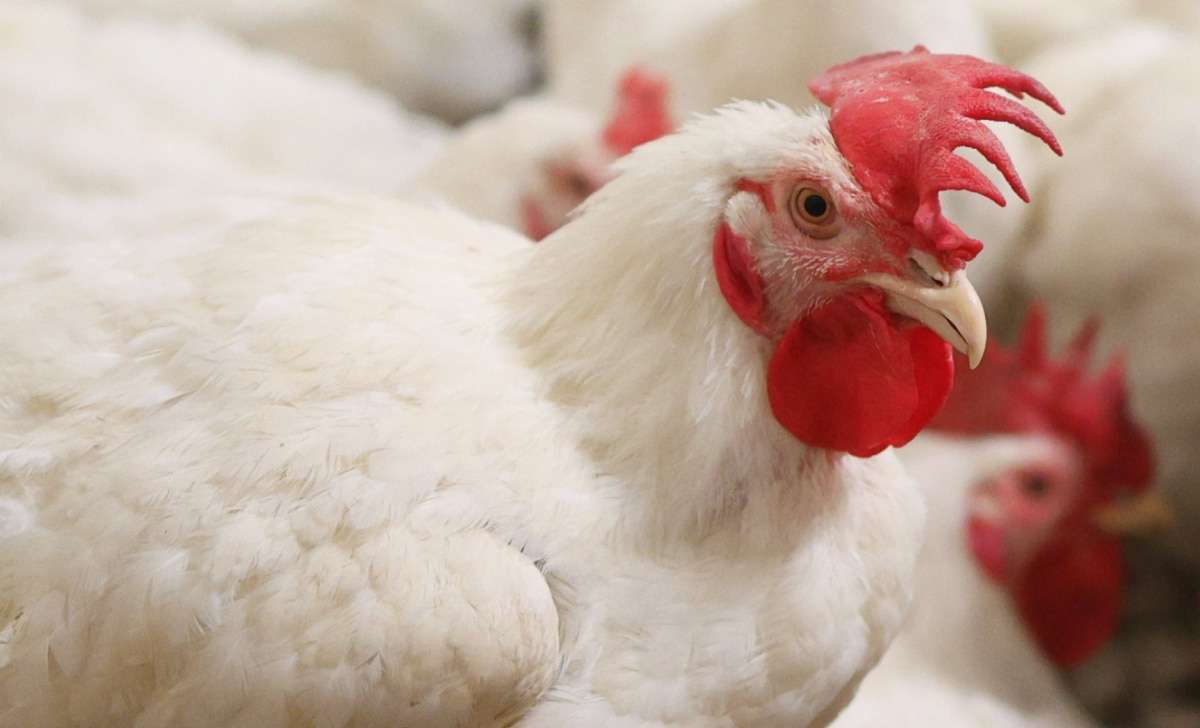
Purpose, not age, determines how long a commercial chicken lives. The lifespan of a chicken in an industrial setting is fixed by its productive role. Modern hybrids bear little resemblance to heritage breeds; decades of intensive selection have compressed what once took months into a matter of weeks.
Broilers: A Lifespan Measured in Days
Fast-growing broiler strains such as Ross 308 and Cobb 500 reach slaughter weight between 30 and 35 days, with average live weights of approximately 2.5 kg in the EU (Welfare Footprint Institute, 2025). Havenstein et al. (2003) documented that modern broilers achieve more than three times the 8-week body weight of 1957 lines on equivalent diets, with most of that gain attributed to genetics rather than nutrition alone.
Growth in broilers is not linear and not uniform across a flock. Tracking live weight against breed-specific growth curves day by day is the most reliable way to detect welfare and performance problems early. Deviation from target weight in the first week can signal nutritional shortfalls or thermal stress that compound throughout the grow-out. Continuous automated weighing across thousands of birds is the practical tool for this. The BAT2 Connect automatic poultry scale provides that uninterrupted daily weight trajectory without disturbing bird behaviour. Manual sessions add a critical data integrity layer: the BAT1 manual poultry scale gives production staff individual bird data, fleshing scores, and hands-on welfare checks that no automated system captures. Because birds are weighed one by one, a manual session produces statistically stronger per-session samples than continuous automatic recording alone.
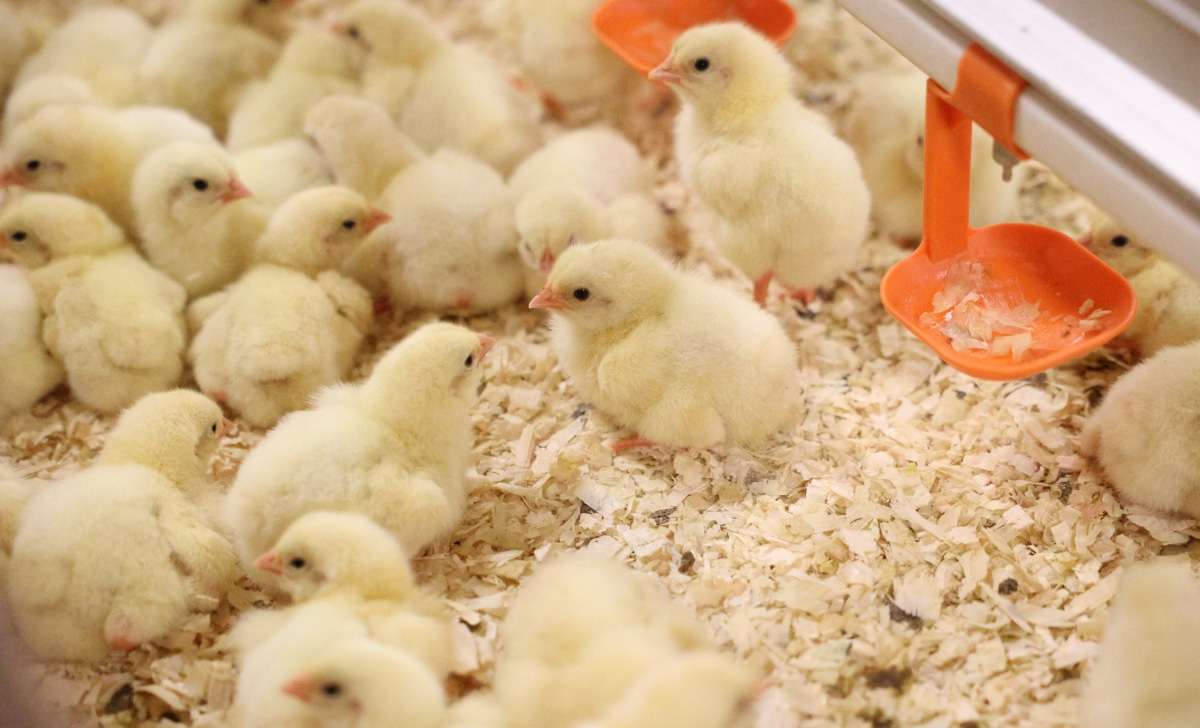
Laying Hens: A Longer Productive Window
Commercial laying hens begin production at around 18 to 19 weeks of age. In a single-cycle system, productive life typically ends between 80 and 95 weeks (The Poultry Site, 2023), though genetic selection for laying persistency has pushed commercial targets toward 80 weeks or beyond without moulting (Lohmann Breeders, 2020). Flock weight throughout rearing directly predicts production outcomes. Reaching target body weight by 16 weeks supports better laying performance, and heavier pullets at the onset of lay produce heavier eggs (Mels et al., 2023). Peer-reviewed welfare monitoring research in commercial Austrian flocks used the BAT 2 for automatic bodyweight and uniformity recording throughout the laying period (Mels et al., 2023), while individual hen weighing at key ages across the same flock series confirmed its value for targeted assessment (Sibanda et al., 2021).
Broiler Breeders: Longest Chicken Lifespan in Meat Production
Among birds in the broiler production chain, the parent stock hen carries the longest productive lifespan. A broiler breeder flock is typically depleted between 60 and 65 weeks of age, depending on fertility, hatch percentage, and market conditions (Cobb-Vantress, 2020). Beyond 65 to 70 weeks, fertility declines to levels that make continued production uneconomical (The Poultry Site, 2022).
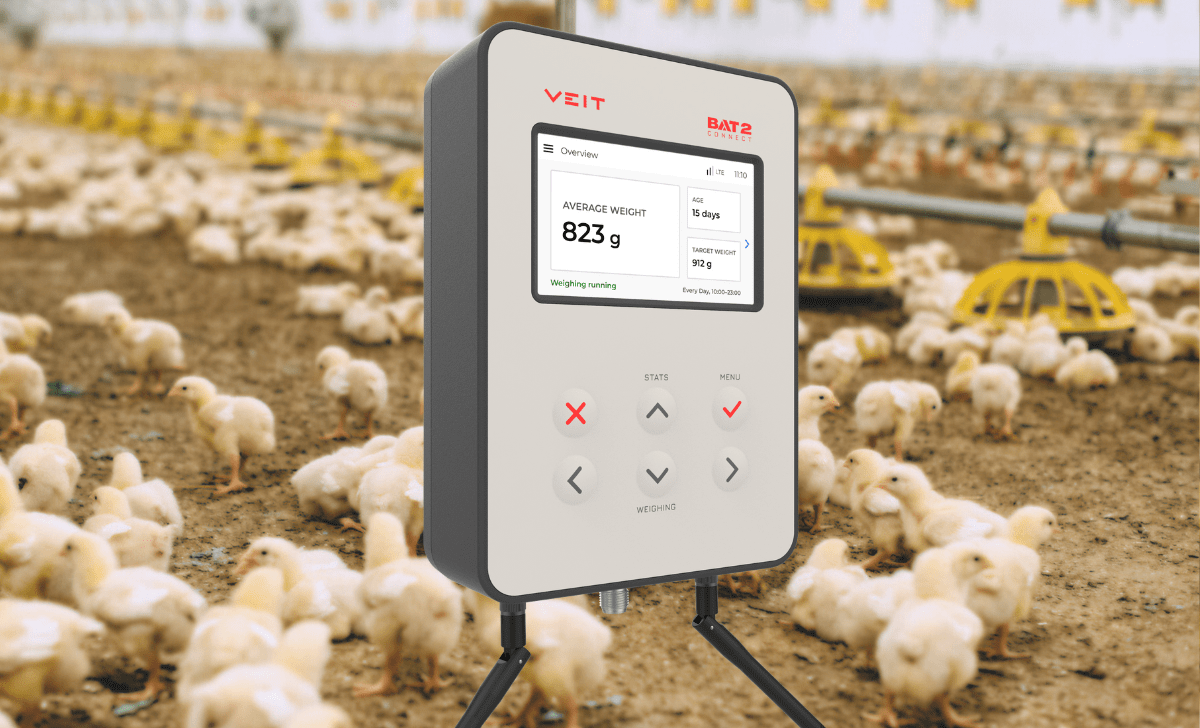
Broiler breeders are genetically inclined toward excess weight gain, which suppresses reproductive efficiency, making body weight the central metric of every management decision from rearing through lay (Cobb-Vantress, 2020). Flock uniformity is equally critical. Poor uniformity directly reduces mating frequency: males that become too heavy cannot complete matings efficiently, and fertilisation rates fall as a result (Cobb-Vantress, 2020).
Flocks with higher uniformity also reach peak egg production earlier and produce more consistent hatching eggs (Abbas et al., 2010, as cited in Mels et al., 2023). The BAT2 Connect supports the continuous automated weighing breeder programs demand. BAT Cloud gives multi-house operations the ability to benchmark weight uniformity across buildings and identify performance gaps early. Body weight assessment of males continues throughout the production period: overweight roosters whose mating activity has declined are identified and replaced with younger, lighter males. Individual male weighing and culling during production requires the precision and hands-on access that only a manual scale provides.
References
1.) Abbas, S.A., Gasm Elseid, A.A., and Ahmed, M.-K.A. (2010). Effect of body weight uniformity on the productivity of broiler breeder hens. International Journal of Poultry Science, 9(3), 225–230. https://ijpsjournal.org/ijps/article/view/1383
2.) Cobb-Vantress (2020). Cobb Breeder Management Guide. Cobb-Vantress, Inc. https://www.thepoultrysite.com/articles/cobb-breeder-management-guide-flock-depletion
3.) Havenstein, G.B., Ferket, P.R., and Qureshi, M.A. (2003). Growth, livability, and feed conversion of 1957 versus 2001 broilers when fed representative 1957 and 2001 broiler diets. Poultry Science, 82(10), 1500–1508. https://pubmed.ncbi.nlm.nih.gov/14601725/
4.) Lohmann Breeders (2020). Feeding laying hens to 100 weeks of age. Lohmann Information. https://lohmann-breeders.com/lohmanninfo/feeding-laying-hens-to-100-weeks-of-age-2/
5.) Mels, C., Niebuhr, K., Futschik, A., Rault, J.-L., and Waiblinger, S. (2023). Development and evaluation of an animal health and welfare monitoring system for veterinary supervision of pullet farms. Preventive Veterinary Medicine, 217, 105929. https://www.sciencedirect.com/science/article/pii/S0167587723000934
6.) Sibanda, T.Z., Kolakshyapati, M., Walkden-Brown, S.W., de Souza Vilela, J., Courtice, J.M., and Ruhnke, I. (2020). Body weight sub-populations are associated with significantly different welfare, health and egg production status in Australian commercial free-range laying hens in an aviary system. European Poultry Science, 84. https://www.sciencedirect.com/science/article/pii/S000390982500298X
7.) The Poultry Site (2022). Cobb Breeder Management Guide: Flock depletion. https://www.thepoultrysite.com/articles/cobb-breeder-management-guide-flock-depletion
8.) The Poultry Site (2023). US Poultry Industry Manual: Production cycles of egg-type chickens. https://www.thepoultrysite.com/articles/production-cycles-of-egg-type-chickens
9.) Welfare Footprint Institute (2025). Broilers: Welfare data and scenarios. https://welfarefootprint.org/broilers/