
How do poultry farming methods worldwide differ across major regions? Comparing global poultry production reveals striking international poultry industry differences in regulatory frameworks, production scales, and welfare standards.
Production Scale Variations
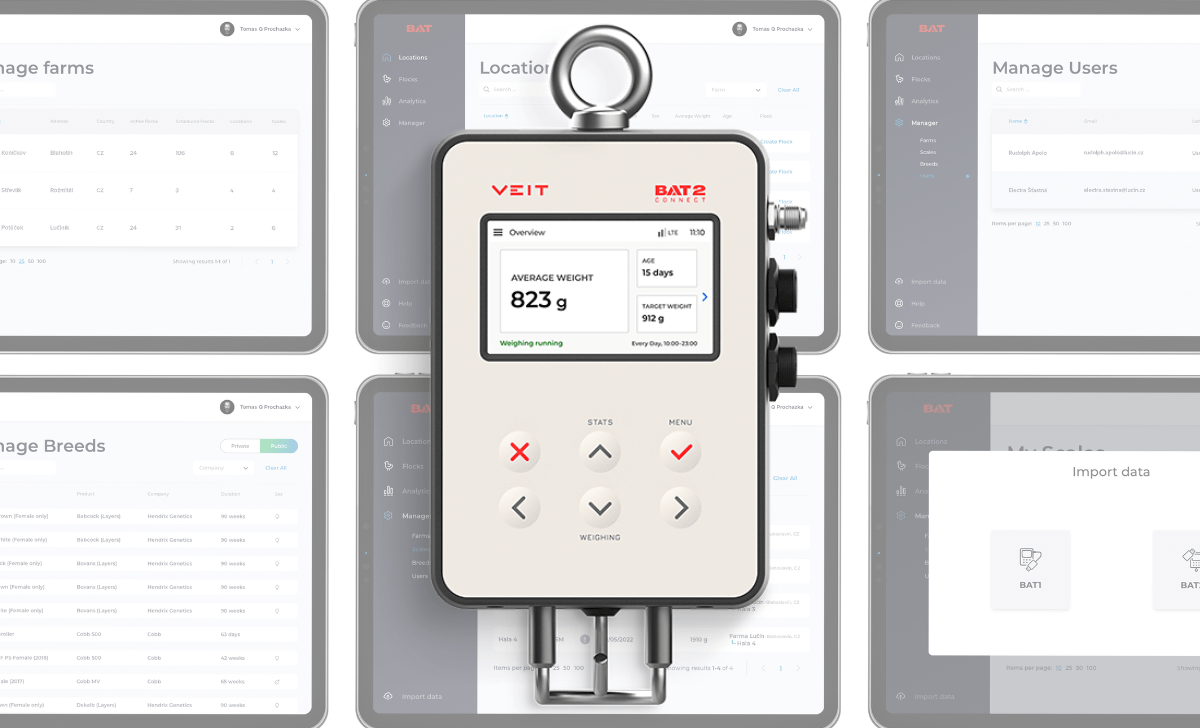
The United States leads with 23.4 million metric tons of chicken meat in 2024, representing significant North American production capacity (Global Tribune, 2024). Asia dominates globally, accounting for 38.6% of global chicken farming practices with 54.8 million tons, while Europe contributes 16.4% of global production (Global Tribune, 2024). Accurate weight monitoring through the BAT2 Connect automatic poultry scale is essential for performance assessment across these diverse regional systems.
Regulatory Framework Differences
USA poultry farming vs European methods reveals fundamental contrasts. European regulations enforce strict welfare standards through Council Directive 2007/43/EC, mandating maximum stocking densities of 42 kg/m² for broilers (European Parliament, 2019). The EU has held a much stricter approach to poultry farming, banning antibiotics for growth promotion in 2006 and phasing out routine preventive use by 2022 (Castro et al., 2023).
American poultry regulations international standards follow FDA guidance GL 209 and 213 with less prescriptive approaches. Canada requires broiler stocking density not to exceed 38 kg/m² (Shynkaruk et al., 2023).
Asian poultry production systems comparison shows evolving standards. China produces 90% of laying hens in cage systems while rapidly industrializing from backyard to large-scale operations (Castro et al., 2023). In 2021, China released its first cage-free guidelines, normalizing a method that benefits greatly from the free-hanging BAT2 automatic poultry scale (The Poultry Site, 2022). The BAT1 manual poultry scale provides essential welfare and performance data for these transitions.
Housing and Welfare Standards
International egg production standards vary dramatically. European regulations require one nest per seven hens with enriched systems providing 15 cm perch space per bird (European Parliament, 2019). Asian systems favor intensive cage housing for economic efficiency. Studies show 75% of Chinese consumers express interest in cage-free products (The Poultry Site, 2022). Integrated data from BAT Cloud platforms enables producers to demonstrate welfare improvements through weight data documentation.
Broiler production worldwide predominantly uses fast-growing genetics like Ross 308 and Cobb 500 across all regions. However, regulatory emphasis differs. Europe enforces stricter stocking density limits and environmental standards, while American chicken consumption patterns prioritize production efficiency with market-driven welfare approaches.
Weight Data: The Universal Performance Metric
Regardless of differences in poultry production worldwide, weight monitoring remains the universal metric for welfare and productivity. From 1985 to 2010, broiler body weight at 35 days increased from 1.4 to 2.4 kg while feed conversion improved from 2.3 to 1.5 (Castro et al., 2023). European welfare protocols include body weight uniformity as a critical indicator. Lower stocking densities improve weight gain and reduce mortality through systematic tracking (Shynkaruk et al., 2023). Producers depend on consistent weight data to optimize flock health and market timing.
The poultry farming USA vs Europe vs Asia comparison reveals divergent approaches unified by weight data driving decision-making across world chicken production systems.
REFERENCES:
Castro, F.L.S., Chai, L., Arango, J., Owens, C.M., Smith, P.A., Reichelt, S., DuBois, C., & Menconi, A. (2023). Poultry industry paradigms: connecting the dots. Journal of Applied Poultry Research, 32(1), 100310. https://doi.org/10.1016/j.japr.2022.100310
European Parliament. (2019). The EU poultry meat and egg sector. European Parliamentary Research Service. https://www.europarl.europa.eu/RegData/etudes/IDAN/2019/644195/EPRS_IDA(2019)644195_EN.pdf
FoodTimes. (2025). EU poultry welfare: call for reform. https://www.foodtimes.eu/food-system/eu-poultry-welfare-call-for-reform/
Global Tribune. (2024). The global poultry meat market. https://globaltribune.net/the-global-poultry-meat-market
Shynkaruk, T., Long, K., LeBlanc, C., & Schwean-Lardner, K. (2023). Impact of stocking density on the welfare and productivity of broiler chickens reared to 34 d of age. Journal of Applied Poultry Research, 32(2), 100344. https://doi.org/10.1016/j.japr.2023.100344
The Poultry Site. (2022). First cage-free production standard launched in China. https://www.thepoultrysite.com/news/2022/01/first-cage-free-production-standard-launched-in-china