
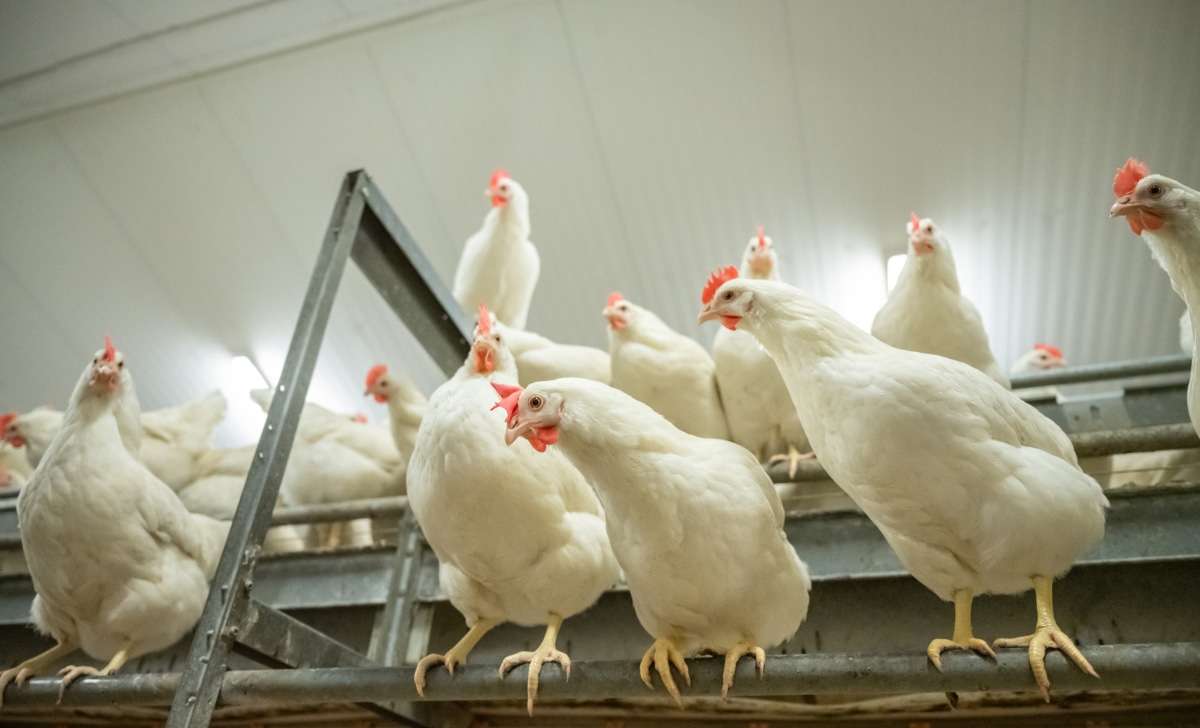
Anyone furnishing a backyard flock runs into the same questions: how high to hang chicken roosting bars, how far apart to space them, and which material keeps toes and keel bones safe. Guidance under the term coop roosting bars is written for a handful of birds. Commercial layer and breeder operations face the same physics, multiplied across thousands of hens.
From Backyard Bars to Commercial Perches
In production settings, „roosting bar“ rarely appears at all. Producers and equipment suppliers call the structure a perch, and its dimensions come from welfare research rather than trial and error. Perches are standard in cage-free, enriched-cage and free-range layer houses and in broiler breeder facilities, where hens use them to rest, socialize, and escape aggressive flockmates (Bist et al., 2023).
Perch Height in Layer and Breeder Houses
Height is the most researched perch variable. Industry guidance calls for at least 20% of total perch length elevated a minimum of 40 cm above the floor, with roughly 20 cm of horizontal clearance from walls and neighboring perches. In enriched colony housing, the highest tier must reach at least 45 cm, with floor-to-perch clearances commonly falling between 21 and 45 cm (Bist et al., 2023). Breeder houses apply related logic to slatted resting areas: Cobb recommends a slat height of 45 cm from the concrete floor, largely to keep droppings from touching the underside (Cobb-Vantress, 2022).
Spacing That Prevents Injury
A perch space of 15 cm per bird is the widely cited minimum for cage-free housing (Bist et al., 2023). Spacing errors carry real welfare cost. Hens that must jump more than roughly 80 cm between perches face a higher risk of collision injury, and flocks in multi-tier systems show significantly more keel bone damage than those in single-tier housing (Marggraff et al., 2024).
Material and Shape: What the Evidence Shows
Controlled pressure-mapping studies favor square or rectangular perches over round ones. Square perches lowered peak force on the keel bone and increased contact area compared with round and oval designs, and soft polyurethane surfaces outperformed steel and hard plastic on both keel bone and foot pad pressure (Pickel et al., 2011). Lower footpad pressure also reduces calluses that can develop into footpad dermatitis (Bist et al., 2023).
Field data complicate the keel bone picture, though: a longitudinal study of 33 commercial layer flocks found no measurable association between perch material and keel bone damage, and an Ontario benchmarking study found comparable fracture rates in floor barns with and without perches (Petrik et al., 2015). Lab evidence still supports soft, square profiles for reasons unrelated to keel bone health. Round steel tube is the cheapest perch material and the most commonly installed in commercial houses. Its round profile requires more balancing effort than a flat-topped design, and hens that spend more effort balancing get less complete rest, which can show up in production as well as welfare scores. Flat perches finished in plastic or rubber cost more to install but lower both footpad pressure and balancing effort.
Linking Bodyweight Data to Perch Programs
Perch and slat specifications assume a reasonably uniform flock at a target bodyweight, so weight tracking belongs in the same conversation as perch design. Pairing individual weight recording with fleshing checks during walks near perch and slat areas gives supervisors a direct read on how the flock is handling its housing.
That hands-on method has research backing. One longitudinal study of commercial layer flocks collected weights with the BAT1 manual poultry scale against breed-specific targets while separately scoring keel bone status (Marggraff et al., 2024).
In multi-tier aviary systems, the BAT2 Connect automatic scale complements those flock walks, recording weight as hens step onto the platform voluntarily throughout the day.
That kind of continuous live weight monitoring
is most useful measured against housing changes over time, not read as a single snapshot.
Centralizing readings across houses, including after a perch retrofit or a change in slat height, is easier with
the BAT Cloud data platform, which keeps historical weight trends in one place.
Where hens flagged during weighing show mobility issues consistent with perch-related injury,
the BAT1 Sorting Machine can separate them automatically for closer assessment in layer and parent stock operations.
References
Bist, R. B., Subedi, S., Chai, L., Regmi, P., Ritz, C. W., Kim, W. K., & Yang, X. (2023). Effects of perching on poultry welfare and production: A review. Poultry, 2(2), 134–157. https://www.mdpi.com/2674-1164/2/2/13
Cobb-Vantress. (2022). Breeder Management Guide. https://www.cobbgenetics.com/assets/Cobb-Files/Breeder-Management-Guide.pdf
Marggraff, J., Gernand, E., Ahlers, C., Huchler, M., Rautenschlein, S., & Donat, K. (2024). Factors associated with keel bone damage – a longitudinal study of commercial layer flocks during the laying period. British Poultry Science. https://www.tandfonline.com/doi/full/10.1080/00071668.2024.2326444
Petrik, M. T., Guerin, M. T., & Widowski, T. M. (2015). On-farm comparison of keel fracture prevalence and other welfare indicators in conventional cage and floor-housed laying hens in Ontario, Canada. Poultry Science, 94(4), 579–585. https://pubmed.ncbi.nlm.nih.gov/25713398/
Pickel, T., Schrader, L., & Scholz, B. (2011). Pressure load on keel bone and foot pads in perching laying hens in relation to perch design. Poultry Science, 90(4), 715–724. https://www.sciencedirect.com/science/article/pii/S0032579119404768